Temperament
The Cairn Terrier is a small Scottish terrier, active and confident. The FCI standard describes the breed as lively, game and hardy. It should be fearless and cheerful, assertive but not aggressive. This is a breed description, not a guarantee about every individual dog.
In daily life, a Cairn may show curiosity, initiative and independence. Its working history helps explain why it enjoys exploring and having a purpose. It does not mean every Cairn behaves in the same way. Experience, health and socialisation all influence behaviour.
Patient, consistent training encourages cooperation and self-control. Positive reinforcement, short sessions and scent games are often more useful than forced repetition. Teach recall early and introduce people, dogs and new settings gradually.
Appearance
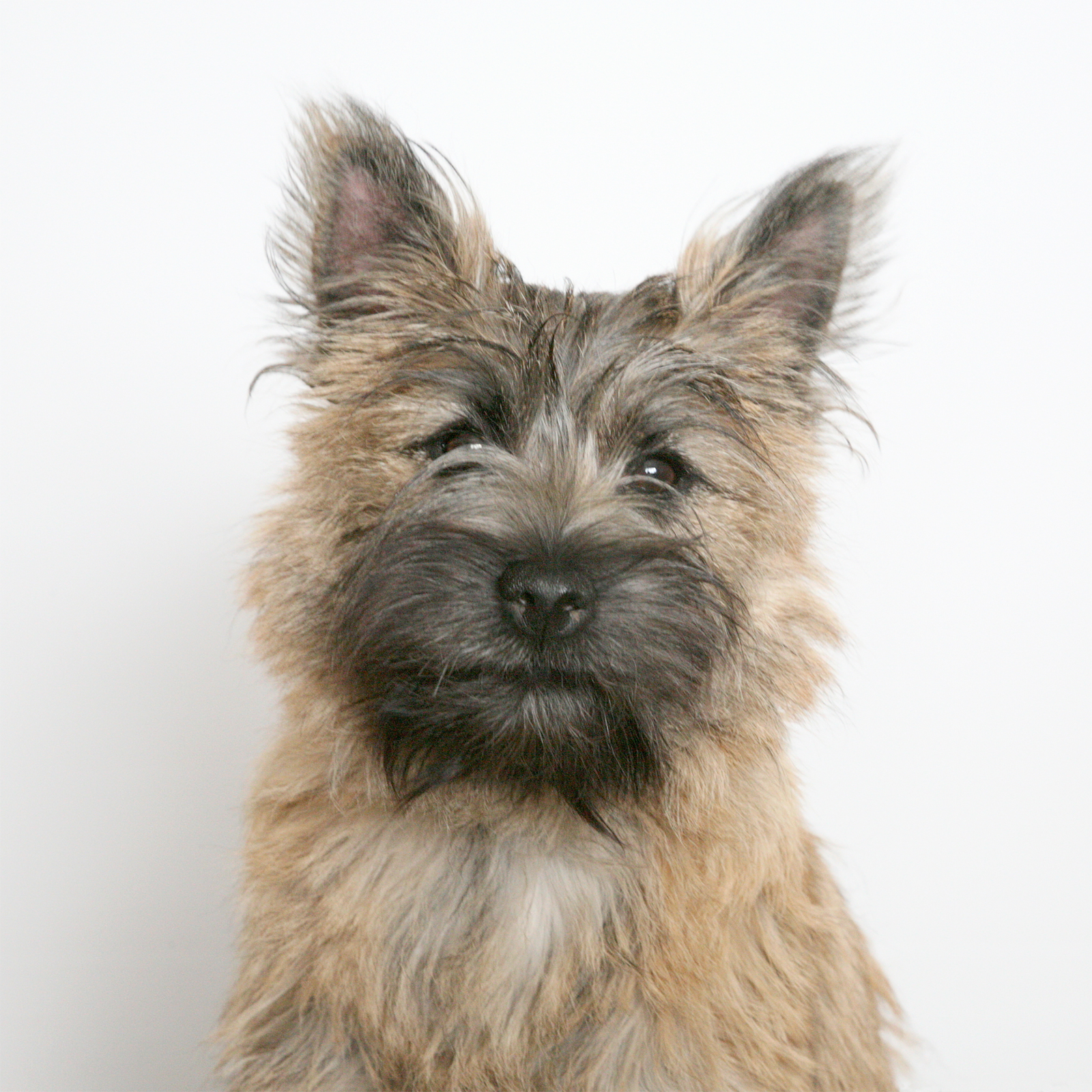
The Cairn is compact, agile and sturdy, with a natural, workmanlike outline. Its head is proportionate, the skull broad and the muzzle strong. The eyes are medium-sized, dark and slightly sunken. The ears are small, pointed and erect; the short tail is carried gaily.
The FCI standard gives an approximate height of 28–31 centimetres at the withers. Ideal weight is 6–7.5 kilograms, in proportion to the dog’s build. These are standard guidelines, not targets to impose on every dog.
The weather-resistant coat has two layers. The outer coat is profuse and harsh, but not coarse; the undercoat is short, soft and close. Permitted colours include cream, wheaten, red, grey and nearly black, with brindling allowed. Solid black, solid white and black-and-tan are not permitted. Brushing several times a week helps keep the coat tidy and allows routine skin checks.
Brief history
The FCI lists Great Britain as the country of origin. Breed sources describe the Cairn as a Scottish terrier from the Western Highlands and the Isle of Skye. It worked over rocky ground and helped flush small quarry from hiding places.
The name refers to cairns, piles of stones found across the Scottish landscape. The dogs needed agility among rocks, crevices and uneven ground. Their original work helps explain the standard’s emphasis on strength, free movement and a weather-resistant coat.
Some dogs appeared in shows as “Short-haired Skye Terriers” early in the twentieth century. The British Kennel Club adopted the Cairn Terrier name in 1910. The first Challenge Certificates for the breed were awarded in 1912. Today, the FCI recognises it definitively under Standard No. 4, Group 3, Section 2.
Lifestyle
Cairns benefit from daily walks, play and scent-based activities. Exercise duration and intensity should suit the dog’s age, health and temperament. A routine that alternates exploration, short training games and rest can help keep activity balanced.
A garden does not replace walks and interaction. Secure fencing helps, since following a scent or noticing a small animal may outweigh a recall cue. Use a lead in unsecured areas. Gradual introductions also support peaceful life with other pets.
Socialisation supports confident behaviour; read more about the importance of socialisation. For guidance on suitable methods, see what training is right for your dog.
Documented health conditions
A Cairn Terrier is not destined to develop a particular disease. The 2022 UK Breed Health and Conservation Plan identified several priorities. These were ocular melanosis with secondary glaucoma, diabetes mellitus and genetic diversity. These are population-level concerns, not predictions for an individual dog. The current Royal Kennel Club page lists BVA/KC/ISDS eye screening as best practice. It offers no breed-specific DNA package.
Ocular melanosis involves progressive pigment accumulation in eye tissues. In some dogs, it can interfere with fluid drainage and contribute to secondary glaucoma. The Cairn Terrier Club of America recommends eye examinations by a veterinary ophthalmologist, with repeat checks over time. Screening cannot guarantee that a condition will never develop.
The Cairn Terrier Club of America also recommends bile-acid testing and kidney ultrasound at specified ages. These checks help assess possible liver vascular abnormalities and kidney concerns. Recommendations differ across countries and breeding programmes. A veterinarian can advise which checks suit a dog’s age and family history.
Diabetes requires veterinary diagnosis and treatment; appearance alone cannot identify it. Unusual thirst or urination deserves a veterinary check, without assuming a breed disorder. Before adoption, ask for verifiable health records and discuss them with your veterinarian.
Curiosities
A cairn is a pile of stones, often used as a marker in the landscape. The name therefore recalls the terrain where these small terriers worked, rather than a particular coat colour.
“Short-haired Skye Terrier” belongs to the breed’s classification history. Today, the Cairn Terrier and the Skye Terrier are distinct breeds. The first Challenge Certificates for Cairns in 1912 marked an important step in the breed’s official history.
The FCI standard values a natural, functional appearance. The goal is not to give the dog an artificial, ornamental outline. Build, coat and movement should remain compatible with health and everyday activity.
Gait
The FCI describes a very free-flowing stride. The forelegs reach well forward, while the hindlegs provide strong propulsion. Viewed from behind, the hocks should be neither too close together nor too wide apart.
This movement reflects an agile dog able to cross uneven ground. The standard describes a breed ideal, not a diagnostic test. Speed, surface, age and fitness all affect the movement seen on a particular day.
New lameness, stiffness or reluctance to walk calls for veterinary assessment. Do not push activity when the dog shows pain. A short video cannot replace a full clinical examination.
Ideal owner
The Cairn suits people who enjoy an active, curious dog without expecting automatic obedience. It needs walks, play, clear rules and quiet time with the family. Apartment living can work when daily activity and attention are provided.
Owners should be comfortable managing a terrier that takes initiative and notices its surroundings. Recall and life around small pets call for supervision and consistent training. Children and dogs need respectful interactions, always with adult oversight.
Allow time for regular coat care and preventive veterinary visits. This may not be the easiest choice for someone seeking a completely sedentary dog or minimal grooming. Consider the individual dog’s temperament and request documented information from the breeder or rescue organisation.