The Bull Terrier is a British terrier recognized by the FCI as Standard No. 11 in Group 3. Its outline is distinctive, but temperament matters as much as appearance. The standard describes the breed as courageous, lively and playful. It also calls it even-tempered, amenable to discipline and especially good with people. Every dog remains an individual. Education, environment and health shape daily behaviour.
Bull Terrier temperament
The FCI describes a courageous dog, full of spirit and fond of play. The standard also calls it even-tempered and amenable to discipline. This description does not guarantee identical behaviour in every dog. Early experiences, breeding and family management all influence an individual.
A muscular build often comes with curiosity and a desire to take part. Many Bull Terriers seek contact and follow their household’s activities. Clear, consistent rules make daily life easier. Teaching pauses and self-control matters as much as providing active games.
Determination can make learning less automatic. Short sessions, motivation and suitable rewards can help maintain attention. Harsh corrections do not replace clear communication. A gradual approach supports trust, cooperation and confidence in everyday encounters.
Socialisation should be positive and respect each dog’s pace. Controlled encounters help a dog learn about people, places and other animals. Close contact should not be forced. Watch body language and end an experience if the dog appears uncomfortable.
Appearance
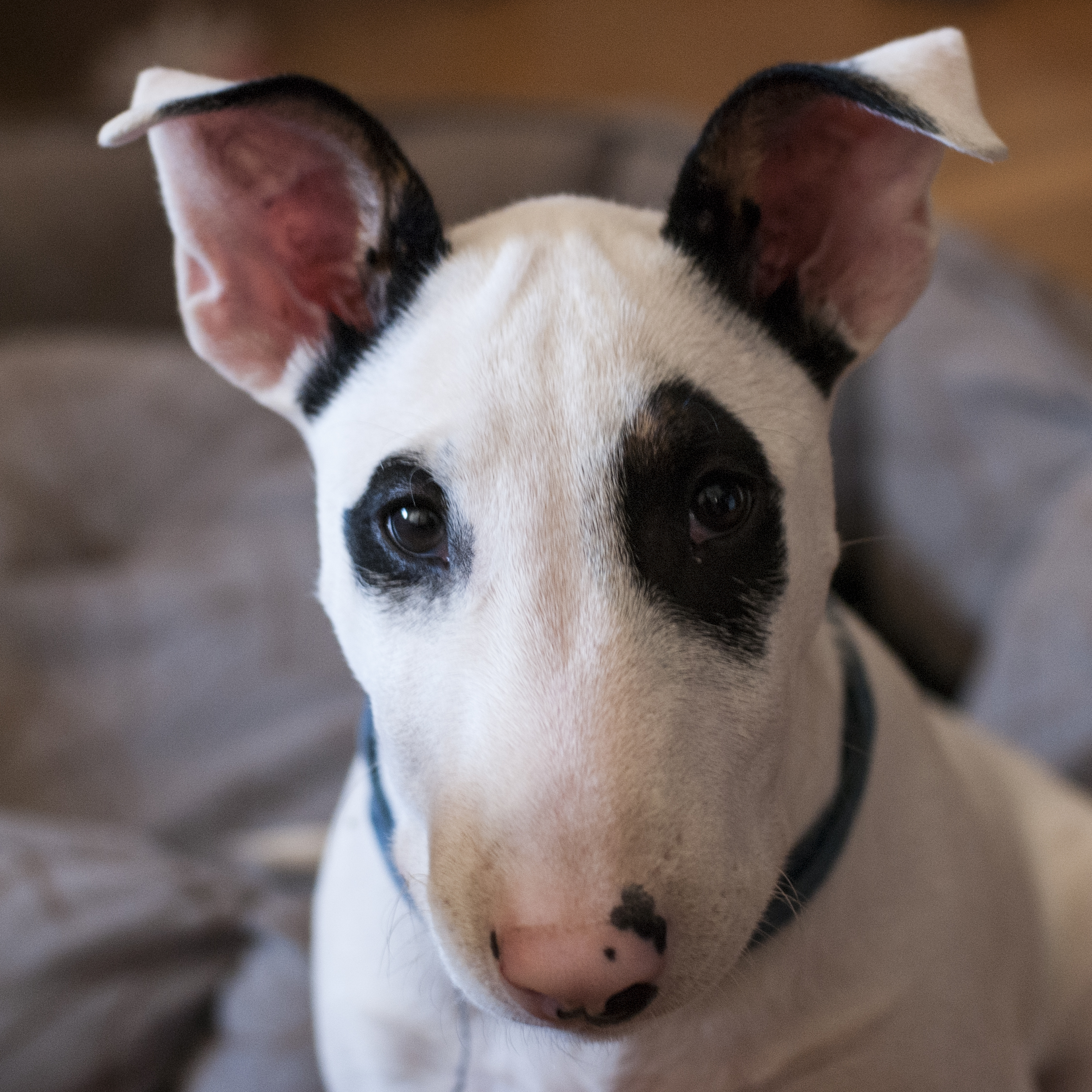
The Bull Terrier is strong, muscular, compact and well balanced. Its head is the most distinctive feature: long, deep and egg-shaped, with a profile curving gently down towards the nose. Viewed from the front, it appears full, without marked hollows. The eyes are small, dark, oblique and triangular, with an intense expression.
The ears are small, thin and close together. The dog should be able to hold them erect. Its neck is muscular and arched. The chest is deep, and the body is rounded, with well-sprung ribs. The short tail is thick at the root, tapers to a point and is carried horizontally.
The coat is short, flat, dense and glossy. The white variety has a pure white ground, although skin pigmentation and head markings are not penalised. In coloured dogs, the predominant coat may be brindle, red, fawn or tricolour. Brindle is preferred when other qualities are equal.
The FCI standard sets no weight or height limits for this variety. Instead, it calls for substance proportionate to the dog’s size and a balanced outline. The Miniature Bull Terrier has a separate standard. It should not be confused with a small example of the standard variety.
Historical background
The FCI standard gives Great Britain as the breed’s country of origin. It says James Hinks established the modern type in the 1850s. His selection made the oval head a defining feature, still widely associated with the breed.
A dog of the current type was shown in Birmingham in 1862. The Bull Terrier Club was formed in 1887. The breed’s history also includes a smaller variety, known since the early nineteenth century. It fell out of favour before the First World War and left the British Kennel Club register in 1918.
In 1938, Colonel Richard Glyn and other enthusiasts founded a club for the Miniature variety. Its standard retained the same general approach but added a height limit. This distinction helps explain both the history and current FCI nomenclature.
Today, the Bull Terrier is known mainly as a companion and a partner in shared activities. Selection produced a compact and recognisable breed. Historical origins alone do not define the character of every modern dog.
Lifestyle
The Bull Terrier needs regular movement and opportunities to use its mind. Varied walks, scent games and guided play can enrich the day. The right amount depends on age, fitness and veterinary advice. For puppies, activity and jumping should be adjusted during growth.
Alternating active periods with rest helps create a sustainable routine. Short exercises fit more easily into daily life. Self-control games and simple cues can make outings easier to manage. Learning to relax is also a skill that deserves patient practice.
Meetings with unfamiliar dogs should be planned thoughtfully. A lead, appropriate distance and supervision help people assess each situation. Living with other animals depends on the individuals and gradual introductions. Children and dogs should always be supervised by an adult.
The short coat needs simple care, including regular checks of skin, ears and nails. Protection from cold and intense heat remains important. The breed should not spend much of the day isolated. Taking part in family life can support a stable relationship.
To explore other British terriers, read our guides to the Airedale Terrier and the Border Terrier.
Documented health concerns
Breed-health recommendations concern screening, not individual diagnoses. The Bull Terrier Club of America and the American Kennel Club list tests relevant to breeding stock. These include patella evaluation, a cardiac examination, BAER hearing testing and a urine protein-to-creatinine ratio.
- Patella evaluation can identify signs of patellar luxation.
- A cardiac examination lets a veterinarian assess heart function.
- BAER testing checks hearing responses and can identify congenital deafness.
- The urine protein-to-creatinine ratio contributes to kidney-health screening.
The breed club also includes lethal acrodermatitis among conditions considered in its screening programme. A screening recommendation does not mean every dog is affected. A veterinarian should interpret results alongside the dog’s history and examination.
Anyone considering a puppy can ask for records of parental health checks. For an adult dog, discuss symptoms or changes with a veterinarian. A test list does not replace regular examinations, prevention or an individual assessment.
Curiosities
The oval head is often described as egg-shaped. Its profile curves continuously from the top of the skull to the tip of the nose. Triangular eyes also distinguish the breed from many other terriers. Correct shape must still support function and health.
The FCI sets no maximum height or weight for the standard Bull Terrier. That does not make size irrelevant. The standard asks for balance, suitable substance and proportions appropriate to sex. The body should look neither weak nor overloaded.
The official description recognises white and coloured varieties. Several colours are accepted in the coloured variety, while blue and liver are highly undesirable. These points guide conformation judging. They do not measure a dog’s affection or individual worth.
The Miniature Bull Terrier has a distinct history, although much of its standard is shared. Its organised revival began in the twentieth century. A height limit separates it from the standard variety, which has no numerical height limit.
Gait
The standard describes free, smooth movement that covers the ground with easy strides. The overall impression should have a characteristic jaunty air. Coordination matters more than speed or stiffness.
At a trot, the front and rear legs move parallel. They converge towards the centre line only at faster speeds. The forelegs reach well forward. The hind legs move smoothly from the hip and flex well at the stifle and hock.
Strong hindquarter drive supports efficient movement. An irregular gait can have many causes, including age, ground and fitness. One observation cannot establish a diagnosis. Persistent changes or signs of pain need veterinary assessment.
During growth, avoid activity that is disproportionate to development. Movement should suit the dog’s maturity and individual condition. The standard describes an ideal, while a veterinarian assesses functional health in an individual dog.
Ideal owner
The Bull Terrier suits people with time, consistency and an interest in daily interaction. Its unusual appearance should not be the only reason for choosing it. Consider time, space, veterinary costs and the ability to provide a stable routine.
An attentive owner uses clear rules and rewards that suit the dog. They make time for socialisation, training and rest. Activities should respect age and health. A qualified behaviour professional can help with questions about training or management.
Prepare the home and household in advance. Supervise interactions with children and other animals, even when the dog is familiar. Every encounter should allow space to move away and respect signs of discomfort.
Before adoption or purchase, speak with a veterinarian and responsible breeders. Asking about health checks helps put risks in perspective without turning them into certainties. The ideal companion is someone who values the actual dog, not a stereotype of the breed.