Temperament
The Bedlington Terrier combines liveliness, confidence and sensitivity. The FCI standard describes an intelligent, affectionate and dignified companion. At rest, the dog appears mild; when needed, it can show courage and tenacity. These qualities do not mean every individual behaves alike. Early experiences, education, health and surroundings shape each dog’s responses.
Its terrier background has left a strong interest in moving objects. A chase may therefore capture its attention more than a recall cue. Consistent rules, well-chosen rewards and safe opportunities to explore are important. Harsh punishment can undermine trust and cannot replace clear, patient training.
Within the family, a Bedlington may be affectionate and engaged, while still needing quiet time and respect for its space. Children and dogs should learn calm interactions under supervision. Gradual socialisation helps the dog encounter different people, sounds and animals. It cannot guarantee automatic compatibility with every household or pet.
Appearance
This is an elegant, agile and muscular dog that should not look heavy. Its body is slightly longer than its height at the withers. The FCI standard gives an approximate height of 41 centimetres and a weight between 8 and 10 kilograms. These are reference measurements; sex, frame and individual growth create variation.
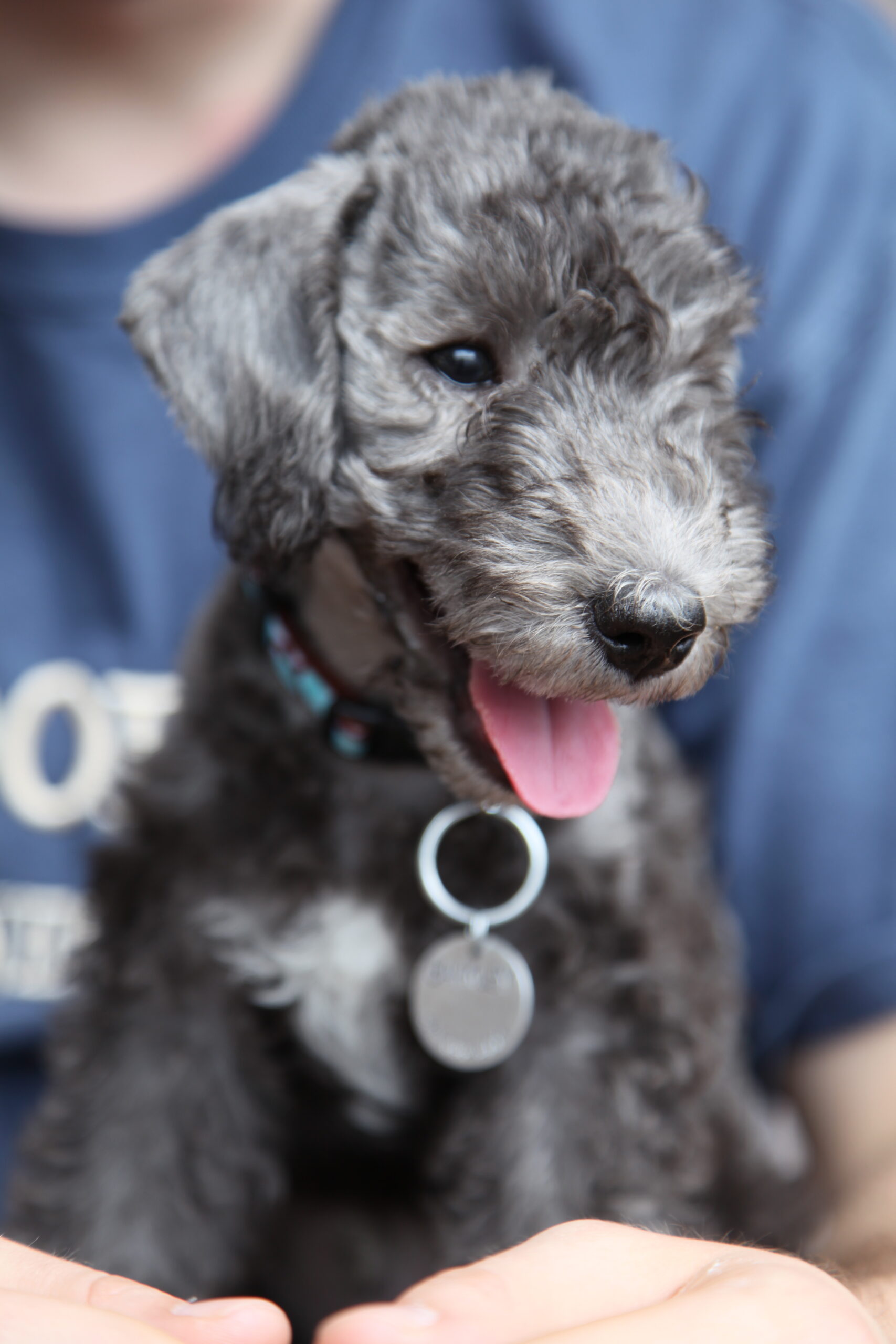
The narrow, rounded head tapers into a shape described as pear-like or wedge-shaped. A pale, silky topknot, small bright eyes and hanging ears complete its distinctive outline. The back arches naturally over the loin. The tapered tail is carried low, never over the back.
The coat is thick, linty and inclined to twist, especially over the head and face. Standard colours are blue, liver and sandy, with or without tan markings. The coat needs regular brushing and periodic trimming. A breed-specific grooming guide recommends weekly brushing to reduce tangles and debris. Frequency should suit the individual coat.
Historical background
The breed takes its name from Bedlington, in Northumberland, a region of northern England associated with mining. The name Rothbury Terrier appears in historical accounts and refers to a nearby area. Earlier origins remain disputed; available sources do not establish every ancestral cross with certainty.
The FCI standard reports that Bedlingtons were used to catch rabbits and control small vermin. Their reputation soon spread beyond their home region. According to the standard’s historical account, a breed association was founded in 1877. Hunting work helped select agility, stamina and quick responses.
Today the Bedlington is valued as a companion and also takes part in sporting activities. Its soft outline can suggest an exclusively quiet dog, but its history describes an active terrier. Understanding both sides helps owners recognise the dog’s motivations and everyday needs.
Lifestyle
The breed benefits from daily movement, scent exploration and shared activities. Varied walks and short search games can meet different needs. Exercise should reflect age, health, weather and conditioning; one fixed daily figure would not suit every dog.
In open spaces, a secure fenced area or suitable lead is prudent. The chase instinct may switch on quickly when small animals appear. Recall, self-control and lead manners need consistent practice beyond puppyhood. Puzzle games can complement physical activity with mental work and regular breaks.
The linty coat should not be allowed to mat; brushing and regular clipping belong in the routine. Practical needs resemble those of other terriers, although each breed and dog differs. Compare the guides to the Airedale Terrier’s temperament and Cairn Terrier care.
Documented health conditions
Copper toxicosis is an important documented condition in the breed. It is a liver disease associated with copper accumulation. A deletion variant in COMMD1 was long linked to the condition. Research has also identified affected Bedlingtons without that deletion, indicating a more complex genetic picture.
A 2023 study compared liver and DNA samples from 24 affected and 10 unaffected dogs. It found an association between the ATP7B:c.4358G>A variant and copper toxicosis. The authors noted limits in the clinical data and measurements available. A statistical association does not establish an individual diagnosis or predict one dog’s health by itself.
The Royal Kennel Club lists a COMMD1 DNA test as Good Practice for breeders. It lists BVA/KC eye testing as Best Practice. Screening can inform breeding decisions, but it is not a complete diagnosis. One specific test cannot exclude every possible cause. A veterinarian should interpret the dog’s findings and advise whether further checks are appropriate. The club also notes conformational concerns; individual welfare matters more than generalisations.
Interesting facts
The familiar “lamb-like” look comes from the pale topknot, the shape of the muzzle and the dense coat. That visual resemblance contrasts with the dog’s athletic build. Appearance alone does not describe its temperament. Beneath the elegant outline is a terrier selected for practical work.
The standard calls the coat linty and inclined to twist, rather than simply curly. The arched topline is also part of the intended conformation. The listed height and weight are breed references, not targets to impose on every individual.
The breed’s local story is connected with northern England and a mining community. Historical sources use both Rothbury Terrier and Bedlington Terrier, but the full ancestry is not settled. It is useful to distinguish the standard’s documented account from theories about earlier bloodlines.
Gait
The movement changes with speed. At slower paces, the standard describes a light, springy and rather mincing action. A slight roll may appear when the dog moves at full stride. The breed is also capable of galloping at high speed.
These descriptions concern typical movement; they do not certify an individual dog’s condition. New or persistent pain, stiffness or reluctance to move deserves veterinary attention. Activity should increase gradually and suit the dog’s fitness, rather than being inferred from an athletic appearance alone.
Ideal owner
The Bedlington suits someone who wants an active terrier and also respects its quieter periods. The owner should make time for walks, kind training and scent-based games. A garden can be helpful, but it cannot replace companionship or shared activity.
Future owners should plan for brushing, regular grooming and routine veterinary care. Before choosing a puppy, they can ask breeders about recommended screening results and the health history of the lines. Test results need informed interpretation and should never be treated as absolute guarantees.
With consistent guidance, safe spaces and suitable activities, a Bedlington can be an engaging companion. It is not simply a decorative or low-maintenance choice. Consider temperament, coat care and health. Assess the individual dog, rather than relying only on breed reputation.