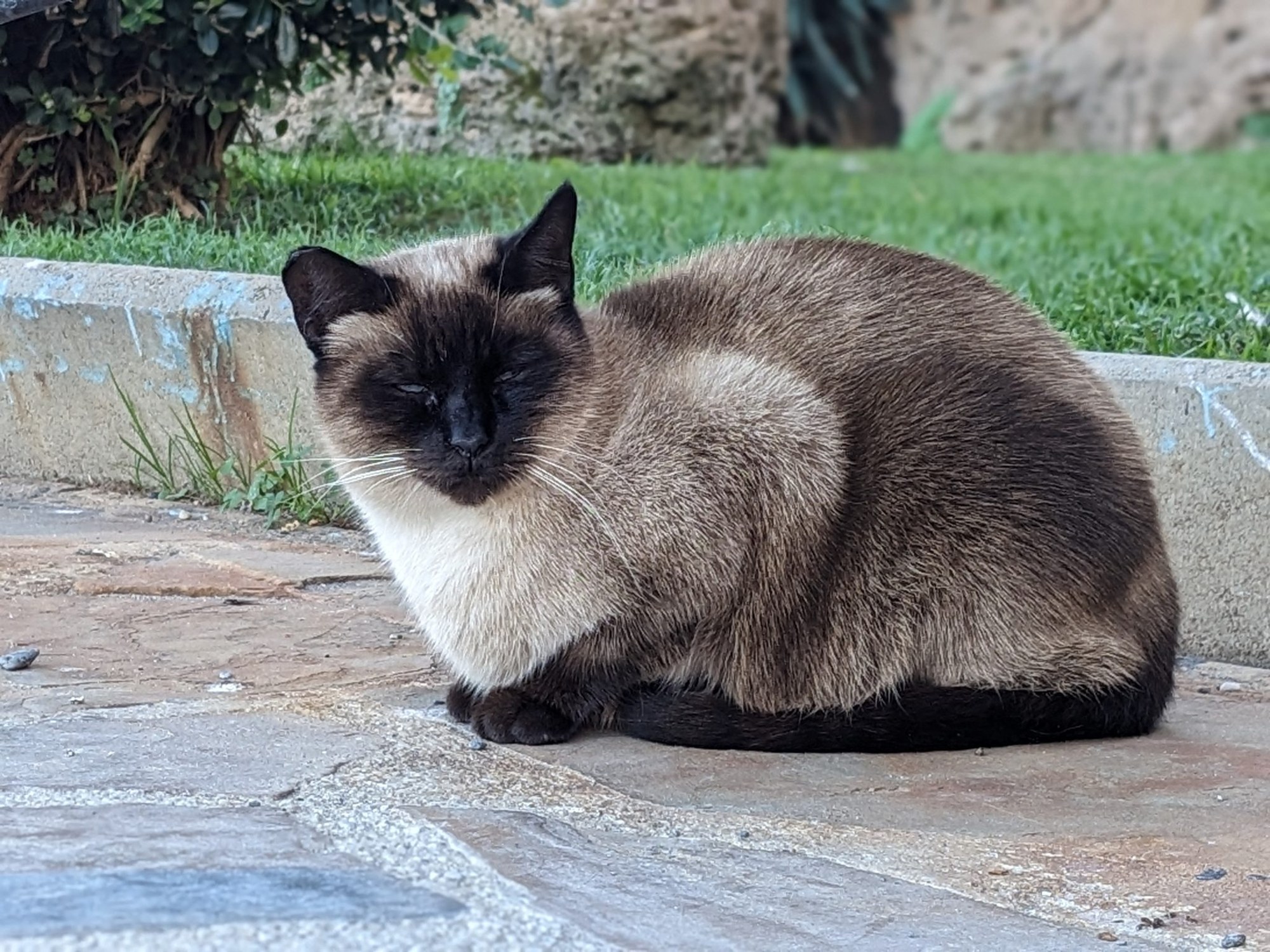
The Siamese is a shorthaired, slender cat known for its colourpoint contrast. FIFe describes it as active and highly communicative, but each cat has its own preferences. Choose based on time, environment and individual compatibility. Coat colour and eye shape alone cannot predict temperament.
Temperament
The FIFe profile describes the Siamese as lively, curious, vocal and interested in people. Some cats often seek interaction and use persistent calls. These are reported tendencies, not guarantees. An individual may prefer more distance or periods of quiet.
Offer contact voluntarily and end play before the cat becomes frustrated. Do not punish vocalising or behaviour that may signal an unmet need; first observe the routine. When visitors or animals arrive, provide quiet places to retreat. Our guide to playing with your cat offers safe, gradual ideas.
Appearance
The FIFe standard describes an elegant, svelte and muscular cat with long, balanced lines. The head forms a wedge, the nose is long and the ears are large. Eyes are almond-shaped and intense deep blue. The body is elongated, with slender legs and tail.
The coat is very short, fine, glossy and close-lying, with almost no undercoat. The colourpoint pattern has darker extremities: mask, ears, legs and tail. The body should contrast clearly with the points. FIFe permits several point varieties, including some tabby and white patterns.
Short hair generally needs less combing than a long coat, but care is still individual. A soft brush can help during shedding. Check ears, teeth and claws regularly. Make handling comfortable through brief sessions and rewards. Never restrain the cat by force.
Brief history
FIFe links the earliest colourpoint cat images to Tamra Maew, a Thai manuscript dated to the fourteenth century. The profile says the first Siamese cats were brought to England from Siam in 1884. Siam is the historical name for present-day Thailand.
Modern breeding changed the appearance compared with cats shown in older documents. The FIFe profile notes this change without treating every historical image as the current standard. Documented history helps distinguish records from legends. It does not prove that all modern cats descend from one individual.
Lifestyle
Provide safe high places, scratching surfaces and short games that let the cat choose whether to join. A good routine includes exploration, rest and interaction. Simple food puzzles can add variety when introduced gradually. For general advice, see our guide to living and learning with a cat.
- Place water and litter in accessible, quiet areas.
- Offer games with breaks and a way to leave.
- Provide hiding places where the cat will not be disturbed.
- Notice changes in appetite or behaviour.
For an indoor cat, enrich the home without filling it with constant stimulation. In a home with other animals, provide separate resources and gradual introductions. Use a secure carrier and help the cat become familiar with it in advance. Introduce major changes in small steps.
Health conditions
The FIFe profile and standard do not list a disease that affects every Siamese. UC Davis provides information and genetic tests for PRA-rdAc, an inherited form of progressive retinal atrophy. Its resources include the Siamese among breeds to consider for this variant.
The test covers specific mutations and is not a complete eye examination. A result does not replace an eye-health assessment or rule out every cause of vision problems. Ask a veterinarian whether testing is relevant to the line and individual cat. Changes in vision, unusual collisions or abnormal pupils need clinical assessment.
Do not infer a diagnosis from eye colour or breed alone. If choosing a kitten, ask for test records and clarify which variants were examined. A veterinarian interprets results alongside examination, age and family history.
Interesting facts
The contrast between a lighter body and darker points reflects how pigmentation is distributed. Points include the face, ears, legs and tail. Appearance changes with age and individual circumstances; a standard description cannot replace knowing the cat.
FIFe describes the Siamese as vocal and highly communicative. Some cats have distinctive calls, but frequency and volume vary. Noting when a cat vocalises may help reveal whether it wants play, food or attention. If the behaviour changes suddenly, consider health first.
Gait
The FIFe standard describes body lines and paw shape but does not set a Siamese-specific gait test. We therefore do not assign an undocumented special stride. Observing normal movement at home is more useful than asking a cat to walk on command.
If jumping becomes difficult, limping appears or movement changes persistently, contact a veterinarian. Do not try to correct posture with exercises or handling. A short, spontaneous video can show usual movement if requested. Clinical assessment determines whether further checks are needed.
Ideal owner
A Siamese may suit someone who enjoys interaction and can provide daily play. This does not guarantee that a cat will like being carried or staying close all day. Consider the individual temperament, household routine and other animals.
Before adoption, ask how the cat responds to handling, noise and time alone. Prepare separate resources and resting places. With a breeder, request health records and ask about available genetic tests. The best choice respects the individual cat and the household’s actual capacity.