The Maine Coon is a natural, large and powerful cat that developed in the northeastern United States. Its full coat and long tail are distinctive, but they do not describe every individual. Before adopting one, consider space, grooming, activity and settling-in time. Needs always depend on the cat in front of you.
Temperament
FIFe describes the breed as amiable and, in its profile, often gentle, playful and communicative. Some Maine Coons use chirps or trills rather than frequent meowing. These are tendencies reported by the profile, not guarantees. Age, experience and household life influence how an individual cat interacts.
Provide quiet places and let the cat choose when to approach. Children should learn not to chase it or disturb sleep and meals. Introduce other animals gradually and under supervision. Our guide to living and learning with a cat offers general ideas, not a required training method.
Appearance
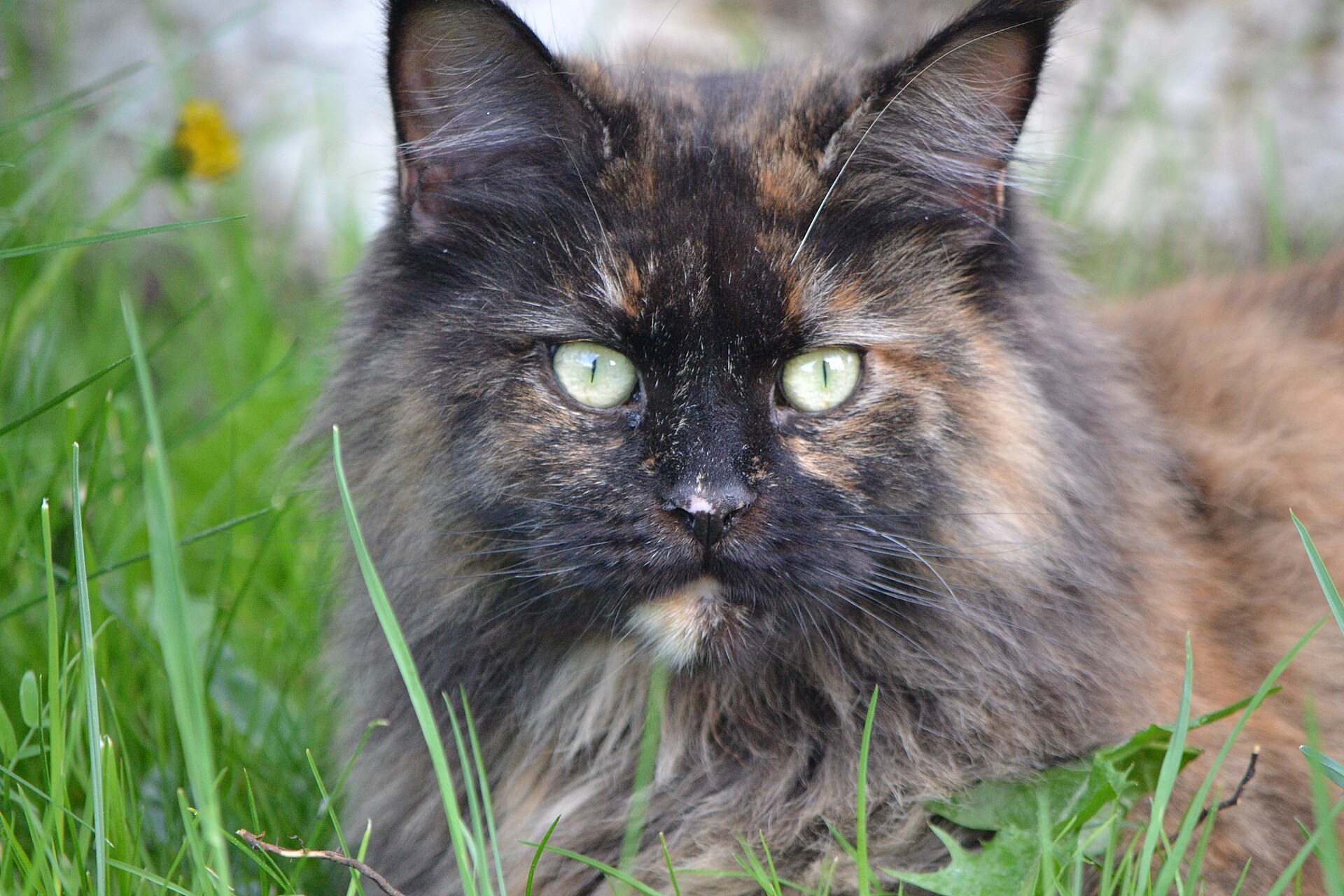
The FIFe standard describes a large, powerful cat with a broad chest and a long, muscular, rectangular body. The head has square outlines, a defined muzzle and large ears, often with tufts. Females are usually proportionally smaller than males. Growth may be slow; adult size alone does not measure health.
The coat is dense and silky, suited to different weather. It is shorter on the head, shoulders and legs, then longer along the back and sides. The tail is long and full. Many varieties are accepted, but pointed patterns and some colours, including chocolate, lilac, cinnamon and fawn, are excluded. Any amount of white is permitted.
Brushing helps manage tangles and loose hair, especially behind the ears and under the legs. Be gentle and stop if the cat becomes stressed. Introduce a comb and nail care gradually. For general advice, read our guide to long-haired cats.
Brief history
FIFe traces the breed to working farm cats in Maine, New England. The earliest written records cited by the organisation date to 1861. FIFe recognised the breed in 1982. These dates document records and recognition; they do not identify one founding cat.
Stories connect the breed with longhaired cats brought by Vikings or with Marie Antoinette’s court. FIFe presents these as legends rather than proven origins. It is useful to separate folklore from documented history. The name refers to the US state of Maine, not a cross with a raccoon.
Lifestyle
Prepare observation spots, scratching surfaces, hiding places and quiet resting areas. A sturdy cat tree can offer climbing space if it is stable and accessible. Short chase or search games provide activity without forcing contact. For ideas suitable for different cats, read our guide to playing with your cat.
- Place water, food and litter in calm areas.
- Offer shelves and hiding places without blocking routes.
- Balance play with independent exploration and rest.
- Check the coat for tangles and debris regularly.
A large frame alone does not tell you an ideal weight. A veterinarian can assess body condition and advise on portions. Keep routines predictable and respect times when the cat withdraws. During travel or a move, prepare a safe room before allowing it to explore.
Health conditions
Hypertrophic cardiomyopathy, or HCM, is a heart disease also described in Maine Coons. UC Davis reports a genetic variant associated with increased risk in the breed and offers a specific test. That test concerns the variant examined; it does not diagnose HCM by itself or rule out every other cause.
Ask a veterinarian which checks suit the individual cat, and request records from a breeder. Echocardiography and clinical examination answer different questions from a genetic test. No result can predict the future with certainty. Abnormal breathing, weakness or sudden difficulty calls for prompt veterinary advice.
Being this breed does not make disease inevitable. Cats without obvious signs may still need planned checks based on age and history. Do not begin supplements or treatment based on an online description. A veterinarian can interpret results and signs in context.
Interesting facts
The name Maine Coon is linked to stories about raccoons. FIFe explains that mating between a raccoon and a cat is biologically impossible. The story is popular folklore. The full coat and striking tail may have encouraged the association, but they do not prove an origin.
The FIFe profile describes many cats as expressive and playful. Some communicate with soft vocalisations, but volume and frequency vary. Daily observation helps you recognise your own cat’s signals. A quiet cat can also be behaving normally.
Gait
The FIFe standard describes shape and proportions but does not provide a Maine Coon-specific gait test. It would be inaccurate to invent a characteristic stride or use gait to assess health. Simply observe how your cat moves in its familiar environment. Do not force it to perform.
Stiffness, reluctance to jump or limping can have many causes and do not identify a diagnosis. If the change persists, contact a veterinarian. Do not manipulate the limbs or try painful exercises. A spontaneous video may document movement at home if the professional requests one.
Ideal owner
A Maine Coon may suit someone who wants a large cat and can care for a long coat. Time, environmental enrichment and a veterinary-care budget are important. A breed description does not guarantee that a cat will be sociable or enjoy being carried.
Before adopting, ask about the particular cat’s temperament and routine. Make sure the home has quiet areas and stable climbing structures. From a breeder, ask which health checks are relevant and request available results. Choose based on real compatibility, not size or appearance alone.