The Gordon Setter is definitively recognised by the FCI under Standard No. 6. The FCI places it in Group 7, the pointing dogs. It is a British setter developed for hunting and field work.
Temperament
The standard describes the Gordon Setter as intelligent, capable and dignified. It also calls the breed bold, outgoing and kindly in an even disposition. These words describe the ideal, not a guarantee about every individual dog.
Its hunting history helps explain some everyday needs. The dog explores its surroundings, follows scent and works willingly when given clear guidance. Consistent, reward-based training supports communication. Short sessions, search games and breaks can help maintain attention.
Gradual socialisation lets a puppy experience different people, animals, sounds and places. Respect the puppy’s pace and watch its responses. A hunting instinct does not make a dog aggressive. It does call for responsible handling, a well-practised recall and supervised contact with small animals.
Appearance
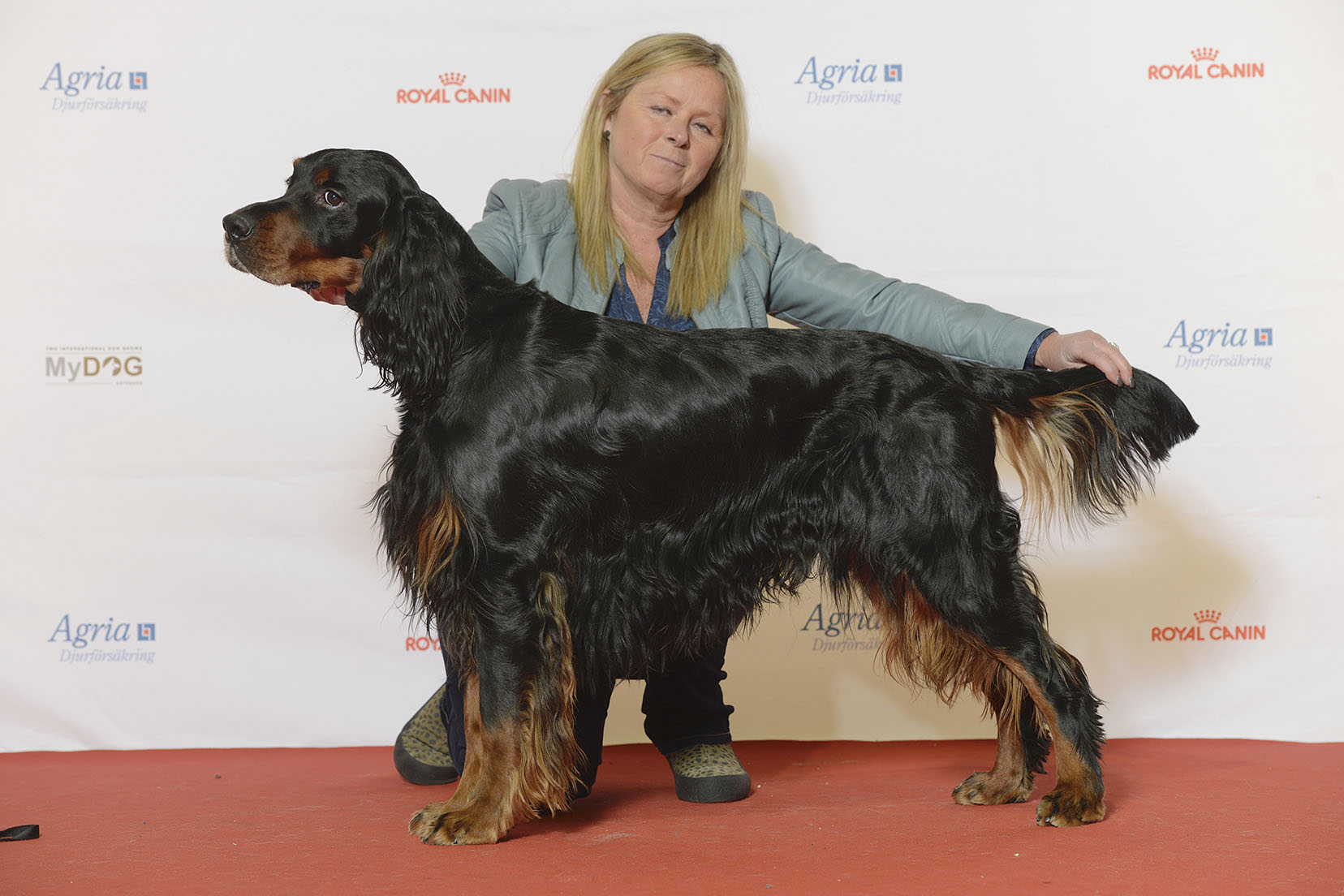
The Gordon Setter is elegant yet substantial, with a build suited to sustained movement. Its coat is deep black with clearly defined chestnut-tan markings. Tan appears above the eyes, on the muzzle, chest and legs. The FCI standard permits no other colour.
Hair is short and fine on the head and front of the legs. Elsewhere, it is moderately long, flat and without pronounced curls. Feathering is longer on the ears, underside and backs of the legs. Regular brushing helps prevent tangles and remove debris.
The ears are low-set, thin and close to the head. The eyes are dark and bright. The chest is deep, while the body is moderately long. Standard height is about 66 centimetres for males and 62 for females. Standard weights are approximately 29.5 and 25.5 kilograms.
Historical notes
The FCI lists Great Britain as the breed’s country of origin. Its history is especially associated with Scotland and the Gordon family’s castle. Black-and-tan pointing dogs were bred in the region for bird hunting.
The fourth Duke of Gordon helped establish the type associated with his name. He did not create every dog that came before it. Historical sources describe black-and-tan setters in the area before his kennel became influential.
For many years, the breed was called the Black and Tan Setter. The British Kennel Club adopted the name Gordon Setter in 1924. Selection for field work remains part of its history, although the breed is now also a family companion.
Lifestyle
A Gordon Setter needs daily exercise, scent-based activities and time with its family. A hurried walk does not replace safe opportunities to explore and learn. Search games, scent work and controlled retrieving can provide useful stimulation.
The FCI classifies the breed as a pointing dog with working trials. Physical exercise should therefore be balanced with focus and self-control training. Build recall skills gradually in different settings. A lead or secure fencing protects the dog and wildlife in open areas.
A predictable routine helps balance activity, rest and coat care. Gradual handling practice makes brushing and checks easier. For general training ideas, see this guide on choosing the right training for your dog.
Documented health conditions
Breed sources identify conditions worth discussing with responsible breeders and veterinarians. Before breeding, the Royal Kennel Club recommends DNA testing for PRA rcd4 and hip screening. It also lists eye and elbow testing as good practice.
These tests help breeders manage specific risks. They do not show that an asymptomatic dog is ill. A genetic result should be interpreted with a veterinarian and in light of the test’s purpose. PRA includes different conditions; an rcd4 test does not rule out every eye problem.
The Gordon Setter Breed Council lists hip dysplasia and PRA rcd4 among conditions to monitor. It also reports an ongoing heart-disorder data collection with the University of Nottingham. Available information does not establish general prevalence or predict an individual dog’s health.
A deep chest makes it useful to understand gastric dilatation-volvulus, an emergency noted by the breed council for susceptible dogs. Ask a veterinarian which signs require urgent attention. Regular care and health records for both parents support informed decisions.
Curiosities
The black-and-tan coat is one of the Gordon Setter’s most recognisable features. The older common name referred directly to those colours: Black and Tan Setter. Today’s name recalls the Scottish noble family associated with the breed’s history.
The Gordon belongs to the setter family, but it is distinct from the English Setter and Irish Setter. Coat colour, proportions and breeding history help tell them apart. The FCI groups these breeds among pointing dogs but gives each its own standard.
The official description refers to a galloping outline and a build suited to sustained work. The coat’s feathering is not merely decorative. It needs regular care and checks after outings through long grass or woodland.
Gait and movement
The FCI standard describes movement as steady, free-moving and true, with plenty of drive from behind. The hindlegs are long, broad and muscular, with well-bent stifles. This supports an expansive action without requiring a constantly fast pace.
The standard describes the breed’s ideal movement. It cannot replace veterinary assessment or diagnose joint disease from a single walk. Pain, lameness or persistent changes in gait deserve professional attention.
The ideal owner
A Gordon Setter suits people who want to share daily activities with an energetic, cooperative dog. An ideal owner plans walks, scent games, kind training and enough rest. A garden alone is not enough without time for interaction and outings.
Owners should manage interest in scent and game rather than rely on an untested recall. The household must also care for the coat and ears and keep up with health checks. This practical guide explains how to clean a pet’s ears without replacing veterinary advice.
Choosing this breed means considering lifestyle, experience and everyone’s expectations. Meet transparent breeders, ask for screening results and observe the parents when possible. Individual temperament, health and the quality of the relationship matter more than coat colour.