
What is the liver? We have all heard of this organ, but many people have no idea what its function is within the body. Despite this, it is one of the most important organs of all, and diseases affecting it can, in some cases, even lead to death. This is why it is important to understand its role and, above all, protect it for the health of our dog and cat.
This page will not discuss all liver diseases, because that would be impossible; rather, we will focus on the most common ones.
The functions of the liver
The liver is strategically positioned within the body: it is located where it can collect all the blood coming from the digestive organs, such as the intestine, and from the spleen, which destroys red blood cells (which carry oxygen) that are too old to “work.”
Thus, all nutrients from digestion reach the liver; some remain in the blood, but most are stored and later released when needed. Our animals do not always eat beneficial substances: if they ingest dangerous substances that would be absorbed in the intestine, the liver modifies them to make them less toxic and ensures that they are eliminated in the urine. It is somewhat like the body’s “doctor.”
Another function is to “dispose of” dead red blood cells in the spleen; it disassembles them, and their waste products form bile, which is released into the intestine, where it dissolves ingested fats. Finally, it creates clotting factors, substances that make the blood “hard” if a vessel is damaged, for example in a wound. The fact that a cut stops bleeding is therefore the liver’s “doing.”
Liver diseases
First of all, we must say that the diseases that damage the liver are numerous and varied. In this article, we address only diseases that cause primary liver damage; we will leave out infectious diseases, which are covered on dedicated pages, and diseases that have other symptoms but also produce a harmful effect on the liver, since these too will have dedicated pages.
Poisoning
There are countless toxic or poisonous substances that can affect our animals. Not all of them, but most, once absorbed from the intestine, reach the liver, which tries to make them less toxic. If, however, the amount ingested is large or the substance is very potent, the liver cannot neutralize everything, so these substances begin circulating through the body and cause very serious damage. Poisonous mushrooms are a typical example, usually acting in this way.
There may be fever and sudden lethargy, and in some cases fainting: it depends solely on the toxic substance. In any case, if we suddenly see symptoms of this kind, we must rush to the nearest veterinarian.
Fibrosis and cirrhosis
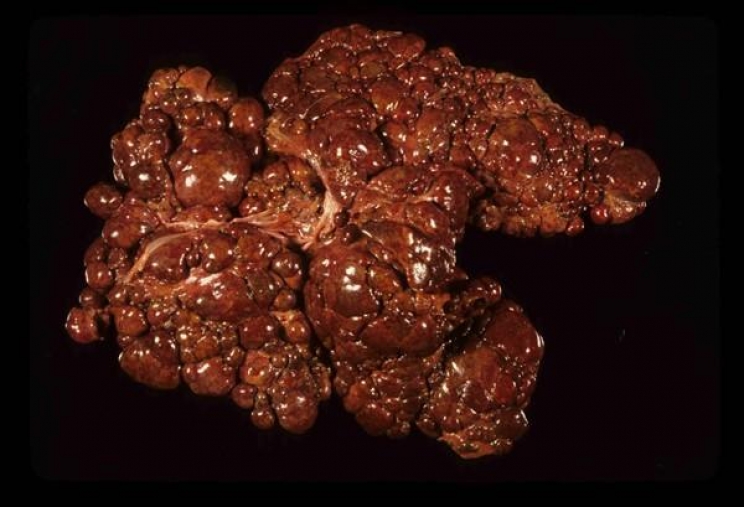
The mechanism by which these two conditions develop is the same, because fibrosis refers to a situation that is still reversible, while cirrhosis is used when it is already too late to do anything.
We generally hear about them in connection with alcoholics, because alcohol is, in fact, a poison for us (and for dogs and cats too); it gives the liver too much work to do as it “detoxifies” it, and in this way the liver cells (the individual units that make it up) become weaker and smaller; connective tissue, a whitish substance that is normally present in very small amounts and separates one cell from another, takes the place left by the cells, eventually “strangling” them and causing an irreversible loss of liver function (the surface of the liver is no longer smooth, but full of bumps).
This condition results from small amounts of toxic substances being taken continuously over time, and we recognize it from weight loss, lethargy, occasional episodes of vomiting, and the presence of jaundice: when we lift the dog’s or cat’s lip, the mucous membrane, instead of being pink, is yellowish, and this is one of the main warning signs for the owner, because it results from poor liver function.
This is one of the main situations in which we speak of liver failure, that is, when the liver cannot perform its normal functions.
Fatty liver disease
Little known, it is a very common liver disease that develops slowly and can lead to liver failure.
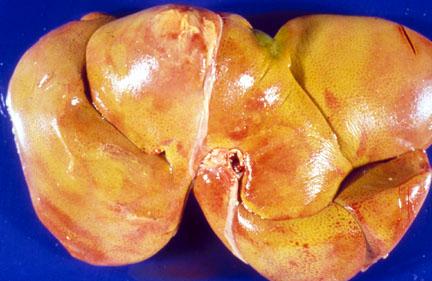
As we have said, the liver stores nutrients from digestion, including fats. If there are too many of these fats, due to a poor diet maintained throughout life, one that is excessive and fatty, they tend to accumulate. They accumulate to such an extent that the cells become literally overrun with fat and can no longer perform their normal function.
In this case, there is no need to wait for symptoms; we can recognize the condition, which affects cats more than dogs, from the fact that the animal is visibly obese.
The diet must be changed immediately so that the liver can recover.
The worst possibility is that the overly fatty liver (which becomes yellow instead of its normal brown color) becomes so fragile that when the cat performs a fairly normal action such as jumping, the liver may break cleanly, causing severe internal bleeding that will lead to death very quickly, with nothing that can be done.
We must always pay attention to diet, because getting something so important wrong can put our animal’s life at risk.