

Despite the widespread campaigns in favor of sterilizing pets and strays, many owners still choose not to subject their companions to this option. The reasons behind this choice may vary, but most of these owners probably have misconceptions about it or do not fully recognize the importance of sterilization. In this article, we will try to clarify the most frequent doubts related to this practice, but above all we will explain why it is important to sterilize animals.
What sterilization is and how it is performed
Sterilization is a surgical procedure that involves removing part of the animal’s reproductive system, in order to interrupt sexual activity and prevent pregnancies.
In males, sterilization is also known as neutering. The procedure involves removing the testicles, the organs that produce and release sperm. Once a dog or cat is deprived of its testicles, it stops producing testosterone, the hormone responsible, among other things, for sexual activity. This mainly inhibits the ability to reproduce and the urge to mate.
Neutering is performed under general anesthesia and the procedure itself is relatively short. It is performed without opening the abdomen of the animal, except under particular conditions. The veterinarian makes an incision in the skin of the scrotum, which covers the testicles, blocking the blood vessels to prevent bleeding. The testicles can then be removed, with a few stitches applied to the skin.
The wound tends to close within a few days, with a very low likelihood of complications.
In the female, sterilization is more complex because it is a true surgical procedure. The primary effects of sterilization in female dogs and cats mainly include preventing pregnancy and inhibiting “heat”, the external manifestation of sexual receptivity.
There are two methods: ovariectomy or ovariohysterectomy.
The first involves removing only the ovaries, which are responsible for producing egg cells that are fertilized when they come into contact with sperm. Ovariohysterectomy, on the other hand, involves removing the ovaries as well as the uterus, the organ that houses the fetus after fertilization.
In both cases, the veterinarian must open the abdomen of the female dog or cat because the organs to be removed are located inside the body, unlike in males. In recent years, laparoscopic surgery has also become widespread in veterinary medicine. This makes it possible to operate without making a large incision in the abdomen, using only small cuts through which the necessary surgical instruments are inserted.
Despite the major advantages of laparoscopic sterilization, not all veterinary practices and clinics have the equipment needed to perform it, so they still use the traditional method.
Sterilization surgery in females has a longer overall duration than in males and also involves longer postoperative recovery times, precisely because of the presence of a true surgical wound.
When it can be performed
Sterilization, in both males and females, should preferably be performed within the first year of life. This can prevent the development of undesirable habits in males, such as running away from home to look for females to mate with or fighting with other males in the neighborhood.
In females, there is also an additional benefit: preventing mammary tumors. By sterilizing female dogs and cats before the first heat, usually from six months of age, the risk of mammary tumors approaches zero and increases exponentially as the number of heat cycles increases.
In any case, an animal can also undergo sterilization once it has reached adulthood. The only exception may be elderly animals, for which anesthesia can involve risks.
Why it is important to sterilize animals
Some owners may choose to forgo or postpone sterilization in anticipation of a future litter or in the case of breeding animals.
In all other circumstances, sterilization should preferably be performed to prevent a long series of situations, including:
-
Mammary tumors in females;
-
Testicular tumors in males;
-
Uterine infections;
-
Urine marking;
-
Territorial and mating fights with other household animals or strays;
-
Running away from home to mate;
-
Unwanted pregnancies;
-
Infectious diseases transmitted through mating and fighting;
-
Dominance-related aggression;
-
Accidents outside the home.
In any case, the most important aspect of sterilization is undoubtedly the possibility of combating stray-animal overpopulation. At present, the number of stray dogs and cats is indeed very high, despite the great efforts of shelters and volunteer organizations.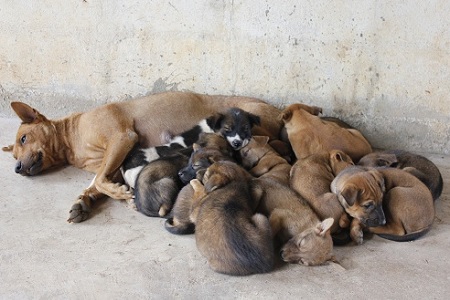
However, promoting the adoption of puppies and adult animals is absolutely not enough to ensure a significant reduction in stray-animal overpopulation. For every animal that is adopted, many are abandoned every day.
If all dog and cat owners sterilized their animals, the number of unwanted pregnancies would decrease. It is not always possible to find homes for every litter, so more people choose to “get rid of them” by releasing them in the countryside or on the streets, or even ending their lives.
One of the most important achievements animal-rights activists have secured in recent years is certainly the possibility of accessing free sterilization for strays. Each municipality appoints a veterinary practice or clinic to sterilize stray female dogs and cats and those living in shelters. This prevents unwanted pregnancies and can significantly reduce the number of strays.
Another concern owners often raise about sterilization is that they have heard it makes animals gain weight. This is not true, at least not directly. Sterilization does not automatically make a dog or cat obese. Rather, it is a more sedentary lifestyle, the disappearance of mating-related roaming, and the snacks we “extend” to our companions so that we do not feel guilty that make them gain weight. By continuing to provide exercise and ensuring a healthy diet, obesity does not become a problem.
Understanding these fundamental aspects is certainly an important step in combating stray-animal overpopulation, as well as protecting the health of our animals.