
Hip dysplasia is one of the problems most often discussed in connection with dogs. It is a fairly common joint disorder that can become seriously disabling for a dog. Let’s look together at exactly what it is, how it is diagnosed, and what treatments are available for hip dysplasia.
What is hip dysplasia?
Hip dysplasia is a joint disorder typical of medium-, large-, and giant-breed dogs. To better understand what it involves, we must first understand the structures that make up the hip.
The hip is the joint formed between the hind leg and the pelvis. In animals, it has the same characteristics as in humans. The femur is the long bone in the upper part of the leg—in other words, the thigh and buttock area.
The upper end of the femur has a broader structure composed of two rounded portions, similar, for example, to the classic pirate’s bone. One of these spherical parts meets the pelvis, a single large bone formed by the fusion of three parts: the ilium, ischium, and pubis.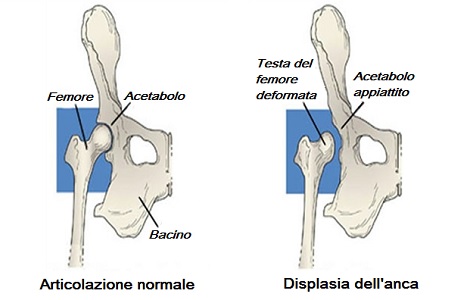
The head of the femur fits into a particular depression called the acetabulum, formed simultaneously by small parts of the three pelvic bones.
The acetabular cavity is lined with cartilage, a structure less resistant and less compact than bone, whose function is to make it more accommodating for the femoral head.
The femur and acetabulum remain close thanks to several ligaments, particularly elastic bands that connect the bones and allow movement, as well as a capsule that surrounds the entire joint.
The hip joint, also called the coxofemoral joint, forms during the animal’s growth, changing over time to ensure proper contact between the progressively growing bones.
If, during a dog’s growth, the femoral head and pelvis cannot remain in the correct position and maintain proper contact, the first symptoms of hip dysplasia may appear, worsening as the animal grows.
Because the two bones are in improper contact, the structures forming the joint begin to deteriorate. Initially, the cartilage lining the acetabulum wears down; then the bones and ligaments also begin to suffer damage, causing painful arthritis.
The causes
Hip dysplasia can be caused by a series of factors that act together, predisposing the dog to the problem. These include:
-
Hereditary causes: it has been shown that hip dysplasia can be inherited, from parents to offspring. The risk is even higher if both parents carry the genes that determine the appearance of the problem;
-
Environmental causes: dysplasia is more common in dogs that, from a young age, are subjected to frantic running and reckless jumping. A young dog’s joints are still not very strong, so excessive and continuous stress is enough to increase the risk of problems such as hip dysplasia;
-
Dietary causes: dogs must eat the appropriate amount based on their age, breed, and size. Overfeeding a dog, especially while it is still a puppy, predisposes it to joint weakness. At the same time, excess calcium—for example, giving a dog bones from a young age—can cause the skeleton to harden prematurely, meaning the joints will not fit together perfectly;
-
Breed: the breeds most affected by hip dysplasia are medium-, large-, and giant-sized breeds. In particular, German Shepherds, Boxers, Golden Retrievers, Rottweilers, English Bulldogs, and Newfoundlands.
The symptoms
Hip dysplasia appears from the first months of a dog’s life, on average between 5–10 months of age. However, it is not uncommon for dogs to show their first symptoms earlier or in adulthood.
During the veterinary visit, owners report that the dog refuses to go down stairs or get into the car and seems tired after only a few meters of walking. 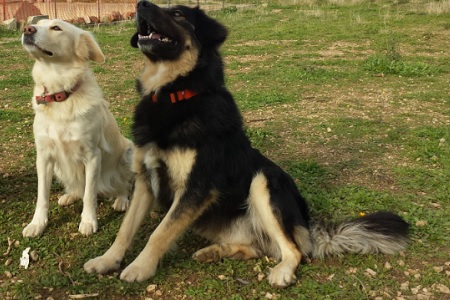
The classic sign of hip dysplasia is the “bunny-hopping” gait. Anyone who has seen a rabbit walk will know that it moves both hind legs simultaneously. A dog with hip dysplasia runs in the same way, without alternating the movement of its hind legs, but keeping them together.
Other symptoms include:
-
It cannot sit “properly”, but moves its hind legs to one side;
-
It tends to lean against the wall if it has to remain seated;
-
It cannot jump up with its paws on its owner, but loses its balance;
-
The dog stops after a few steps;
-
The dog cannot run;
-
The dog limps when running or even walking.
Diagnosis
In cases of hip dysplasia, early diagnosis is essential. Only by addressing the problem in its early stages can its progression be stopped at the outset, or at least its worsening delayed.
The veterinarian performs movements on the joint and also evaluates the animal while standing still, walking, and running.
The veterinarian then takes an X-ray of the joint to obtain a clear view of the femur and pelvis and how they join together. Several views will be necessary—that is, different “shots” with the joint in multiple positions—so do not be alarmed if your veterinarian prefers to use anesthesia. An animal with dysplasia will certainly be in pain, so it is better to spare it this suffering while awake and also prevent possible bites.
Grades of dysplasia
After an accurate diagnosis, the veterinarian will be able to determine the grade corresponding to the dog’s condition. Dysplasia is classified as follows:
-
Grade A: the joint is normal and perfectly congruent, so there is no sign of hip dysplasia;
-
Grade B: the joint is almost normal and slightly incongruent;
-
Grade C: there is mild hip dysplasia. The joint is incongruent and there may be early signs of inflammation;
-
Grade D: dysplasia is moderate and the incongruity between the femoral head and acetabulum is evident. The acetabulum may appear slightly flattened and signs of inflammation are always present;
-
Grade E: dysplasia is severe. The acetabulum is flattened and the femoral head deformed.
Treatments
Hip dysplasia can be treated conservatively or surgically.
The conservative approach is preferred in mild cases of dysplasia, to stop its progression. The veterinarian may therefore recommend treatments such as:
-
Changing the diet to a more balanced one;
-
Giving supplements for joint health, such as chondroitin sulfate and glucosamine;
-
Giving anti-inflammatory drugs to reduce inflammation and pain;
-
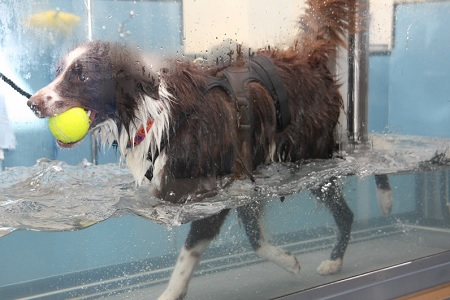
Taking the dog to supervised physiotherapy sessions, preferably with the help of a qualified professional;
-
Allowing the dog to swim, but only when it is not in the acute inflammatory phase.
As for surgical treatment, it is recommended in more severe and advanced cases. The various techniques include:
-
Triple pelvic osteotomy (TPO): recommended in the early stages, when the problem still concerns the joint cartilage rather than the bone. The three bones forming the pelvis are “cut” to separate the acetabular cavity. It is then rotated and secured with a plate so that it better fits the femoral head. A newer and more practical form of TPO is DPO, Double Pelvic Osteotomy, which involves “cutting” the ilium and pubis while leaving the ischium intact;
-
Juvenile pubic symphysiodesis: performed in very young puppies, at most by 5 months of age. The pubic symphysis is a kind of fusion between the two halves of the pubis. It forms once the animal’s growth is complete. In dogs with hip dysplasia, it may be useful to fuse the two halves early, positioning the acetabulum forward and downward so that it can connect more easily with the femoral head;
-
Dartroplasty (DAR): thi
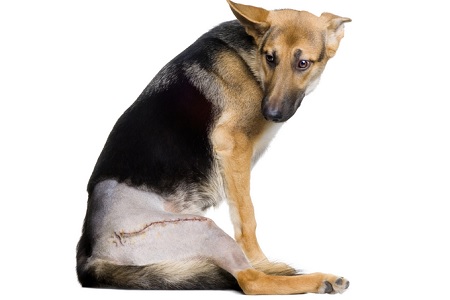 s technique involves reshaping the edges of the acetabulum by taking bone fragments from other parts of the pelvis. It makes the acetabular surface wider, providing more space for the femoral head;
 -
Femoral head ostectomy: this procedure removes the femoral head and allows the animal’s body to form a kind of capsule that compensates for the missing femoral head. It usually takes approximately 4–6 weeks for the capsule to form;
-
Hip replacement: in the most severe cases, no other operation is possible except insertion of a total hip prosthesis. This is the most drastic intervention, but also the most effective when the dog does not respond to any alternative treatment. Recovery takes quite a long time, so the dog needs approximately 3 months of rest.
As general advice, we can say that to prevent hip dysplasia, excessive physical exertion should be avoided in puppies, and they should be given the proper diet.
Another very important aspect is pregnancy. Female dogs with hip dysplasia may find it difficult to bear the weight of pregnancy and childbirth, so early sterilization is recommended.
Finally, if you notice any of the symptoms of hip dysplasia, discuss them openly with your veterinarian. Prevention and prompt treatment are essential in cases of hip dysplasia.