
FIV is one of the most serious diseases a cat can contract. Closely related to human HIV both in classification and symptoms, the terminal stage of the disease is known as feline AIDS, or FAIDS.
There is no cure and no vaccine, and cats that contract it remain infected for life; however, with the help of a veterinarian, it is possible to create conditions in which a sick cat can still have a dignified life.
Dogs, like humans, cannot contract this disease in any way.
What it is and how it is transmitted
To understand how the FIV virus works, we need to spend a few minutes understanding how it acts in the body.
Most viruses enter cells, “take control” of them, and cause the body’s cells to produce many copies of the virus itself before dying. The immune system (white blood cells) begins fighting the many viruses present in the body, which are gradually defeated until recovery.
The FIV virus, which belongs to the Lentivirus species, does not behave this way. Inside it is a strand of RNA (similar to DNA, without becoming too technical) that the virus integrates into the cat’s cells. It is a “modest” integration, so the cells do produce the virus, but little by little, while continuing their normal activity.
And the cells that produce the virus are precisely those that should fight it, namely white blood cells, which therefore can no longer perform their function because they are damaged “from within”.
The body is thus left without immune defenses. The virus itself is not fatal—in fact, it does almost nothing; the problem is that by greatly weakening the immune defenses, any other pathogen, encountering little resistance in the body, will cause far more damage than normal.
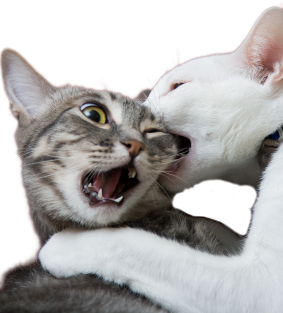
Transmission occurs through direct inoculation into the blood, usually by biting. The virus is found throughout the infected cat’s body, including its saliva: when a bite occurs, saliva comes into contact with blood and the virus enters the healthy cat’s body.
Sexual transmission is less common, but since cats often bite each other when mating, the result is often the same.
What it does
In explaining how the virus works, we have already explained where its danger lies.
The virus enters the blood and is initially recognized and fought, but since it is present in small quantities, the immune response is greatly reduced. In this way, the virus manages to enter white blood cells, which then begin producing it.
In the first phase of the disease, there will be fever resulting from a “normal” immune response. There are no particular symptoms; it is a low-grade fever that disappears after a few days, and often even the veterinarian does not realize that the cat has FIV, since there can be many causes of this fever.
At this point the cat will remain well for a long period, ranging from a few months to many years, and in some cases lasting for life.
This continues until another disease is contracted, revealing all the effects of the cat’s compromised immune defenses and potentially, in some cases, even causing death.
How it is treated and prevented
Let us begin by saying that the disease is very widespread in Italy. If you have a cat, particularly a male, that roams freely, the likelihood of contracting FIV is very high.
As for treatment, as we said at the beginning, the disease is incurable. Once the infection has been contracted, the only way to act is to be aware of it: if you notice that your cat—there is no better definition—is “out of it” (responds slowly, walks as if drunk, is always tired), a veterinary visit is recommended to confirm or rule out the disease.
If it is sick, whether male or female, it should be neutered or spayed as soon as possible to encourage it to stay indoors, allowed outside as little as possible, and taken to the veterinarian whenever it has a fever or feels unwell in any way, so that any disease it may have contracted can be treated. Only in this way can we ensure a dignified life and prevent premature death for our four-legged friend.
For prevention, in the case of a healthy cat, we must act primarily by avoiding contact with other cats, especially strays. Neutering encourages male cats to be more sedentary and prevents fights over mating, situations in which transmission often occurs, while encouraging females to avoid mating.
At present, this is the only effective prevention method, since, just as with human HIV, there is currently no cure or effective vaccination.