
Feline infectious peritonitis is one of the most dangerous diseases our cat can suffer from. It is a disease caused by a virus, mainly affects kittens and, at present, the only available vaccine does not work particularly well because of the virus’s specific characteristics.
On this page we will try to understand how to prevent the infection, which once contracted unfortunately cannot currently be treated.
This disease affects cats only and does not affect dogs.
What It Is and How It Is Transmitted
Feline infectious peritonitis is caused by a virus of the coronavirus genus, a very unusual type of virus.
Unlike all others, it is a mutating virus: this might sound like science fiction, but it is not, because the virus is highly unstable. When it reproduces, it does not create another virus similar to itself, but rather a different one. It is a little as if a cat could give birth not only to kittens, but also to puppies and baby mice.
What seems merely curious is actually a problem for preventing this disease: first, because a cat that becomes infected will not necessarily develop symptoms (the virus can reproduce in a benign form without being dangerous, or in a malignant form that can even be fatal); second, it is not possible to develop a vaccine because each virus has its own form, and the dead virus injected through the vaccine, so that the body can later recognise the live virus, may not be the same virus the cat actually encounters.
Transmission occurs mainly through faeces, because infected cats shed the virus from their intestines. However, a cat may have the “good” virus and show no symptoms, while in the body of the second cat to which the virus is transmitted, a mutation may occur that makes the disease manifest.
What It Does
The FIP virus (the English acronym for Feline Infectious Peritonitis) enters the body orally, is swallowed and spreads from the intestine throughout the body.
The virus is ingested by certain white blood cells, macrophages, which cannot digest it. The virus therefore reproduces inside them, and these cells, which should defend our body against the virus, instead become its main spreaders.
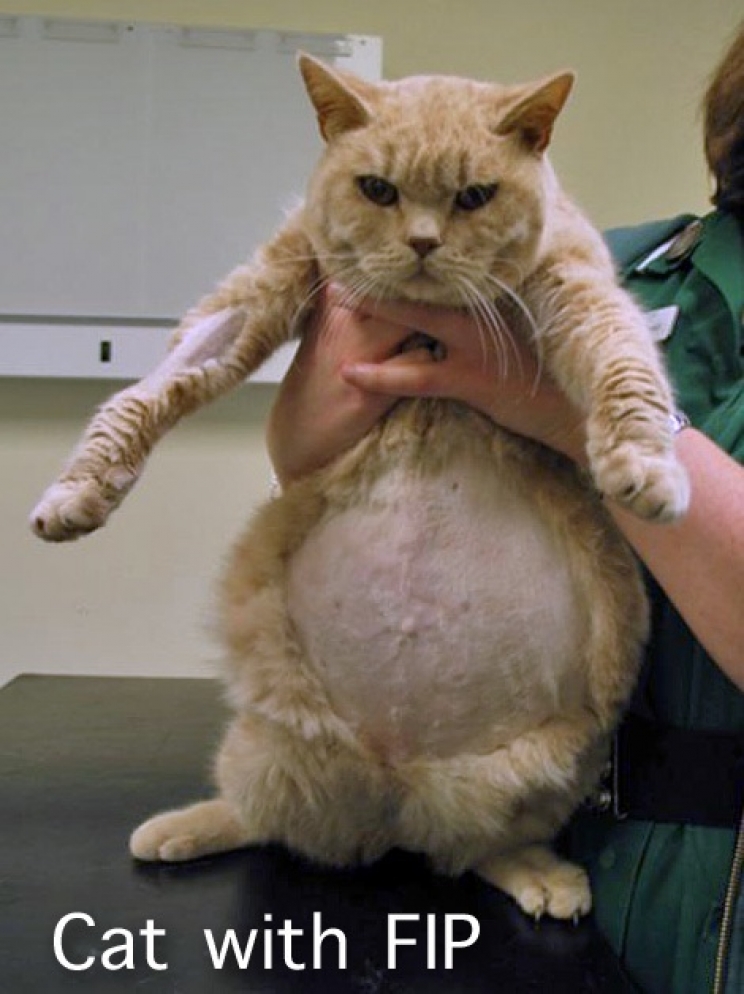
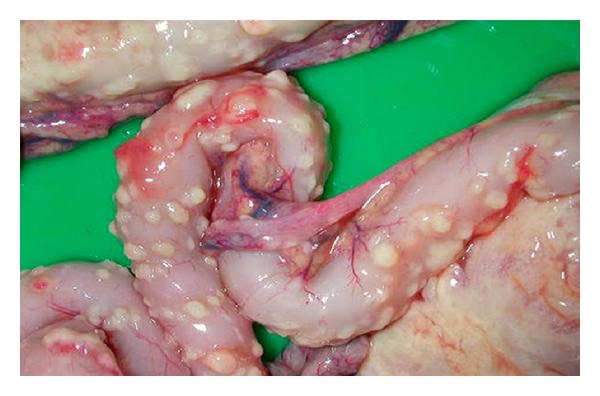
The disease may occur in a “dry” form, with many small infections spread throughout the various organs, or in a “wet” form, which causes the cat’s abdomen to fill with fluid.
The cat’s antibodies attempt to limit the infection and “surround” the virus to make it harmless. In doing so, however, these virus-and-antibody complexes, known as immune complexes, deposit throughout the blood vessels. In some cases, defensive cells in the blood surround them, giving rise to the dry form (the image shows an organ with the small infections mentioned above); in other cases, they damage the blood vessels, causing fluid to leak from them into the abdomen. The abdomen therefore swells because it is full of fluid.
The symptoms are fairly characteristic: the cat is usually young, because adults appear to be less susceptible to the infection; it also does not eat, has a fever that does not go away with antibiotics (antibiotics kill bacteria, not viruses), its mucous membranes (especially the gums) may turn yellow if the liver is affected, and the cat may develop neurological problems. The cat’s abdomen may become extremely swollen. In some cases, FIP infection ends in death.
How to Prevent It
Preventing the virus relies mainly on hygiene, since it is transmitted through faeces.
The virus survives poorly at room temperature, so it dies fairly quickly indoors; it survives well both in the cold and when dried inside faeces. Faeces dry out if they are not removed from the ground for a couple of days.
Therefore, if we already have a cat that has no problems (it may be healthy or carry the “good” form of the virus, which causes no harm) and intend to get another one, we can ask the veterinarian to perform a rapid test to find out whether the first cat is ill.
If, instead, we have a kitten, we should avoid letting it roam outside alone, especially if there are many cats in the neighbourhood where the virus could persist. At home, if we take care and clean the litter box every day, it will be practically impossible for our cat to contract this disease.
The vaccine is currently little used and may have some preventive effectiveness only where many cats are present, such as catteries or feline colonies.