

When we intend to get a dog or cat, we often consider one fundamental factor in our choice: sex. Some people prefer females and others males for reasons of “liking”, but many owners prefer males because they think they are less problematic.
Males cannot have unwanted pregnancies, nor can they develop dangerous diseases such as pyometra or troublesome ones such as mastitis. And they do not necessarily have to be neutered, as females do.
Whether these opinions are right or wrong is for each of us to decide; the fact remains that males also have their own problems regarding the “attributes” that females lack. In this article, we examine the main diseases of the male reproductive system.
The testicles
Let’s start where everything begins: to fertilize a female ovum, a male gamete is needed, called a sperm cell. These cells are produced in the testicle, the equivalent of the female ovary. The testicles are located outside the abdomen, enclosed in a skin sac called the “scrotum”, and are easily visible from the outside.
Cryptorchidism is one of the most common conditions, occurring when one or both testicles do not descend into the scrotum. The testicles originate in the abdomen, where the ovaries are located in females (below the kidneys), and then move downward during the first months of a dog’s or cat’s life. Sometimes they do not, and an undescended testicle will not be able to produce sperm cells.
It does not cause problems for the animal, but since it is an organ that could develop a neoplasm in the future, it is advisable to remove it through a simple surgical procedure. It does not function anyway.
Similar conditions include monorchidism, when the animal has only one testicle because the other did not develop, and testicular ectopia, when the testicle descends somewhere slightly forward, to the side of the penis, instead of into the scrotum. In this case, although incorrectly positioned, the testicle functions perfectly.
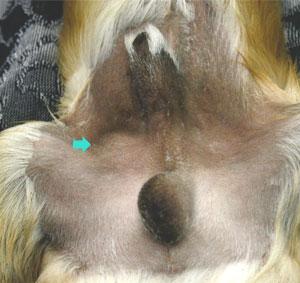
An inguinal hernia occurs when an organ such as the intestine descends into the scrotum instead of the testicles. It is very painful for the dog, partly because food cannot pass properly and presses from inside against the testicles. We must therefore take the dog to a veterinarian as soon as possible for treatment, with a simple surgical procedure that removes the “extra” organ.
There are also tumors, or testicular neoplasms. They function like all other neoplasms, with the difference that, being in a relatively “secluded” organ, they generally do not cause serious problems. The risk of metastasis nevertheless exists, and if we see one testicle larger than the other (when they were previously equal), we should consult a veterinarian for a check-up and, if necessary, have castration performed as soon as possible.
Orchitis and epididymitis are inflammation of the testicle and the first part of the canal that carries sperm cells outward, respectively (the epididymis). These are very painful conditions; the dog or cat may have a fever and become aggressive if we try to touch its testicles. In America, Brucella canis, a bacterium that causes these problems and is transmitted sexually, is widespread.
Although painful, it is fairly simple to resolve with antibiotic and pain-relief treatments lasting a couple of weeks.
The prostate
The “journey” of sperm cells begins in the testicles, where they are produced. They then pass through the epididymis and the vas deferens, tubes that carry them toward their final destination, the urethra, which ends at the tip of the penis, through which they are expelled.
The prostate is located where the vas deferens join, at the beginning of the urethra (it is positioned “across” the urethra), a gland that adds prostatic fluid to the sperm, giving semen its typical consistency. This sugar-rich fluid nourishes the sperm cells during their journey.
Older dogs may develop prostate problems.
Benign prostatic hyperplasia is one of the most common conditions, affecting unneutered dogs over eight years old. The prostate enlarges and “strangles” the urethra, making it difficult for semen and urine to pass and causing pain and blood loss. It decreases in size spontaneously when the dog is neutered.
Prostatitis is inflammation of the gland. It is very painful, is caused by bacteria and may cause fever. It is treated with antibiotics for several weeks to prevent further problems. It is painful; the dog has difficulty urinating and refuses to mate.
Finally, the prostate can also develop tumors: the most common is adenocarcinoma, which is malignant. As it grows, it causes the same symptoms as prostatitis or hyperplasia, including pain when urinating, and the veterinarian will determine what is wrong. Treatment consists of complete surgical removal of the prostate, also helping to prevent future metastases.
Finally, diseases of the penis are not very common and may be caused by trauma (bites, blows) or infections contracted sexually during mating. While mating does not cause particularly serious problems in dogs, in cats it can transmit dangerous diseases such as FIV or FeLV.
Penile problems can be recognized because, being an organ full of blood, the emission of urine will be preceded by the emission of a few drops of blood. A visit is advisable to determine where the problem lies.
In any case, let us remember that for all these conditions (apart from prostatic adenocarcinoma), male neutering is curative; unless we want the dog or cat to reproduce, we can prevent all of them with a simple surgical procedure (much simpler than in females) that is also inexpensive.
The animal’s behavior changes little; after losing its sexual instinct, it will tend to stay closer to us (especially the cat), and one procedure resolves many potential diseases at once.