
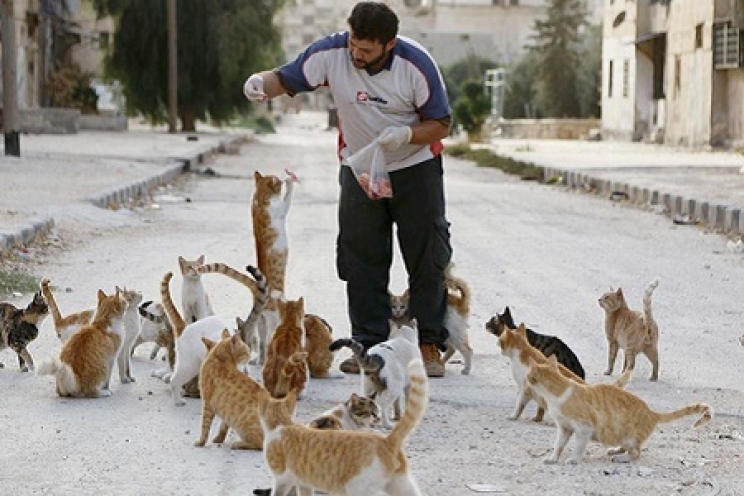
In recent days, we have been hearing a great deal about the issue of stray animals, with particular reference to the possibility of giving food and water to stray animals. It is summer, and the lives of many dogs and cats living on the streets and in the countryside may truly depend on a simple bowl of water and a piece of bread. The law, however, still seems unclear on the matter.
It is a fact that not all citizens and politicians are animal lovers. But in some cases, indifference borders on outright mistreatment. Recently, in fact, we have witnessed a veritable parade of incredible news and cases, in which mayors prohibit residents from caring for strays by feeding and giving them water.
All this is decidedly absurd, especially when compared with the recent decision by the municipal administration of Istanbul, which decided to equip the entire city with original dispensers that, in exchange for a plastic bottle to recycle, dispense a handful of kibble for stray animals, which can use them when needed.
For example, consider the woman from Siliqua, in the province of Cagliari, who in 2009 found herself facing a fine of 105 euros for giving food and water to a poor stray dog dying in front of the town’s nursery school. In this case, the mayor invoked Ordinance 38 of 1 April 2009, according to which feeding a stray animal is prohibited. The woman’s protests and appeals against the municipal police and the mayor were of no avail.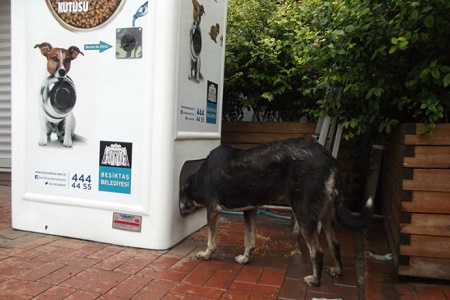
A similar event occurred in 2012 in San Vito dei Normanni, in the Brindisi area, where Mayor Alberto Magli had issued an ordinance prohibiting people from feeding stray animals, following a report by the local health authority denouncing “an increase in the fouling of public land, with a consequent increased risk of transmission of infections from ecto- and endoparasites to the population”. The outcome was clear: “within the urban perimeter, it is prohibited to administer food to animals wandering in the area”.
In this case too, citizens did not accept the decision and filed an appeal through animal-rights associations “Lega per l’abolizione della caccia” and “Earth” directly with the Lecce Regional Administrative Court. The judge upheld the animal-rights activists’ complaint, deeming the health authority’s statement unfounded, as it had never provided any real and verifiable evidence, as shown by the official text. But that is not all. The mayor’s ordinance was even considered contrary to the current legislation on stray animals, in particular Law no. 281 of 14 August 1991, “Framework law on companion animals and the prevention of stray animals”, which you can read in full by clicking here.
As the legislation states, the health authority is required to control the birth of stray dogs and cats by promoting free sterilization, and absolutely never putting down animals that are not “seriously ill, incurable or demonstrably dangerous”. According to the law, moreover, “protection agencies and associations may, in agreement with local health units, manage colonies of cats living freely, ensuring their health care and survival conditions”. And what does survival depend on more than anything else? Precisely food and water.
More recently, a similar issue arose in Calabria just a few days ago. The “Earth” and “Associazione Vittime della Caccia” associations appealed to the Regional Administrative Court for Calabria against the Municipality of Cropalati. In 2014, in fact, the Municipal Council had passed a resolution absolutely prohibiting “feeding, even occasionally, wandering dogs belonging to others or without an owner”. According to the judges of the Calabrian Regional Administrative Court, the ordinance is entirely contrary to current regulations against animal mistreatment, as had already happened in Puglia.
In conclusion, at present there is no law that can prohibit us from feeding and giving water to stray animals, either in towns or on the outskirts. Indeed, if some citizens were to complain or call the authorities to prevent us from doing so, they would have no right to do it.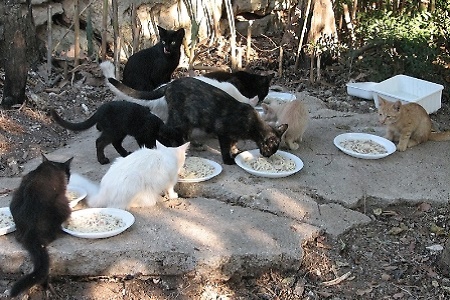
An unpleasant situation that may occur in some cases is that the municipal police decide to fine us because we are “fouling” public land by feeding a stray animal. Knowing the regulations and considering what has happened elsewhere in Italy, we have the right to point out to the officer that we are not violating any regulation, unless the mayor has issued a specific ordinance.
Unfortunately, not everyone has the financial means to pursue an appeal against a fine, however unfounded it may be. Therefore, in such cases we should try to address the issue verbally with the authorities, always asserting our rights. Otherwise, we will necessarily have to pay what is due and then decide whether or not to appeal. Events of this kind should not go unnoticed.
If a mayoral ordinance is already in force, however, we can turn to the many associations active in animal protection, as happened in the examples mentioned in this article.
In conclusion, we can place bowls of water or food for the animals, remembering to appeal to our common sense as well. Water does not make a mess, but food does, so let us try to clean up as soon as the animal has finished eating.