

When summer approaches, the heat, sunshine, and beautiful days encourage us to go to the seaside, to spend a carefree and enjoyable day. Naturally, if we have a four-legged friend, we cannot refrain from taking them with us—rather than leaving them at home all day to suffer in the heat… However, things are not so simple, because taking a dog to the beach means observing a series of rules that we need to know in order to do so responsibly and avoid potentially significant financial penalties.
The regulations
The biggest problem when trying to understand the situation is that regulations governing the possibility of taking dogs to the beach are not national. This means it is impossible to establish a single model that applies equally in Genoa and Palermo. In this article, therefore, we will try to understand how to become “model citizens” by gathering the best possible information, and also how to defend ourselves against beach managers or municipal police officers who claim nonexistent rights or prohibitions in an attempt to drive us and our friend away.
Regulations concerning dogs on the beach may come from three sources: first, the region or autonomous province where the beach to which we want to take the dog is located (note: the region where the beach is located, not our region of residence); second, the municipality where the beach is located; and third, the harbor master’s office for the area in which we are located.
Regional or municipal regulations
The laws are constantly changing, meaning they change from year to year. Therefore, in June, when the bathing season begins, it is advisable to spend an hour making a few phone calls to ensure compliance with the regulations in force.
The first call we should make is to the municipal police, that is, the local police force of the municipality where the beach we want to visit is located. Their contact numbers can be found on the municipality’s website.
There we should ask for information about regional and municipal regulations on access for dogs to the beach. The information will be explained verbally, but it is always a good idea to ask for the legal references on which the information is based. There is no need to read them afterward, but we should note the relevant information, which could be useful in the event of a dispute (in Tuscany, for example, Law 59/2009 is in force: write down this reference and keep it).
In general, regions or municipalities (through specific sections of the municipal regulations, which we can also read ourselves) may have created “blacklists” or “whitelists” of beaches. We have a blacklist when access to beaches in the region/municipality is generally open to dogs, but dogs are prohibited on certain beaches. Conversely, a whitelist exists when access is generally prohibited but the municipality has established exceptions for beaches with free access.
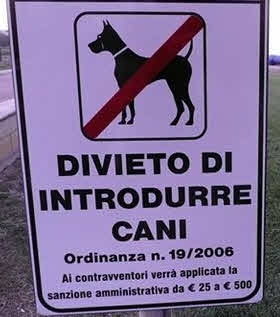
Each individual prohibition or permission is established by municipal ordinances, whose reference is written on a sign at the beach entrance. For example, we may find “dogs prohibited; municipal ordinance 123/2012”, meaning “in this region/municipality access is generally permitted but not on this specific beach, as stated in municipal ordinance 123/2012”. Knowing how the regional regulations work, we will know how to behave accordingly. In the example above, we may not take the dog onto that beach, but we may take them to the adjacent one if there is no specific prohibition sign.
The general rules for public places naturally apply: dog on a leash, muzzle, scoop and bags, and the certificate of registration in the canine registry must be carried with us.
Harbor master’s office orders
The harbor master’s office, or coast guard, is a branch of the Italian navy that issues regulations concerning the sea and the outermost part of the beach; it does not regulate access to beaches, but whether dogs may enter the water.
Here too, we can check the situation each year (orders are generally valid for one year) by contacting the harbor master’s office for the area where the beach we want to visit is located. To find out which office it is, visit the official website (www.guardiacostiera.it) and look for the nearest city. Then call and ask whether the beach located at (for example) 83 Via Del Mare, Tirrenia, falls under its jurisdiction. If the answer is no, the call will be transferred to the competent harbor master’s office. We can then ask for specific information about dogs bathing in the sea, taking care in this case as well to request the legal references, which may be useful in the event of a dispute.
Always carry out these steps before going to the beach, so as not to find ourselves in the wrong without realizing it.