
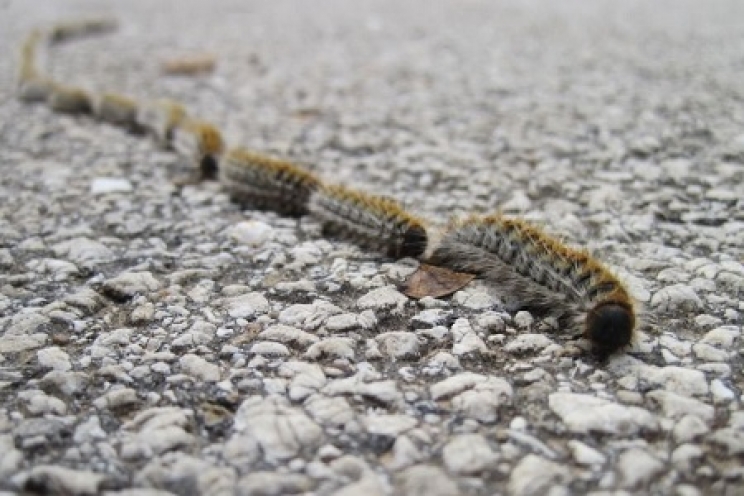
The processionary moth is a truly dangerous insect, not only for our four-legged friends, but also for us and our children. Let us try to understand exactly what the processionary moth is and why it is so dangerous.
What is the processionary moth?
The processionary moth is an insect belonging to the Lepidoptera, just like common butterflies and moths. It grows mainly in areas close to the Mediterranean Sea, including southern Europe, northern Africa and some Middle Eastern countries.
This insect is found mainly near tree-rich areas, both along roadsides and in groves and pine forests. In particular, the processionary moth prefers pine trees – especially Pinus Nigra and Pinus Silvestris, the most common varieties – but also oaks, larches and cedars.
The processionary moth’s life cycle is rather complex.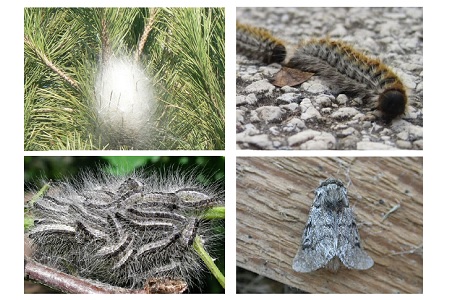
During the summer months, usually around the end of July, the adult processionary moth emerges from the ground, where it had been “hidden”, to reach its preferred trees, where it will mate and lay its eggs.
Thirty to forty days after being laid, the eggs begin to hatch, producing numerous larvae. They begin feeding on the leaves (especially pine needles), causing more or less noticeable defoliation of the tree.
At the end of summer, the larvae prepare to protect themselves from the harsh winter climate by grouping together in nests that are very compact and resistant, located mainly in the sunniest parts of the tree. The nests are about 10–20 centimetres in size and can clearly be distinguished with the naked eye by their bright white colour.
With the arrival of spring, the larvae become active again and leave the nest, descending along the tree trunk in single file to choose suitable ground in which to burrow. It is at this point that we can recognise the typical larval “processions”, from which the insect takes its name.
Once they have burrowed to a depth of 5–30 centimetres, they hide inside a cocoon to complete the maturation process. At the end of the following winter, or even after several years, adult insects emerge from the cocoon, ready to begin the life cycle again.
Recognising the presence of the processionary moth is very simple. During the summer months, in fact, we can see the presence of eggs on the trees’ foliage, visible as whitish clusters.
The larvae, on the other hand, appear mainly around May, with the first warm days. During this period, we can easily notice the presence of long processionary lines along roads and on tree trunks. The lines can reach several metres in length and are distinguished by insects very similar to caterpillars, 1–3 centimetres long and covered with hairs that are highly irritating to humans and animals.
The adult processionary moth, on the other hand, looks very similar to common butterflies, but has lateral triangular wings, characterised by a whitish background with grey and brownish streaks. The body and head are dark, and closer inspection clearly reveals many hairs on the surface. The adult processionary moth is usually no more than 4 centimetres long. Like its “cousin” moths, it is a nocturnal insect, which nevertheless rarely moves away from the trees to enter homes.
Why is the processionary moth dangerous?
The processionary moth, particularly during its larval stage, is very dangerous to anyone who touches it. Its body is, in fact, covered with irritating hairs capable of causing severe irritation following contact. Consider, for example, children who, during a normal walk in the playground, see the typical “processions” and decide to touch them out of curiosity. Or our dogs, which while going out to “do their business”, sniffing the ground, brush against or even accidentally ingest a processionary moth.
The consequences can be dramatic, especially if the larvae are ingested.
The symptoms caused by even slight contact with the processionary moth include:
-
Severe itching
-
Redness
-
Blisters
-
Pain
-
Swelling
In the event of ingestion, which is especially typical of our animals, we may observe:
-
Intense whining
-
Increased salivation
-
Swelling of the nose
-
Swelling of the mouth and tongue
-
Purple tongue
-
Difficulty breathing
-
Vomiting
-
Diarrhoea
-
Fever
-
Blood in the stool
 In some cases, the animal may even inhale the processionary moth’s irritating hairs, suffering severe breathing difficulties.
The same consequence may also occur following swelling of the tongue, which can sometimes reach alarming dimensions, obstructing the entry of air through the mouth. This occurs especially if some hairs remain embedded in the tongue.
Symptoms may also extend to all parts of the body that come into contact with the insect. In dogs with particularly long ears, naturally the underside of the skin covering them may also be affected.
In the most serious cases, especially if action is not taken promptly, but also if the hairs or the insect itself remain inside the mouth, the irritation can become so severe that it quickly causes necrosis, meaning death of the affected body part. For example, the purple area on the tongue could “die”, making amputation necessary.
What to do in case of contact or ingestion
First of all, it is very important to remove the hairs or the entire larva from the animal’s body as quickly as possible. Take water and rinse the muzzle and inside of the mouth thoroughly. If we can identify the presence of the larva in the animal’s mouth, cover our hands and remove it immediately.
Then rush to the nearest veterinarian, who can intervene promptly to reduce the consequences and save our animal’s life.
Let us also remember that the processionary moth is a problem affecting the entire community. If our dog has managed to avoid it, another dog or even a child may not be so lucky. For this reason, whenever you identify processionary lines or nests, immediately report the exact location to the police. If possible, share any photographs and information about the location on social media as well.