
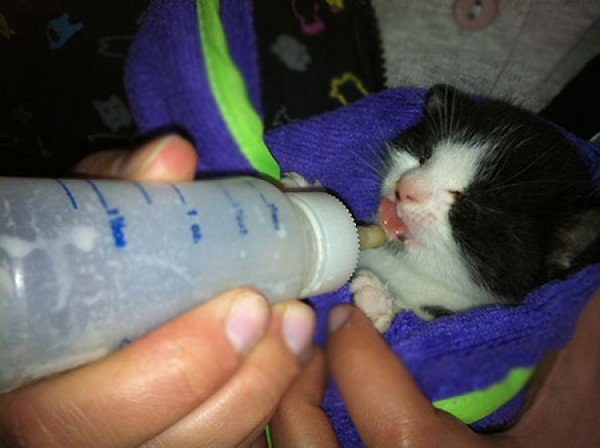
If you have just found an abandoned kitten and believe it is not yet old enough to be self-sufficient, follow this guide to help you care for it.
Animal abandonment is still widespread, despite countless awareness campaigns. Probably the most serious aspect of all this is that newborn kittens, only a few hours or days old, are often abandoned, torn from their mothers and left in the countryside or in rubbish bins. It is also not uncommon to see kittens abandoned by their own mothers because they are ill, small, or part of a litter that is too large.
The life expectancy of kittens this small, exposed to cold and hunger, is truly close to zero. Their only hope is that someone finds them and takes care of them, doing everything possible to replace their mother’s care.
When they are born, in fact, they desperately need to be warmed through contact with their mother and siblings, fed, cleaned, stimulated to relieve themselves and, naturally, protected.
If a kitten under two months old is orphaned, all this care is lacking, exposing its health to serious risks. The situation is even more serious and complex for kittens born only a few days earlier, whose chances of surviving without their mother are truly slim.
What to do
First of all, you must bring it indoors immediately and obtain everything you will need for the next few days. You will need plenty of patience and time to devote to the orphan you have rescued, ensuring that it has everything it needs.
As for the essential supplies, you will need:
-
A cardboard box;
-
Several blankets and towels;
-
A hot-water bottle or, even better, an electric heating pad;
-
Kitten milk replacer;
-
A kitten feeding bottle;
-
A kitchen scale.
Place the box or basket in an area of the house where you can constantly monitor it, protected from cold, noise and other animals. Put the heating pad inside, with a warm, soft blanket on top.
Turn on the heating pad at the lowest temperature, leaving it set to the same mode at all times, to provide suitable warmth that is neither too hot nor too cold.
A hot-water bottle may be suitable only until you can obtain an electric heating pad. First, it would be inconvenient for you to maintain the correct temperature at all times; the kitten could also become too hot or too cold.
Remember that warmth is essential for very young kittens, whose body temperature can easily drop. If a kitten is cold, its blood does not circulate properly and it may also be unable to digest what it has eaten, and could die.
Place the kitten on the blanket and wrap it in an old sweater or towel so that it feels more protected.
Bottle-feeding
Kittens feed on their mother’s milk directly from her nipples, just like newborn babies.
When the mother is absent, therefore, you must encourage them to feed by recreating the same conditions they would experience in nature.
First, you need to determine the kitten’s age, to get an idea of how much it should eat. If you do not know the birth date, a veterinarian may provide an approximate age. Bear in mind that a kitten only opens its eyes after 2 weeks from birth; before then, they remain sealed.
As a basic rule, kittens need to eat very often, both during the day and at night. The younger they are, the more often you will need to feed them.
Up to 2 weeks of age, they will need to eat every 2-3 hours, more frequently during the day. Later, the interval between meals can be extended by one hour as the weeks pass.
As a rule, a kitten must feed exclusively on milk until it is 30 days old. After this period, you can slowly and gradually begin weaning, supplementing the milk replacer with food specifically designed for young kittens; in general, however, you can continue bottle-feeding until 6 weeks of age.
Buy a powdered milk replacer specifically for kittens. Do not rely on popular beliefs or on advice from people who are not experts in the field. Cow’s milk is absolutely unsuitable for kittens because it is harder to digest and can cause severe diarrhoea.
Follow the instructions on the milk-replacer packaging and try to prepare enough milk for just one day. If left in the refrigerator for too many hours, it can easily spoil, putting the kitten at risk of indigestion.
For dosage, consider that a kitten should eat in one entire day an amount of food equal to 25-30% of its body weight. Therefore, monitor the kitten’s growth with a scale to adjust the ideal dose day by day.
Once the milk is ready, pour it into the kitten bottle, which you will previously have sterilised by boiling it for a few minutes in a saucepan. This is essential because such young kittens are more susceptible to illness.
Using a sterile needle, make a small hole in the bottle nipple. It must be neither too small nor too large. The ideal size allows a few drops of milk to come out without excessive flow.
Pick up the kitten, wrap it in a towel and make sure it assumes the same position as when it suckles from its mother. Ideally, keep it on its stomach with its head slightly raised.
Do not place it on its back for any reason, because the milk could go down the wrong way and enter its lungs. In these cases, the risk of aspiration pneumonia is always present.
Once the meal is finished, do what a woman would do with her baby. Hold it upright against your shoulder and make sure it burps.
Relieving itself
After eating, the kitten must relieve itself. During the first days of life, a kitten may be unable to defecate and urinate on its own, so you will need to stimulate it, just as its mother would naturally.
Using a cotton ball moistened with lukewarm water, gently massage the area beneath the kitten’s tail, simulating the effect of its mother’s tongue. Before long, you will see the cotton wool slowly turn yellow with the kitten’s urine.
As for defecation, many kittens may have constipation problems. In these cases, ask your veterinarian for advice before relying on tips or improvisations that could endanger the kitten’s health.
How to tell whether the kitten is hungry
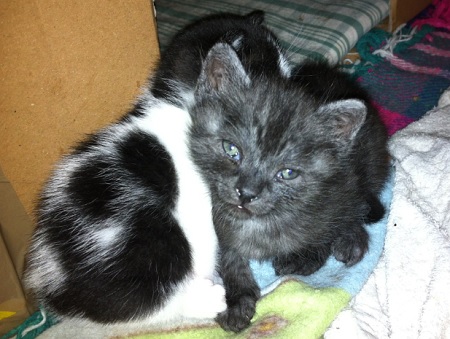 Kittens stimulate milk release from their mother’s nipple by pushing the area around it with their paws or by nudging it with their heads. Under normal circumstances, this is the signal that the kitten is hungry.
If the mother is absent, you can tell whether the kitten wants to eat simply by the fact that it is awake. At that age, all animals sleep a great deal unless they feel hungry.
A kitten that is awake, meowing, lifting its head and moving it from side to side is clearly looking for its mother’s nipple. Almost certainly, if you bring a finger close to its mouth, it will begin nibbling and sucking the fingertip, mistaking it for its mother’s nipple.
This is the right time to feed it.
If they continue behaving this way even after you have fed them, they have probably not taken in enough milk.
Growth
Monitor the kitten’s weight every day. If it is well nourished, it should gain about 10 grams per day.
If its weight does not increase as it should, the kitten is probably not managing to take in enough food. Discuss this with your veterinarian, who will know what to do.
Saving an orphaned kitten’s life can be very rewarding. Remember, however, that three essential things are indispensable: patience, consistency and precision. The kitten must be fed and monitored day and night to ensure that it grows healthy and strong.
If you do not feel able to take on such a commitment, contact the nearest organisation or your veterinarian, without feeling guilty. You will still have played an important role in saving a life.