
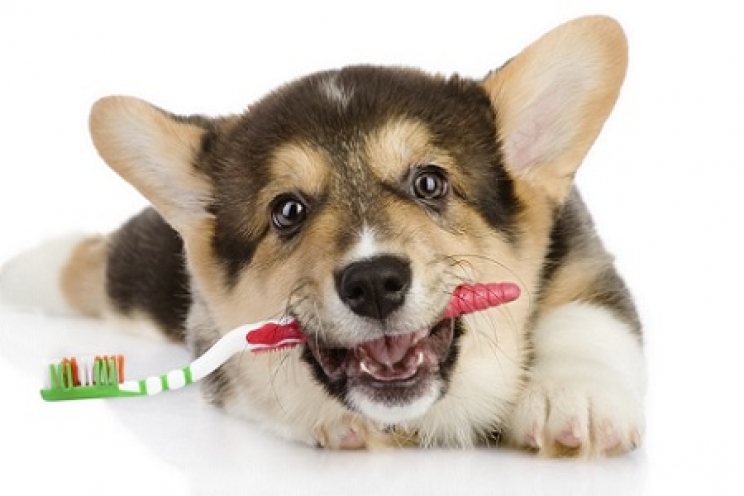
Dental hygiene in our animals is neglected by most owners, but it remains fundamental for the health of the mouth and the entire body. In this article, we will explain how to ensure our four-legged friends have a healthy, clean mouth, starting with tooth brushing.
Why is oral hygiene important?
Dogs and cats do not naturally have the ability to care for the hygiene of their mouths and teeth in the way we understand it. For this reason, all the food residue that inevitably accumulates after every meal creates a series of problems, leading to the formation of plaque and tartar, the sworn enemies of every dentist.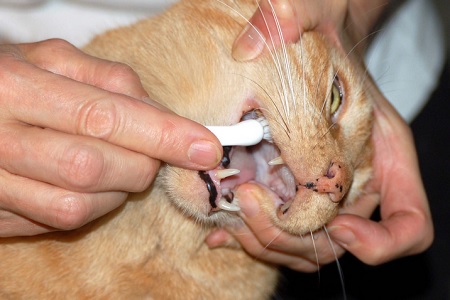
These structures are simply accumulations of food residue, which are progressively attacked by bacteria normally present in the mouth, eventually forming deposits that are more or less solid.
Plaque forms within just a few hours and can be removed fairly easily through proper oral hygiene. Tartar, on the other hand, results from plaque hardening as the days pass, eventually covering the gum line and tooth, making it difficult to remove except through a specific scaling procedure.
The consequences of plaque and tartar on our animals’ gums and teeth often make themselves felt, quite literally. The main warning sign that all owners eventually notice is halitosis. In some cases, the problem can become so significant that the bad smell is noticeable in every corner of the room where the dog, and less often the cat, lives.
If the problem is neglected, the animal may develop more serious dental problems, such as painful cavities, gum inflammation and collections of pus. In the worst cases, bacteria multiplying inside the mouth can even “travel” through the blood vessels until they reach the heart, causing very serious infections.
To avoid all this, it is enough to follow a few simple tips which, over time, can make a difference to our animals’ health, starting with tooth brushing.
How to brush a dog’s and cat’s teeth
If the animal is not used to having its mouth handled with toothpaste and a toothbrush, or if we are performing the first cleaning sessions, we can use a simple cotton gauze, wrapped around our index finger and gently rubbed over all the dog’s teeth.
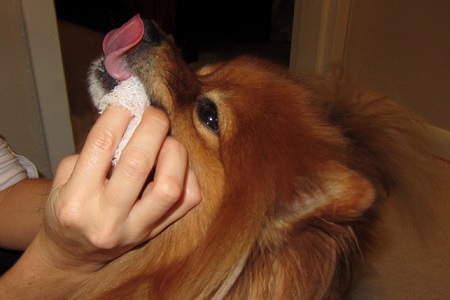 For cats or very small dogs, it is preferable to use a wooden stick or even a crochet hook, around which we wrap the gauze and gently pass it over the surface of the teeth.
For the first few times, we can “flavor” the gauze by rubbing it on dry food, making it more interesting to the dog’s and cat’s eyes and nose.
If the animal is more accustomed to having its mouth handled, we can choose the classic toothbrush. Various solutions are available, including special toothbrushes that fit comfortably over the fingertips. This remedy helps make tooth cleaning faster and more targeted, but in reality it does not work as well as a traditional toothbrush.
For larger dogs, we can also choose a toothbrush intended for human use, with medium bristles and a fairly small head. For cats and smaller dogs, buy one for children, with softer bristles capable of reaching even the most hidden spaces.
We can use the dry toothbrush, brushing from top to bottom for the teeth of the upper arch, and vice versa. In this way, we will manage to remove much of any plaque deposits present on the animal’s teeth.
To freshen the breath, especially in the presence of halitosis, we can use toothpaste specifically for animals, applying a small amount directly to the toothbrush. It is very important never to use human toothpaste, because in most cases it contains substances that can harm our animals. Let us always remember that while we can understand that the foam produced by toothpaste must be spat out, Fuffi and Fido will swallow it without thinking twice.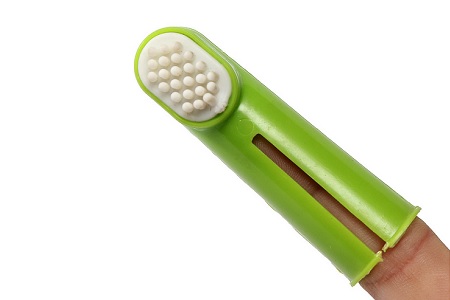
Alternatively, we can buy spray toothpastes or mouthwashes for animals, which may help to a limited extent, but will never be as effective as thorough tooth brushing. We can say that they act mainly as breath fresheners, but unless we use them by dabbing them onto the gauze or toothbrush, they will never be able to remove plaque and food residue perfectly.
Try to be consistent in cleaning the dog’s and cat’s mouth. With some determination, we should be able to reach daily cleaning, or at most no less than twice a week.
Choose a quiet place and a fixed time, for example before our friend’s dinner. This way, once the procedure is complete, we can reward it with its daily portion of food.
Dogs and cats must be accustomed to having their mouths handled from an early age, by massaging and touching their muzzles fairly often. An adult animal will rarely accept having hands put in its mouth if it is not accustomed to it. In any case, nothing is impossible, so it is enough to be consistent and patient and teach it that having its teeth brushed can also be pleasant.