
When we think of our sweet, gentle pets, the last thing that comes to mind is that they might attack us. In most cases, this is absolutely true, precisely because we have personally raised and trained our four-legged friend since puppyhood. However, we may encounter a stray dog or a pack while walking or cycling, especially if we are with our puppy or a child. Unless we are very familiar with canine nonverbal language, we could easily trigger a territorial defense mechanism in their minds that may lead to a real attack. Here is how to prevent these situations and what to do if a dog tries to attack us.
Despite the widespread campaigns emphasizing the importance of training our animals, many owners still believe it is right to shape their dogs’ character according to outdated and highly counterproductive methods. This is precisely why we so often hear about dogs attacking their owners, and in some cases even children.
Assuming that we should understand the reason for the attack, it is fair to observe that we ourselves often unintentionally provoke aggression in our dog or in the stray we happen to encounter.
If we do not perfectly understand the gestures and attitudes dogs use and understand to communicate, we could easily send signals that the dog might completely misinterpret, interpreting them as a threat.
For example, if we encounter a group of strays during a walk on the outskirts of town and approach them directly without slowing down, perhaps with a broad smile on our face and shouting something loudly, we would certainly be mistaken for aggressors. In such cases, if we are lucky, the dogs will run away frightened; otherwise, they may decide to attack us.
That is why it is so important to recognize the signals that precede an attack.
How to Tell If a Dog Wants to Attack Us
Unless it is an especially calm, sociable dog accustomed to contact with people, an unfamiliar animal will hardly trust us, but will remain wary. In most cases, it will ignore us, cautiously studying our movements.
However, the dog may interpret our presence and some of our behavior as a threat. In these cases, it may send us a series of signals, from the most obvious to those less understandable to humans, such as:
-
It growls and bares its teeth;
-
It barks at us;
-
It stiffens its body and limbs;
-
It holds its tail high and straight;
-
Its body seems ready to spring forward;
- It looks straight into our eyes.
Even a dog with a frightened attitude may decide to attack if it feels threatened. For this reason, we should also avoid approaching a dog that keeps its tail between its legs and looks at us from below.
How to Approach a Dog Properly
There are some simple precautions we should put into practice whenever we meet a dog we do not know, whether it is a sweet little dog or an angry Pit Bull. The most important are: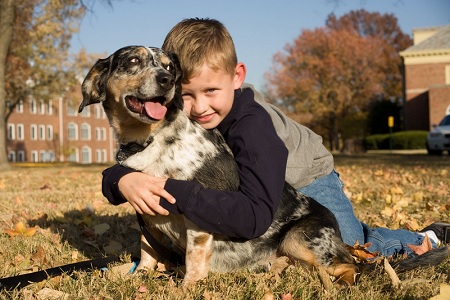
-
Do not look directly into its eyes;
-
Do not approach it quickly;
-
Do not stand directly in front of the dog;
-
Do not put your hands near its face or head;
-
Do not hug it;
-
Do not bend over it;
-
Do not pick it up.
What we should do instead, if we really want to “make friends,” is approach slowly, frequently looking away and keeping ourselves to the side of the dog. Let us make our intentions clear before making any movement, then slowly extend one hand in its direction while keeping a safe distance. Once it has finished sniffing us, we can gently stroke it on the back or sides of its body.
If, instead, we feel we can resist the temptation to “make friends,” we can simply limit ourselves to ignoring it. It will approach us out of curiosity as soon as it feels safer.
What to Do If a Dog Is About to Attack Us
If we are out on the street and a frightened or aggressive dog suddenly appears in front of us, we can behave as follows to avoid making it feel threatened and triggering its reaction:
-
Do not look it in the eyes;
-
Try to ignore it;
-
Keep your mouth closed, without baring your teeth;
-
Do not shout for any reason;
-
Stand still with your arms motionless at your sides;
-
Do not run under any circumstances, so as not to encourage the dog to chase us;
-
Do not throw anything at it or wave objects in its direction;
-
Do not turn your back on the dog, but try to remain sideways to it;
-
Do not pick up our dog or child, because it might interpret this gesture as an attempt to take away its future prey;
-
Try to move away slowly, walking sideways to the dog and keeping a safe distance from it.
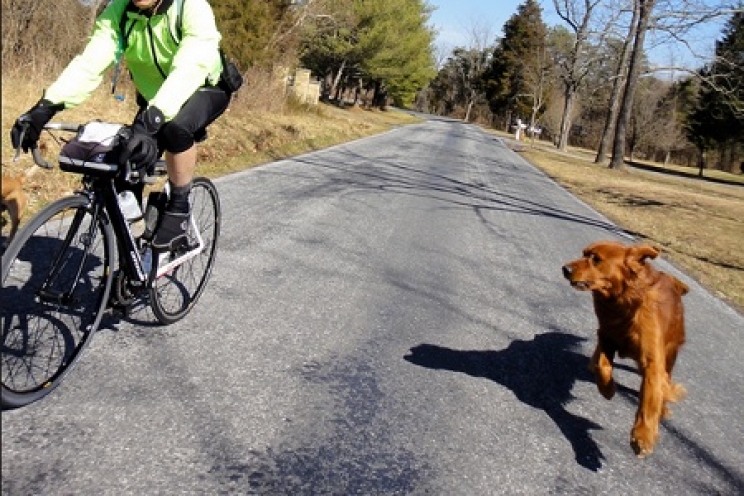
Some dogs are truly fixated on people who jog or ride bicycles. In these cases, they interpret the rapid movement as an attempt to escape, so they immediately pursue the new prey.
If we are cycling or running through the countryside and encounter one or more stray dogs, the first thing to do is avoid running away. The dog would catch up with us in an instant because it is much faster than we are.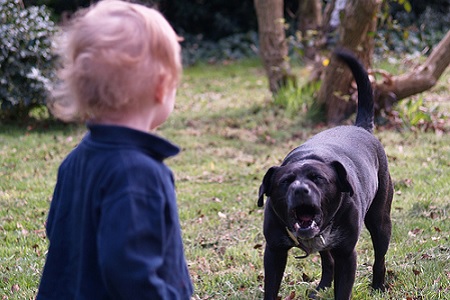
Instead, stop, get off the bicycle, and keep it between you and the dog. Ignore it, without looking it in the eyes, and proceed slowly, trying to remain calm. If we have a wooden stick or a stone with us, throw it away from ourselves and the dog, to encourage it to direct its predatory instinct toward the object.
Do not hit it for any reason. It would feel even more encouraged to fight us. Rather, if we have a stick, use it only to make the dog bite the object instead of our body.
And what if it is already too late and the dog has begun its attack? Do not try to run away or pull the hand, arm, or any other part of the body it is holding between its teeth. Protect the face and neck, the most delicate areas, using the arms, and try to appear harmless. Reacting with kicks, punches, and screams would only further encourage it to attack us.
Once we have managed to move slowly away from the dog or pack, immediately call someone who can intervene at the scene, because if we managed to get away unharmed, an elderly person, a child, or someone unable to defend themselves from the attack might pass through the same place after us.
The final precaution, naturally, is to avoid isolated places, especially if we are alone. Dogs tend to be less territorial and more intimidated in the presence of several people, so we should always go out in a group if we really want to go for a run or ride a bicycle through the countryside.