
One of the most frequent complaints owners make about their dogs concerns so-called “mounting.” You have organized a family dinner, but as soon as everyone settles onto the sofa, Fido clings with all his strength to Grandma’s leg and begins moving his pelvis rhythmically, as if he wanted to simulate sexual intercourse. Embarrassment is inevitable in these situations, because we all instinctively associate this behavior with an expression of clearly sexual intent. In reality, this is not always the case.
The meaning of mounting
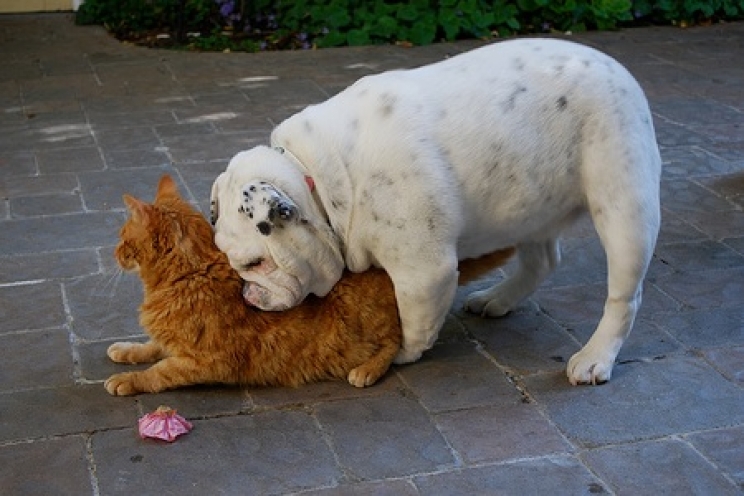
Let’s think about it carefully. “Inappropriate” mounting mainly targets our legs, cushions, blankets, and even dogs of the same sex or entirely different species. Who among us has never seen a female dog mounting a male dog? Funny images of dogs clinging to cats and other animals can even be found online.
Explaining all this as a sexual matter would be far too reductive. We are physiologically “programmed” to reproduce, so surely a dog is perfectly capable of understanding with whom it can mate and with whom it cannot.
So what are the reasons behind mounting?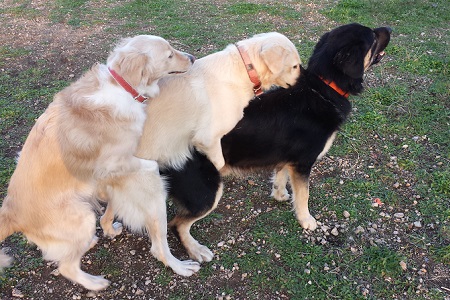
One of the most frequent reasons, especially in puppies and females, is excitement—not in the sexual sense, but rather as an adrenaline release. You return home after a day at work and start playing with your dog. Its happiness is indescribable, and its level of physical and mental arousal is through the roof. This is why some dogs may begin to “mount” their owner’s leg. In this particular situation, the dog is simply trying to lower its adrenaline levels, using us in effect as an outlet for the excess energy accumulated during play.
The same reaction may occur in a dog that is too anxious or stressed, mounting objects or people to relieve accumulated tension and stress. This is typical of crowded places, the introduction of new animals or children, or any situation that may stress the dog.
In some cases, the dog may “mount” its owner’s leg to receive attention. If every time it does so we tell it to stop, physically move it away, or laugh about it, the dog may interpret all these actions as attention that we are finally giving it. If we react by pushing it away or using more vigorous physical interaction, it might even believe that we are doing so to start a fun game.
According to other theories, some dogs may engage in so-called “hierarchical mounting.” In practice, the dog mounts another dog it considers inferior from a hierarchical perspective, precisely to impose its dominance. According to this theory, therefore, the dog mounts its owner’s leg because the owner has failed to assume the role of pack leader. This does not mean that we should start punishing or yelling at the dog to appear more authoritative in its eyes—in fact, quite the opposite. We should try to be a figure the dog can follow, respect, and listen to: a guide, not a cruel master to fear.
Let’s remember that dominance is not synonymous with aggression, as many owners mistakenly believe. Rather, a dog that tends to mount every person and animal it encounters may actually be very insecure.
What to do
First of all, we need to observe our dog carefully. Let’s try to understand which situations stimulate mounting the most, which inappropriate partners it prefers, and above all how we react each time it does so. This will first of all help us understand which of the reasons listed may be causing our dog’s mounting behavior.
The solutions vary depending on the origin of the “abnormal” behavior.
The only thing we can do whenever our dog mounts people, objects, or other animals is to interrupt it without scolding or punishing it for any reason. The dog would not understand why we are angry and could become confused or frightened.
Instead, whenever we catch it in the act, make a high-pitched sound by clapping our hands to distract it.
If it tries to mount our leg during play or when it is overly excited, ignore it and try to move away without looking at or touching it. It might interpret any gesture from us as attention, reinforcing its behavior.
Only once it has stopped can we reward it, for example by giving it one of its favorite toys.