
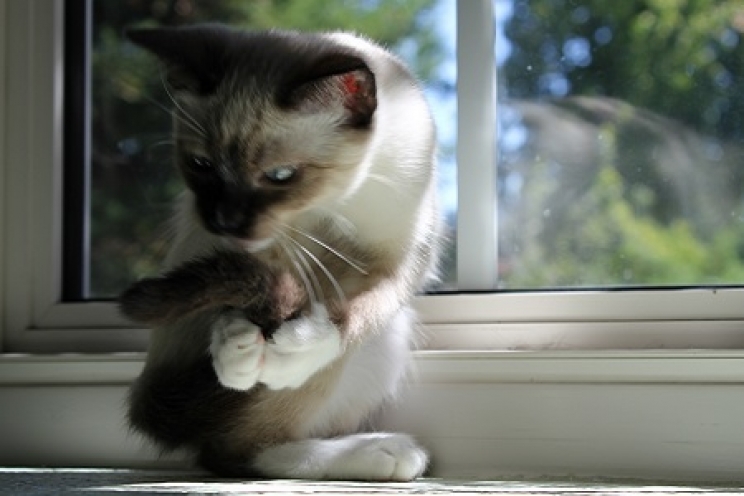
Our cats are increasingly prone to various behavioral disorders, which are both the cause and consequence of many physical and psychological problems. Unfortunately, not all owners are able to recognize these issues immediately, and veterinarians often fail to give them the importance they deserve.
What are behavioral disorders
This term encompasses a long series of changes in an animal’s behavior, which represent the direct consequence of emotional or physical distress. 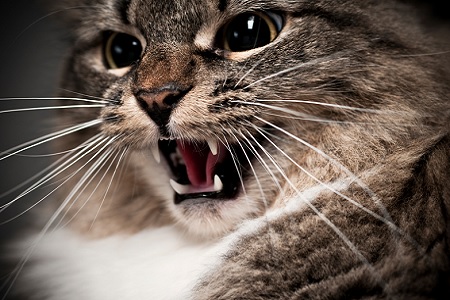
This is why a stressed, traumatized, or unhealthy animal channels its distress into its actions, displaying behaviors that differ from its usual ones.
This is exactly how a cat begins licking or pulling out its fur, causing wounds, ingesting objects it finds around the house, or even experiencing hallucinations.
Behavioral disorders are a problem that is often not given enough importance. Many owners minimize their cat’s altered behaviors, so over time they become increasingly intense and ingrained, making true recovery difficult.
Initially, in fact, the disorder appears only when the cat is going through a difficult moment. At this stage, it can be regarded not only as an outlet, but also as a clear request for help directed at the owner.
As time passes, the altered behavior becomes increasingly frequent, as if the cat had become dependent on it, so that it reacts by displaying it even in response to very mild stimuli.
What are the main compulsive disorders in cats?
The main compulsive disorders affecting cats include:
-
Excessive licking: cats spend a large part of the day grooming, meaning caring for their coat. For this reason, it is not easy to determine when careful grooming becomes a compulsive disorder. Unfortunately, however, this is one of the most common disorders and can generally be identified by assessing the time the cat spends licking itself. Normally, a healthy cat spends half of its waking time grooming. If this proportion is greater, there may be a skin problem, so a veterinarian should examine the cat. We can begin to speak of a compulsive disorder when the cat starts licking itself so intensely and for so long that it pulls out its fur, especially on the belly and inner thighs;
-
Self-trauma: many cats tend to respond to stressful stimuli by hurting themselves. They may bite a paw or another part of their body until it bleeds, sometimes directing their aggression toward other cats or their owner;
-
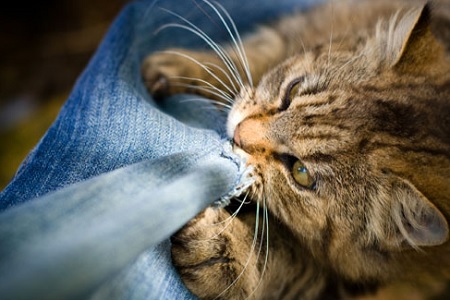
Wool sucking: this behavior is very common in kittens, which tend to compensate for the absence of their mother by sucking wool and other fabrics just as they would suck their mother’s nipples while nursing. The problem arises when they continue doing so as adults, sucking anything within reach. This behavior is a form of escape from reality, allowing the cat to immerse itself in the reassuring atmosphere of its childhood;
-
Running in circles: a cat may begin spinning around in circles, in a movement similar to that of a dog chasing its tail. This too is a compulsive behavior, which the cat uses to channel its negative energy into a physical action;
-
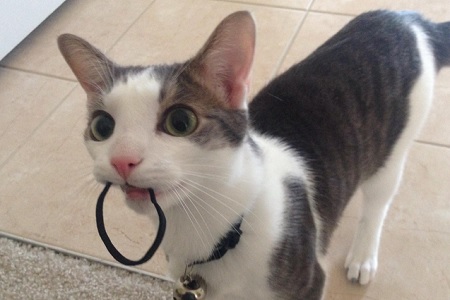
Pica: this behavioral disorder can become very dangerous to the cat’s health. Pica consists of the compulsive ingestion of inedible objects, such as strings, ribbons, toys, or buttons. If a cat ingests foreign bodies, it may face serious risks;
-
Vocalizations: a cat may begin expressing its distress by meowing intensely for no apparent reason;
-
Hallucinations: some cats may appear to be hallucinating, tending to flee from imaginary dangers or stare and hiss at empty space;
-
Feline hyperesthesia: this is a very particular behavioral disorder whose causes are still debated in veterinary medicine. This condition, also called rolling skin, manifests as sudden rippling of the fur, uncontrolled fleeing, intense vocalizations, and violent licking of certain parts of the body.
These are only some of the behavioral disorders that may occur in cats.
What to do when a behavioral disorder is present?
 The first thing to do if your cat suffers from behavioral disorders is not to encourage it. Try to avoid petting it or giving it too much attention when it displays the obsessive behavior. This will reinforce the positive effect generated in the animal’s mind while it performs the altered action.
At the same time, scolding it will accomplish absolutely nothing. On the contrary, you would only increase its distress.
Instead, you should distract it whenever you notice the first signs. Play with it or, if possible, let it go out onto the balcony or terrace, where it can be distracted by insects and birds.
One practical suggestion is to fill its spaces with interactive toys, which it can use with or without you. Make sure it always has visual access to a window, so it can observe the interesting attractions outside.
Once you have followed these precautions, you should address the underlying cause of the problem.
If the cat is stressed because it has a physical problem, your veterinarian can identify and treat it. If the problem concerns several animals living together in the same home, you should ensure that your cat has individual spaces in which to eat and sleep.
The help of a good behaviorist may be necessary in the most severe and entrenched cases, so ask your veterinarian for advice.