
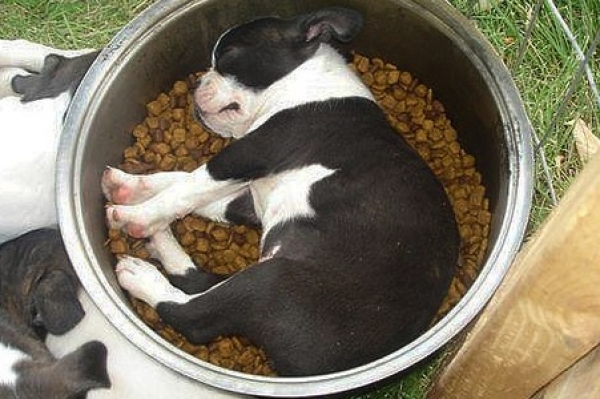
If you want your puppy to grow up healthy and strong, you need to provide a diet suited to its needs and carefully support it throughout its growth. But what is the right diet for a puppy?
When deciding to adopt a puppy, you must be aware of the commitment and dedication required, in return for its love and affection. One of the main aspects to consider is nutrition.
Weaning
Until at least 4 weeks of age, the puppy needs its mother’s milk in order to develop strong and resilient immune defences.
Before this time, moreover, its digestive system is not yet able to properly digest foods typical of the human diet or those intended for slightly older dogs. The puppy’s reaction to these foods could put its health at risk. 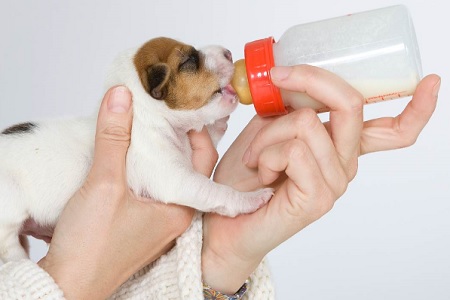
Persistent diarrhoea, which might be less dangerous for an adult dog, can expose a puppy to the risk of dehydration and even death.
The transition from mother’s milk to puppy food is called “weaning”, just as it is for babies starting their first purées and baby foods. It is always a delicate process that should not be taken lightly.
Weaning normally begins at around six weeks of age, becoming fully complete after the eighth or ninth week.
If you have found a puppy that has not yet been weaned, or if the puppy was born at home, you will need to guide it through the weaning process.
It is important, especially during the first few days, to give only liquid or semi-liquid food. Milk teeth begin to emerge during the second or third week of life and are completed only around 55 days. Before this time, puppies will not be able to chew solid food.
Choose a wet food specifically for puppies and mix it with warm water until it reaches the consistency of a purée. The puppy will get used to food other than its mother’s milk, but gradually.
Make sure it eats 5–6 times a day, with small portions divided throughout the day.
As the puppy approaches six weeks of age, gradually reduce the proportion of water, increasing the proportion of wet food.
The rule to always remember during weaning is never to give cow’s milk to the puppy. It is not equipped to digest any milk other than its mother’s, so it could develop severe diarrhoea.
Only if the puppy is not yet 4 weeks old and has been separated from its mother might supplementation with special puppy formula be necessary.
The first meal
Once the puppy is six weeks old, it will already have all its teeth ready to chew solid food. As a rule, when a puppy is adopted, breeders or associations prefer not to separate it from its mother before this time, to ensure that it has developed its immune defences and learned the first lessons in socialisation.
Try not to disrupt the new arrival’s diet. Ask the people who cared for the puppy before you what kind of wet and solid food they offered it, and try to continue with the same food.
Both types of food must be “complete”. This means they must contain and provide all the essential nutrients needed for the puppy to grow healthy and strong.
They must also be easily digestible, so as not to cause indigestion or diarrhoea in the puppy.
Puppy food, usually sold under the label “puppy”, has a higher calorie content, little salt and many nutrients. Puppies grow very quickly and need many substances that will be rapidly used by the body in order to become strong and robust.
Always leave a bowl of fresh, clean water available, but add water to the food only at mealtimes. This is more an educational than a nutritional recommendation, but it can still be useful at this stage.
A very important piece of advice is to avoid relying on improvised quantities, homemade diets or foods that are not specifically intended for puppies and are of poor quality.
The puppy may initially react with gastrointestinal problems, but more serious consequences could appear later, such as stopping growth or developing skeletal deformities and disorders affecting the whole body.
The ideal quantity is usually indicated on food packaging, often with a convenient measuring scoop. Normally, a puppy should eat around 5–6 times a day, with the portion decreasing as it grows. In any case, ask your vet for advice, as they can assess any changes to the daily portion according to the puppy’s growth.
Remember that the feeding routine you establish at this time will affect the puppy’s future health, so do not compromise on quality
Food that costs very little can never contain the same ingredients as medium- and high-priced food. The meats, additives and supplements contained in high-quality food have a cost, so if you want your puppy to grow properly, do not sacrifice its health.