
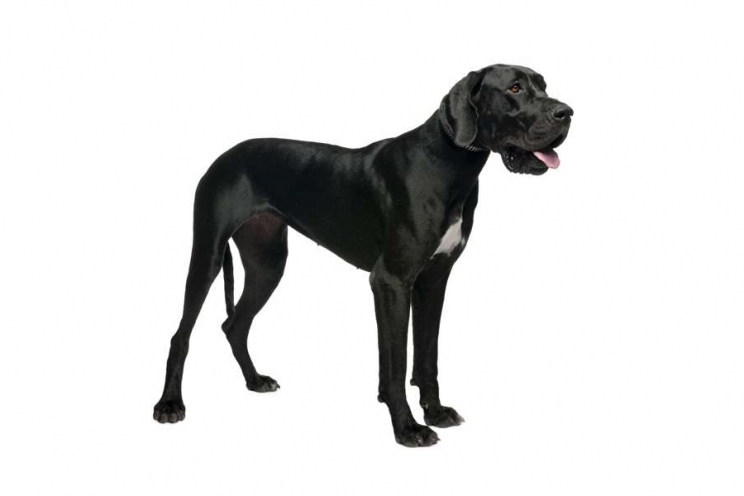
The Great Dane is considered the Apollo of dogs. Protective, affectionate and balanced, it enjoys companionship but may be reserved with strangers. It loves children but may become overly exuberant during play.
Temperament
Protective, affectionate and balanced, it enjoys companionship but may be reserved with strangers. It loves children but may become overly exuberant during play. It is not territorial but nevertheless has a strong protective instinct toward its family, making it an excellent guard dog. Given its imposing size, it requires training from a young age. The ideal temperament is suited to family life: self-confident yet responsive to commands, free from aggression but neither shy nor fearful.
Appearance
Large, powerful yet harmonious and elegant build. Sexual dimorphism is clearly evident, with females smaller than males. The head is proportionate and expressive. The muzzle is deep and rectangular. The lips are abundant but not excessively heavy or pendulous; the pigmentation is dark. The profile of the nasal bridge must be straight, never concave, convex or aquiline. The eyes are lively, medium-sized, not too far apart and almond-shaped, with close-fitting eyelids. The color is as dark as possible. The ears are naturally drooping, set high, and must not fall too flat or too far from the head. The neck is long, dry, muscular, developed at the base and slightly tapered where it joins the head, with an arched profile. It is carried high and slightly inclined forward. Excess skin or a dewlap is considered a fault. The male’s trunk must fit into a square, while in females it may be slightly rectangular. The body has a broad, muscular, slightly sloping croup. The sacrum and tail merge imperceptibly. The chest is broad and deep, with a pronounced but not excessively prominent forechest. The abdomen is well tucked up, forming a graceful lower curve continuous with the ribcage. The tail must reach the hock but must not be too long, and must taper progressively toward the tip. At rest it hangs naturally; in movement it curves slightly like a sabre but must never be carried above the topline. Hooked or curled tails, or tails with long hair, are highly undesirable. All four limbs must be correctly aligned. The forelegs are only slightly inclined forward when viewed from the side. The hindquarters are characterized by a long, broad and muscular thigh. The feet, both front and rear, are round, with strongly arched, tightly closed toes (cat feet) and short, dark nails. The coat is very short, dense and glossy, and never has an undercoat.
The Great Dane standard recognizes five colors:
Fawn Great Dane
Brindle Great Dane
Black Great Dane
Blue Great Dane
Harlequin Great Dane
The standard does not provide for other colors, although certain “false colors” are recognized and result in exclusion from registration in the Stud Book, such as porcelain Great Danes, Isabella-colored fawn Great Danes (washed-out fawn), white markings where they are not permitted, etc. To prevent dogs with these “faults,” since 1947 matings have been regulated, and the different varieties may be bred together only according to precise schemes. Another coat considered a “disqualifying fault” is Merle (or gray-based Harlequin), whose occurrence cannot be prevented through selection. Currently, many countries are pressing for this variety to be included in the breed standard as well.
Historical background
It is believed that the ancestor of today’s Great Dane was introduced to Europe in the 6th century AD by Assyrian warriors (the Alaunt), who used these powerful mastiffs as war dogs. In the Middle Ages, their aptitude for hunting wild boar (as well as deer and bear) became evident. It is hypothesized that over time these dogs were crossed with sighthounds to increase and improve their agility, speed and endurance during hunts. In 1878, a small group of German breeders catalogued, under the term German Mastiff (Detusche dogge), several groups of dogs with similar characteristics that until then had been distinguished according to coat color and size. In 1880, an initial Great Dane standard was drawn up and revised over the years until the current version was established in 2001, when the new provision prohibiting ear cropping came into force.
Lifestyle
It is not a rustic dog and generally needs domestic comforts, adapting easily even to relatively confined environments in relation to its size.
Diseases
Cardiomyopathies
Hip dysplasia
Eye disorders (entropion; ectropion; third-eyelid laceration)
Gastric torsion
Interesting facts
The Great Dane is considered the Apollo of dogs. It is also mistakenly called Danish, but the history of this breed has nothing to do with that country.
Gait
It must be fluid, slightly elastic and have an extended stride. The limbs always move parallel to one another when viewed from both the front and the rear. Pacing must never be present.
Ideal owner
A calm and balanced person who is authoritative and aware of the responsibilities involved in managing a giant-breed dog. They must be willing to spend a great deal of time with their dog, also considering that the Great Dane is not suitable for someone who wants a dog to leave in the garden to guard, given its need for contact with family members.