
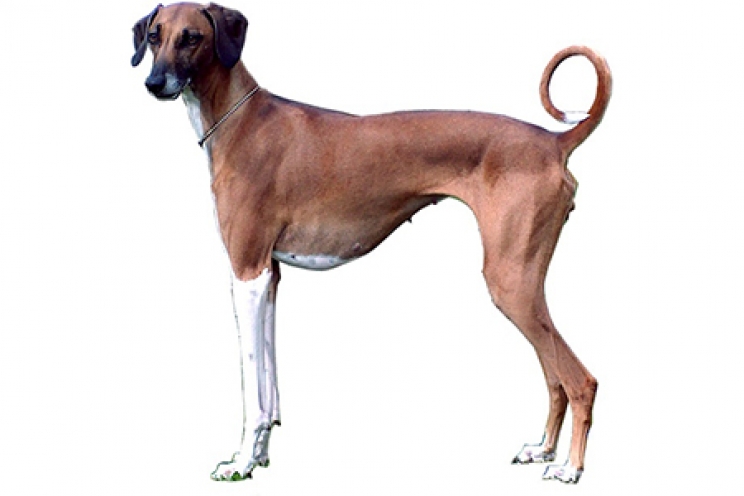
A very strong dog, the Azawakh is not affected by heat at all. Accustomed to the desert climate, it has many virtues, but before showing itself completely it is necessary to earn its complete trust, which will require some time, work, and patience.
Temperament
Attentive, quick, aloof, and very reserved with people it does not know, it can nevertheless be sweet and affectionate with those willing to accept it. Very timid temperament.
Appearance
Large and imposing, it does not inspire fear; rather, it resembles a large puppy seeking love, and its eyes seem to communicate. It is a distinctive dog that requires a special owner. Almond-shaped, rather large eyes. Their color harmonizes with the coat color. The eyelids are pigmented. Ears set fairly high. They are always drooping and flat, rather broad at the base near the skull. Their shape is triangular, with the tip slightly rounded. Their base rises when the dog is attentive. The skull is almost flat and rather elongated. The width of the skull must be absolutely less than half the length of the head. The nose color harmonizes with the coat color. The lips are fine and tight. The cheeks are flat. The neck is well carried, long, thin, and muscular, and slightly arched.The topline is almost straight, horizontal, or rising toward the hips. The trunk is not very broad but must provide enough room for the heart in the sternal region of the chest. The chest is not very broad. The ribs are visible, slightly curved downward and evenly toward the sternum. The chest is keel-shaped, consisting of lean muscles and visible bones. The sternum is well defined and rises high toward the loin without interruption. The tail is low-set, thin, lean, and tapering. It should reach the hock. It is covered with the same type of hair as the body. It is raised when the dog is excited and may be carried in a sickle, ring, or saber shape above the topline.The forelegs are viewed as a whole: long, thin, and almost entirely vertical. The shoulders are lean and muscular, slightly oblique when viewed in profile. The scapulohumeral angle is very open (approximately 130 °). Dewclaws may or may not be removed. The feet are rounded, with thin, tightly closed toes. The pads may be pigmented. The hindquarters are long and lean, with perfectly vertical legs. The thighs are prominent with lean musculature. The coat is short and fine, down to the belly. Color and markings are mixed. Coat: short and smooth. This dog resembles a thoroughbred Arabian horse. The Azawakh’s coat is thin and very short. Various shades of sandy color, including light fawn and blue fawn, with or without white markings, characterize the main colors. Brindle is also permitted in this sighthound breed. Many Azawakhs have white on their feet; sometimes white markings on the forefeet may reach the chest and neck. This variety is permitted by the American standard but not accepted by the FCI standard.
Historical background
Traditionally, the Azawakh is the companion of the Tuareg nomads in the sub-Sahelian desert. The breed is known as “Aidi n’Ailluli,” meaning “the noble dogs of the Free People.” The Azawakh is considered a full member of the family, entrusted with safeguarding the camp and herd from intruders. Agile and possessing great endurance, it also hunts hares, antelopes, and wild boar to provide meat for its family. It appeared in America in 1980.
Lifestyle
It loves open spaces and needs to run to release its energy and stay fit. It lives well with a family but needs respect; it is not a toy.
Diseases
It suffers from otitis and Progressive Retinal Atrophy (PRA).In general, it is a healthy dog. Like most sighthounds, it is sensitive to anesthetics; it may also develop allergies.
Interesting facts
It does not like the rainy season and prefers a hot, dry climate. It can tolerate extreme heat. The Azawakh is a large dog that can withstand temperatures of up to 100 degrees Fahrenheit.
The Azawakh is a sighthound from West Africa, originating in Burkina Faso, Mali, and Niger.
Gait
The Azawakh’s movement is agile and light, particularly graceful and elastic. When walking or trotting, it appears to float effortlessly over the ground. At the trot, the forefoot should not extend beyond the tip of the nose. Movement is an essential characteristic of the breed.
Ideal owner
Anyone willing to understand the Azawakh must be aware of its lifestyle. To survive in dangerous desert conditions, vigilance and instinctive distrust were necessary for this breed of dog.
The Alaskan Malamute is a large dog with a courageous and friendly spirit. Friendly with other animals, it can be a good life companion, always wise and caring.