
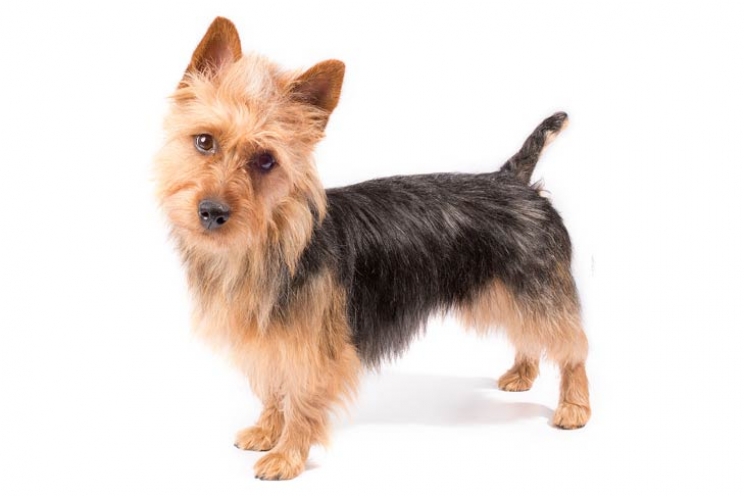
The Australian Terrier is a small, robust, and muscular dog. Playful and naturally inclined to be the center of attention, it knows how to be a point of reference within the family. It loves children but also knows how to command respect.
Temperament
The Australian Terrier is a working dog, balanced and very loyal. Perfect as a companion dog because of its playfulness and sweetness, it can also defend the territory in which it lives and is an excellent life companion.
Appearance
The Australian Terrier has harmonious proportions, although it is longer than it is wide. Its Terrier character can be seen in its substantial musculature and coat, with a well-defined collar extending to the chest. The head has a long, flat, moderately long skull. The stop is slight but clearly defined. The muzzle is powerful and strong, with a length equal to that of the skull. The nose is black and extends along the nasal bridge. The lips are tight with a clean outline. The jaws are strong and hard, with broad teeth and a scissor bite. The eyes are small, oval, and dark brown. The ears are small and erect, without long hair, and very sensitive. The neck is of good length and slightly arched. The body is long in proportion to height. It has a level back and strong loin. The chest is moderately deep, with well-sprung ribs. The breast is well developed. The tail is docked, set high, and carried well. The forelegs have good bone, with strong pasterns and no inclination. The hind legs are moderately long and broad. They have strong, well-muscled thighs, well-directed knees, and well-angulated hocks. The feet are small, round, and compact, with strong pads and tightly joined, slightly arched toes. The Australian Terrier’s coat is harsh, straight, and about 6 cm long. The undercoat, by contrast, is soft and very dense. The muzzle and lower part of the legs must not have long hair. The Australian Terrier’s coat may be blue, steel blue, or gray-blue. Shading on the head is accepted, but black shading is undesirable. Sandy or red without any dark shading. A lighter topknot is accepted. Any other color, but without white markings on the chest or feet.
Historical background
The Australian Terrier is a dog with features similar to the Yorkshire Terrier, but it originated in Australia thanks to the Countess of Stradbroke, who, being fond of this breed, established its basic characteristics. The first breed club dates back to 1887, and in 1933 the breed was entered in the English Stud Book. At the beginning of the 19th century, the breed was introduced to the United States and then spread throughout Europe. The breed standard was approved in Australia in 1961.
Lifestyle
The Australian Terrier has a dynamic and active lifestyle. It enjoys playing outdoors but can also adapt to apartment living.
Diseases
It suffers from otitis and Progressive Retinal Atrophy (PRA).
Interesting facts
The Australian Terrier is good with children but cannot tolerate being constantly teased. It barks easily and is an excellent mouse hunter.
Gait
The Australian Terrier’s gait is free, straightforward, and vigorous. The hind legs drive the forelegs, and the legs move forward parallel to one another without being very close together.
Ideal owner
The ideal owner of the Australian Terrier is consistent in training, not overly strict, and affectionate, able to make the dog feel part of the family.
The Alaskan Malamute is a large dog with a courageous and friendly spirit. Friendly with other animals, it can be a good life companion, always wise and caring.