

When we take our animals to the vet, we may quite often be asked to provide a stool sample for analysis. But what is a stool test for, and how is a sample collected?
What is a stool test for?
The stools of dogs and cats, as well as those of humans, may cause some discomfort, but they are still a product of the body. For this reason, analysing them makes it possible to assess certain important aspects of the body, especially in cases of disorders or disease.
For example, a dog or cat may experience intense vomiting and diarrhoea. In that case, the veterinarian may obtain a great deal of information by analysing the stools, thereby coming as close as possible to a diagnosis.
To better understand what the veterinarian does with our animal’s stool, let’s look at the tests that can be performed on the sample.
The conditions that can mainly be assessed through stool testing include:
-
Presence of intestinal parasites;
-
Presence of bacteria;
-
Presence of white blood cells, which indicate inflammation;
-
Traces of blood in the stool.
After taking a small portion of stool, especially if it is soft or watery, the veterinarian can smear it on a laboratory slide “fresh” or after treating it, in order to examine it under a microscope.
By magnifying the stool, it is possible to assess the presence of parasites. The most common ones in our animals’ intestines are roundworms, strongyles, tapeworms and Giardia. Dogs and cats harbouring these parasites normally develop so-called “worm infestations”, with gastrointestinal symptoms such as vomiting and diarrhoea.
How to collect stool
If you ask your veterinarian for an anecdote about stool samples brought in by pet owners, they will certainly have some amusing stories to tell.
In fact, when it comes to collecting and transporting their animal’s stool, owners usually give free rein to their imagination. The veterinarian may therefore receive several kilos of stool or just a tiny piece. Others do not take care to transport and store it properly, so they arrive carrying plastic bags and cups containing days-old stool or stool literally coated in cat litter.
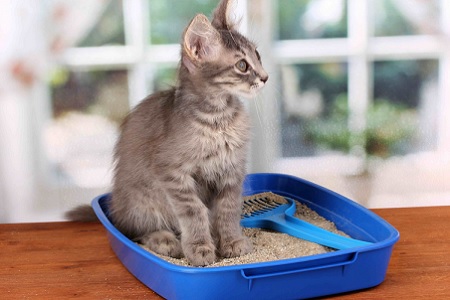 In reality, collecting a stool sample is very simple. You do not need to do anything to your animal; just wait until it needs to defecate. Be ready and take a pair of latex gloves with you during the walk.
Position yourself beside the cat’s litter tray or near your dog while it is about to defecate.
Ideally, you should collect it immediately, especially in the case of diarrhoea, to prevent it from becoming contaminated by contact with the ground or litter. However, it is still fine if you cannot manage this, provided that you pick it up from the ground before the cat buries it in the litter or it becomes mixed with another animal’s stool.
Put on the latex gloves and pick up the stool. If it is solid and compact, you could collect some directly with your hands, but otherwise you could use the usual scoop used to clean the cat’s litter tray or a plastic spoon.
As for the sample quantity, you do not need a large amount of stool to perform a stool examination. A piece measuring approximately 2–3 centimetres is enough.
At this point, place the sample in a special stool container, which can be purchased inexpensively at a pharmacy. It is important that the sample be sterile, to prevent bacteria from contaminating it and altering the results.
A container for urine testing will also work perfectly well, provided it has never been opened.
How to store and transport the stool sample
The sample should be delivered the same day, or at most within 24 hours. If you cannot take it to the veterinarian immediately, place it in the refrigerator or otherwise in a cool, dry place, so that it does not deteriorate.
During the journey to the veterinary clinic, if you do not live far away there is no need to do anything else, but if the journey will take more than 10 minutes, you could use a small cool bag. Pharmacies often sell special small, airtight pouches designed for the short-term transport of medicines.
When you arrive at the veterinarian’s office, try not to keep the jar in your hand or bag for long. Instead, knock on the clinic door and hand it over without waiting in line. You can then wait for your turn for the examination.