
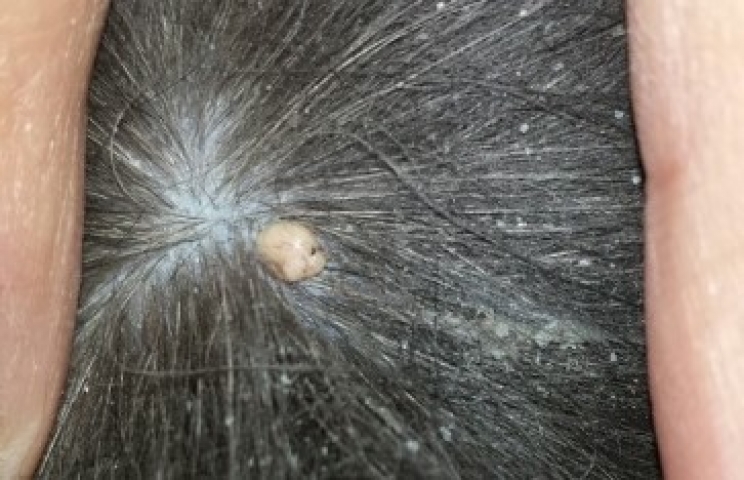
You are stroking your four-legged friend when, suddenly, you notice a growth on its skin that was not there until a few days ago. Inevitably, your mind begins to consider the most serious and irreversible possibilities, but in most cases it may simply be a raised area of skin, perhaps related to age. This is why it is important to understand how to distinguish the various growths on a dog’s or cat’s skin, and what to do in these cases.
Raised Areas of Skin
One of the distinctive signs of old age in our pets is the appearance of one or more raised areas of skin, similar to the typical skin tags that appear on our skin.
They appear as rounded or slightly elongated accumulations of skin, with a diameter of a few millimetres. They generally have the same colour as the surrounding skin and show no particular abnormalities.
They are mostly benign tumours and therefore harmless in most cases. For this reason, your veterinarian will most likely advise against removing them, except in particular circumstances.
The dog or cat may, in fact, scratch vigorously, accidentally scraping the growth with its claws, which may bleed or become infected. In these cases, it is important to see the veterinarian as soon as possible, so that they can decide whether to treat the wound or completely remove the raised area of skin.
Dermoid Cysts
The skin of dogs and cats can also develop so-called cysts, meaning subcutaneous accumulations of various materials.
In humans, fatty cysts are particularly common. They appear as one or more hard “lumps” that can be distinguished from ordinary skin tags because they seem almost like a bump running along the skin.
In animals, however, dermoid cysts are more common, particularly in dogs. They are benign tumours containing a mixture of substances that form part of the skin and normally undergo regular turnover. These include hair fragments, shed skin, sebum and other debris, which gradually accumulate beneath the skin, growing larger inside these structures, which are well delimited from the surrounding areas.
The cause of this problem appears to be linked to a congenital defect that the animal has had since birth. Dermoid cysts mainly develop on the animal’s back, tail or head.
They are normally harmless, but they can rupture, releasing their contents beneath the skin, which may develop serious infections.
Cutaneous Mastocytoma
Cutaneous mastocytoma is a common tumour in dogs and rare in cats. It originates from certain cells normally found in the body, called mast cells, which act in inflammation and even in allergic reactions.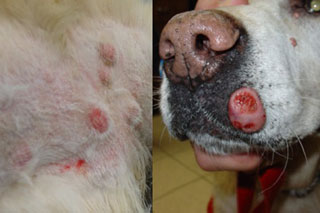
Cutaneous mastocytomas can appear anywhere on the animal’s skin, particularly on the back and legs, but the same type of tumour may also occur in some internal organs, such as the lungs or intestines. In dogs, the cutaneous form is more common, whereas in cats the form affecting the internal organs may also occur at the same time.
The animals most at risk seem to be adults or seniors. Regarding breed, Boxer, Pug, Bull Terrier, Shar-pei, Golden Retriever and Labrador dogs are more predisposed to cutaneous mastocytoma.
Cutaneous mastocytoma appears differently depending on many factors. It may appear as a nodule or growth, rounded or irregular in shape, alone or in groups, bulky or flat, covered with hair or not.
To determine how dangerous the tumour is, all examinations indicated by the veterinarian are essential. Generally, the less aggressive ones are solitary and grow slowly, unlike the more dangerous ones, which grow rapidly, often in groups, have irregular shapes and may undergo heavy bleeding.
The danger of this tumour is mainly linked to its ability to metastasise, meaning “copies” of tumour cells in other areas of the body, nearer to or farther from where they first appeared.
Cutaneous Papilloma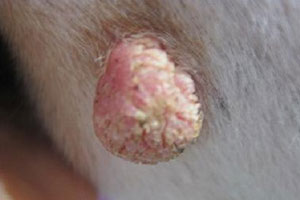
The cutaneous papilloma is a benign tumour that can appear mainly in young dogs, but also in older cats or cats affected by Feline Leukemia Virus (FeLV).
It is caused by a virus that leads to the formation of variable growths. In dogs, they look very similar to warts: light pink, cauliflower-shaped, with a rough, grainy surface. In cats, they may be either this type or flat.
Papilloma may occur in a cutaneous form, anywhere on the body, or in an oral or ocular form.
Cutaneous papilloma is a benign tumour, but in some cases it may transform into a very dangerous malignant tumour, such as squamous cell carcinoma.
Squamous Cell Carcinoma
This is a highly aggressive malignant skin tumour that can affect both dogs and cats.
Squamous cell carcinoma appears to be caused by UV rays. The areas most affected are therefore those most exposed to sunlight, such as the nose, ears and eyelids, and it occurs mainly in animals with white, short hair.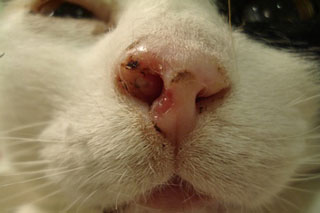
There are two variants. The first involves the appearance of wounds of varying extent on the animal’s body, which tend to bleed increasingly until they form actual ulcers. The second form appears as irregular growths.
This is a very dangerous and potentially fatal tumour, but timely diagnosis can extend or even save the animal’s life.
To prevent it, it is important to avoid direct exposure to sunlight, especially during the hottest hours, possibly using a good sunscreen for animals, applied generously to the ears, nose and most exposed areas.
Let us remember that the first thing to do when strange nodules or growths appear on our friend’s body is certainly not to panic. It does not help us and also puts the animal in an agitated state.
Instead, we should contact our veterinarian as soon as possible. They can carefully examine the growth, also using any necessary diagnostic tests. The most common is fine-needle aspiration, which allows the veterinarian to determine whether there are unwanted cells or other suspicious material at the affected site.
Once the nature of the growth has been established, the veterinarian will know what to recommend and how to proceed. Timely diagnosis and appropriate treatment are the only fundamental tools currently available in the fight against tumours.