

Our four-legged friends are ideal targets for parasites found indoors and outdoors. While dogs are more frequently attacked by ticks, cats are more often infested with fleas, especially if they live indoors but can access balconies, gardens and terraces. What not everyone knows, however, is that these parasites can cause a very troublesome problem in our dogs and cats, involving severe itching: Flea Allergy Dermatitis (FAD). Here is what it is, the symptoms it causes and how it is treated.
What are fleas?
Fleas are tiny parasites that quite frequently infest our four-legged friends. In most cases, especially in Italy, we are talking about Ctenocephalides felis, also known as the cat flea. In reality, despite its name, this type of flea does not have a strong preference for felines. On the contrary, it easily infests other mammals too, including dogs and humans.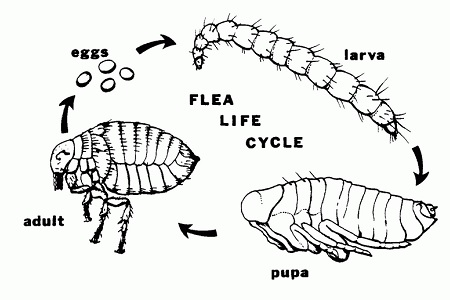
But what do fleas look like? These parasites are really small and have two distinctive features.
The first is a kind of mouth, whose purpose is to pierce the skin and suck blood. The second concerns their legs, which can move in such a way as to make remarkable jumps.
The life cycle of fleas consists of four stages: eggs, larva, pupa and adult. Understanding this is very important for achieving effective prevention.
After finishing a blood meal from its unfortunate host, the female lays up to 20 eggs every day directly on the body of the infested animal, human or even bird. Naturally, the eggs are not attached to the body, but tend to fall off, spreading throughout the places most frequented by the animal.
These eggs hatch within 2-14 days, giving rise to larvae, which cannot yet see, so they remain still in the same place on the animal or in the home, feeding only on adult flea feces and flakes of skin or hair.
Larvae may also fall from the animal or emerge from eggs already present in the environment, so we mainly find them in the most hidden places, such as floor gaps, carpets, beds and cat litter boxes.
 After several weeks, the larva produces a cocoon around its body, transforming into the pupa and beginning a true metamorphosis, which can last up to two weeks. They then break out of the cocoon and emerge as adults as soon as they sense the presence of a potential “prey”.
Adult fleas normally develop in anticipation of summer or autumn, but if the climate allows it, they can last all year round. Think, for example, of the warmth from radiators and fireplaces that we enjoy so much in winter.
Fleas like it too, so if there are still eggs or larvae in the home that have not been eliminated, they can complete their life cycle thanks to the warmth of our house.
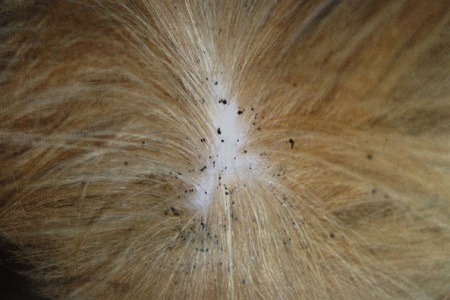
The presence of fleas is not always easy to observe. However, we can often notice tiny black specks among the animal’s fur or in the home, which are none other than flea feces. Where there are feces, there will certainly also be fleas, so all that remains is to arm ourselves with patience and start eliminating them.
The causes of Flea Allergy Dermatitis
Let us start from the premise that every time a flea decides to bite our cat, it causes fairly intense itching and pain, especially in the period following the bite. But the negative effects triggered by fleas also include:
-
They suck blood, up to 14-15 mL per day, weakening the animal to the point of anemia, that is, a reduction in red blood cells;
-
By biting, they create a painful wound on the skin;
-
The wound itches, so the animal may scratch until it creates actual skin lesions, which may even become infected;
-
If the animal is allergic, it may experience additional reactions, including particularly intense itching as well as more serious symptoms, mainly caused by scratching, but above all Flea Allergy Dermatitis;
-
Some fleas can transmit infections if they harbor another parasite inside them, such as the tapeworm Dipylidium caninum, as well as bacteria such as Bartonella.
In the specific case of FAD, therefore, we are talking about a problem of allergic origin, which appears only in animals that are sensitive to certain substances present in flea saliva. As with all other allergies, FAD is also caused by an “error” of the immune system, which recognizes flea saliva as a danger to the body. Once it comes into contact with the animal’s blood, it is literally bombarded by numerous defensive substances produced by our immune system, which try to destroy it while simultaneously damaging everything around it.
The reason why some animals suffer more from a flea bite is not yet clear, but certainly if the dog or cat already has a skin problem, this will be aggravated by the parasite’s attack.
Furthermore, it seems that FAD affects young animals much more, particularly those between 3 and 5 years of age.
Symptoms of FAD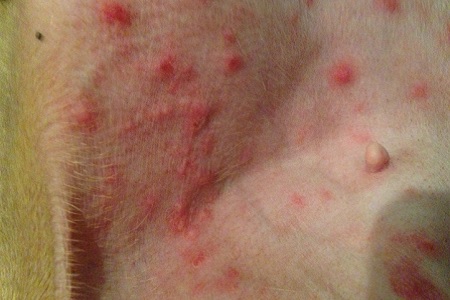
In allergic animals, the bite triggers severe inflammation localized in the area of the puncture, which may lead to various typical symptoms of Flea Allergy Dermatitis, such as:
-
Severe itching
-
Hair loss
-
Reddening of the skin
-
Bleeding wounds, including wounds with pus
-
Scabs
-
Black, rough and greasy skin
The most affected parts of the body are mainly the back, the base of the tail, the back of the thighs, the abdomen, the flanks and the animal’s neck.
The intensity of the symptoms varies depending on the severity of the animal’s allergic reaction, but above all on how much the dog or cat can scratch the skin, causing wounds.
What to do
First of all, we must eliminate the underlying problem by eradicating fleas at every stage of their life cycle, not only on the animal but also in the environment where it lives.
Disinfect all the places where the dog or cat lives with specific products or using bleach, without overdoing it, and especially when our animal is not nearby. Remember to disinfect kennels, beds, blankets, carpets and even our sheets if the dog or cat sleeps in our bed. Carpets, in particular, are a problem, especially if they are very thick or woven, so we should try to do without them.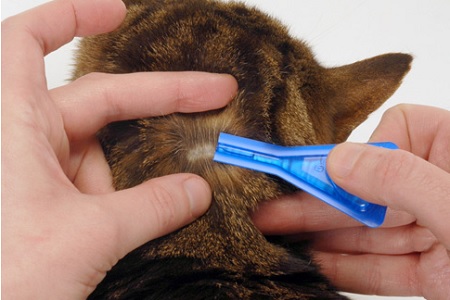
Of course, we must treat the dog or cat as well, asking our veterinarian for advice. If there is a flea infestation despite regular antiparasitic treatments, it means that the product is not suitable for our case. Let us make sure to purchase an antiparasitic product that can also eliminate immature flea stages and not only adults.
The treatment should be repeated for several cycles, according to the veterinarian’s advice, even when the ideal flea season has ended.
There are also specific tablet products for eliminating fleas and simultaneously preventing new infestations, especially those based on spinosad, which are very effective in cases of Flea Allergy Dermatitis.
The veterinarian may also prescribe products to apply to the fur, such as specific lotions, ointments or shampoos. Corticosteroid and antibiotic treatments may be necessary only in the most serious cases or when infected lesions are present. If the animal continues scratching incessantly, it may prevent the wounds from healing, so it may be useful to use an Elizabethan collar or a more comfortable post-operative body suit made of hypoallergenic fabric.