
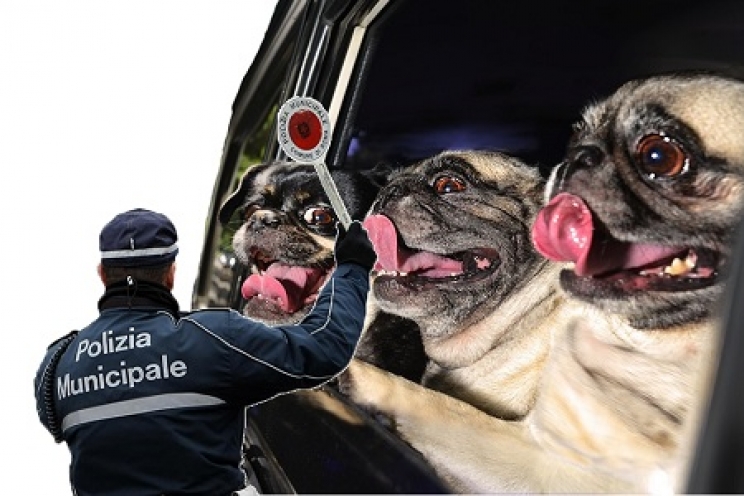
How many of us, faced with the need to travel by car with Fido, have found ourselves wondering what the law says about transporting animals? After asking ourselves this question, we often put off checking, either because we forget or because we simply do not know where to look. Now, however, there will be no more excuses. Let us look clearly and simply at how we should travel by car with a dog or cat.
Those who do not live with an animal probably do not consider the issue. Indeed, they might often point the finger at someone seeing Fido sitting freely beside the driver’s seat. What is not always taken into consideration is that transporting an animal by car, while convenient in many cases, can also become a necessity in others.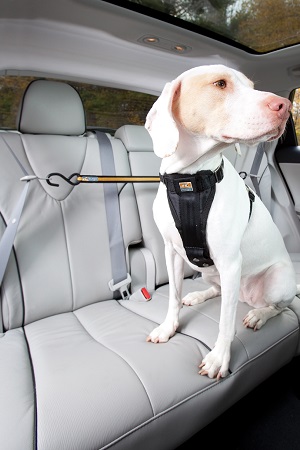
Think, for example, of a visit to the vet. Reaching a clinic in another town, or simply far from home, inevitably requires a ride by car. But that is not all. Holidays and short family trips, brief journeys, appointments with the groomer and, why not, even a walk in the countryside are just some situations in which it may be necessary to take a dog or cat in the car.
In all these cases, the fundamental principle we must consider is that the safety of ourselves, the animal and everyone else on the road must never be put at risk. That said, let us see what the law says.
The subject is addressed by Article 169 of the “New Highway Code”, concerning the “Transport of people, animals and objects on motor vehicles”. According to the legislation, “(…) the transport of more than one domestic animal is prohibited, as is transporting them in conditions that constitute an impediment or danger to driving. The transport of domestic animals only, even more than one, is permitted provided that they are kept in a suitable cage or container, or in the rear compartment behind the driver’s seat, appropriately separated by a net or other similar suitable means which, if installed permanently, must be authorized by the competent provincial office of the General Directorate of M.C.T.C.”.
Let us try to understand this better.
First of all, we must therefore consider how many animals we intend to transport by car.
The law allows us to transport a single animal in whatever manner we consider most suitable, provided it does not interfere with the driver. This means that we must rely on common sense. It is preferable for the dog to sit, perhaps, on the rear seats or in the trunk, naturally leaving the upper part uncovered. We should take additional precautions if our friend becomes agitated or overly exuberant when getting into the car. Yes to animal safety belts, carriers or protective nets. All this becomes absolutely necessary especially for cats, which only in very rare cases might calmly accept remaining loose in the car.
If, on the other hand, we need to transport more than one animal, the law is very precise on this point. In these cases, none of the animals may be free to move around the vehicle’s passenger compartment. We must therefore ensure that the animals are separated from us and from one another.
Choose a cage or carrier of a suitable size for the animal, or opt for a practical solution: a net. This separates the trunk from the rest of the car, preventing the animal from easily reaching the front and rear seats. It is convenient, allows us to drive more peacefully and leaves plenty of space for the dog or cat, provided our car has a sufficiently large trunk.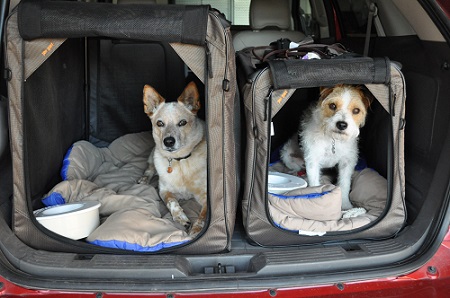
Another point addressed by the law concerns the protective net. There are, in fact, two types: fixed and removable. The removable type can be fitted and removed by the vehicle owner at any time. If, instead, we prefer a fixed version, we must first register it with the Civil Motorization offices.
Finally, relying on common sense, if we transport two or more animals, we should always reduce the chances of their “bickering” or even attacking one another.
We should therefore choose a combination of these solutions, leaving, for example, the dog in the trunk behind a protective net and the cat in its carrier on the front or rear seat. There are also dividers on the market that create separate sections in a sufficiently large trunk.
For the rest, we should always rely on common sense.