
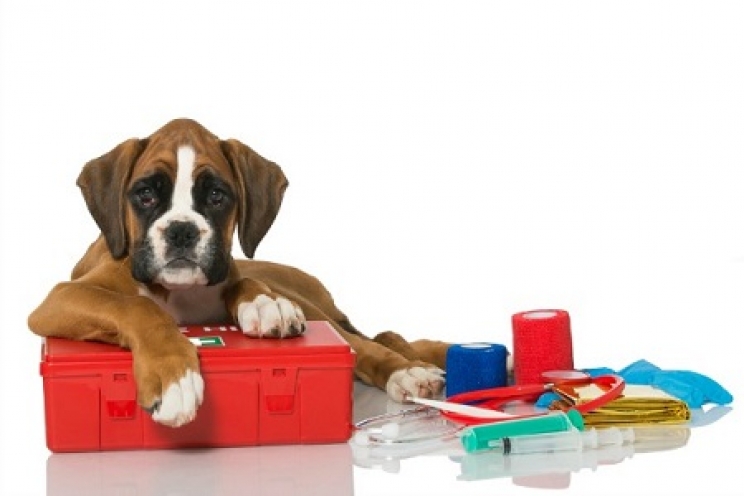
All pet owners should always have a first-aid kit on hand to help their dog or cat when necessary.
At home, you should never be without everything needed for first aid, whether in the countryside or at the park during your daily walk with your dog. Dangers, from the minor to the most serious, are always around the corner, so it is important to have everything necessary to deal with them in the best possible way.
There are ready-made first-aid kits on the market containing the tools and materials that may be needed in the event of wounds or minor trauma. In any case, you can also put one together yourself by purchasing everything you may need individually.
Let us see what the ideal first-aid kit for animals should contain, to take with us during walks and short trips: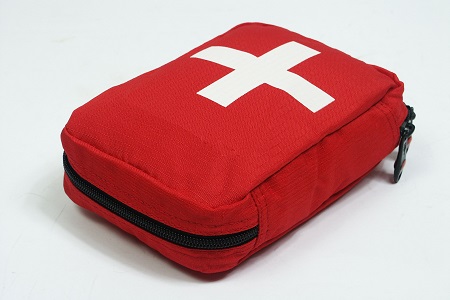
-
Container: one idea might be to get a larger kit to keep in your medicine cabinet, and a smaller, more manageable one to take outside;
-
Veterinarian’s business card: make sure you always have your veterinarian’s telephone number at hand so you can call immediately in case of danger;
-
Disinfectant: it should be alcohol-free and have high bactericidal power. The most suitable is Betadine solution, which is particularly useful for wounds and cuts;
-
Hydrogen peroxide: it should never be missing, especially in cases of poisoning to induce vomiting;
-
Adhesive bandage: the most suitable for our animals is paper tape, which adheres less to fur and can be removed more easily without causing pain when pulled off;
-
Sterile gauze: excellent for applying pressure to a wound and applying disinfectant without waste;
-
Elastic bandage: it may be used to bandage the animal’s paw in case of wounds and trauma;
-
Saline solution: you can use the larger glass bottle and draw it up with a sterile syringe, but softer packages that are easier to carry are also available, without the risk of breakage;
-
Tweezers: excellent for removing thorns, grass awns, foreign bodies and ticks;
-
Rounded-tip scissors: special scissors are available that are specifically designed to avoid injuring the animal, thanks to their rounded tip and slightly curved shape. In any case, ordinary children’s scissors will also do;
-
Latex gloves.
As for the complete kit to keep at home, it should contain everything our dog or cat might need in every possible situation. The complete supplies include:
-
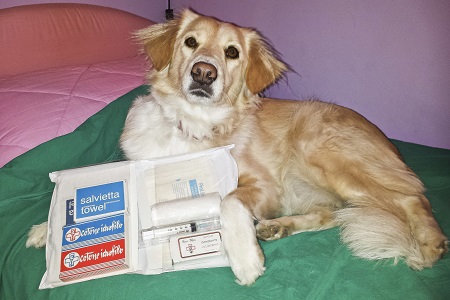
Thermometer: it must be digital, with an audible signal indicating the end of the temperature measurement. Choose one that takes only a few seconds to measure, because animals rarely have patience for this procedure. For further advice, read the specific article by clicking this link;
-
Syringes: it may be useful to have syringes of various sizes, which can be used both for injections and to administer syrups or medicines mixed with food;
-
Antiparasitic: every owner should have a regular antiparasitic treatment routine to prevent fleas and ticks. Choose it according to your animal’s species and weight, and apply it according to the time of year and lifestyle. In summer it should be applied once a month, while in winter it may be omitted for cats that live indoors. You will find all the details in this article;
-
Thermal blanket: a special electric blanket that can be heated when necessary to keep the animal warm. It can be especially useful following surgery;
-
Elizabethan collar: a special funnel-shaped plastic collar placed around the animal’s neck to prevent it from licking or biting wounds, especially after surgery;
-
Fabric muzzle: it may be useful if your dog is particularly agitated or aggressive, to facilitate first-aid procedures;
-
Dry ice: it is not always possible to have something cold available, especially in the event of heatstroke, so dry ice can be very useful.
Some medicines can be kept in our animals’ medicine cabinet for use in emergencies. Always remember to use them only if authorised by your veterinarian. Also ask for the specific dosage of each one and write it with a pen on the individual packages.
The main medicines that may be needed by our animals include:
-
Antibiotic ophthalmic ointment: very useful for treating conjunctivitis;
-
Cortisone-based ointment: helps relieve itching associated with irritation or insect bites;
-
Anti-inflammatory: may be useful in cases of fever, bladder inflammation and pain;
-
Antihistamines and cortisone: may be useful for severe reactions to insect bites, particularly bee and wasp stings;
-
Antiemetics: in some cases they may be prescribed to stop vomiting;
-
Motion-sickness medication: if your dog suffers from car sickness, these medicines may be useful before long journeys.
Once you have organised everything necessary, you can assemble your complete first-aid kit.