
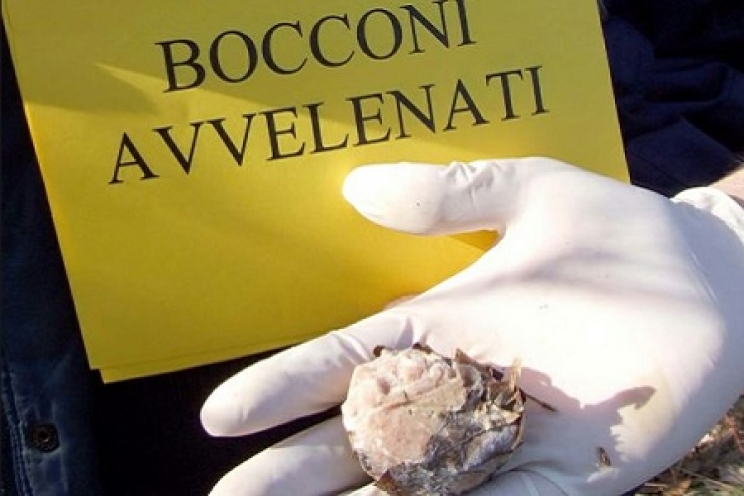
Unfortunately, it still happens that people who are intolerant of animals decide to play at being “Little Chemists”, making poisoned baits at home to place in street corners and in the countryside. Whatever form they take – meatballs, morsels, eggs, rolled-up slices of ham, carcasses of small animals – within a few minutes or a few days they can seriously endanger the lives of our animals. This is why it is very important to be able to identify which poison is involved and promptly put into practice all the measures that may save the life of the dog or cat.
We are talking mainly about dogs, which tend to avidly swallow everything they find interesting. These meat-based baits hide the poison inside, making it very difficult for our dogs to detect its presence. Cats, on the other hand, are naturally wary and usually reluctant to ingest products they do not know. In any case, they too can become victims of poisoned meatballs.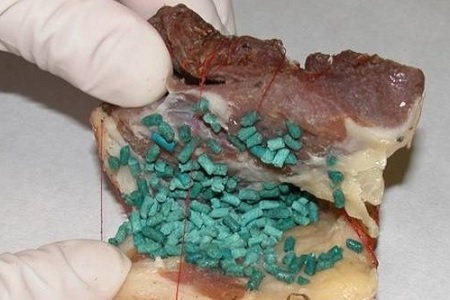
The consequences depend on a number of factors, including the type of poison used, the dosage, the animal’s weight and size, and the time elapsed since ingestion. Each poison affects the body differently and acts within different time frames. For this reason, we recommend trying to learn the symptoms and remedies for each one, or keeping a note with all the necessary information on your cellphone.
Here are the most commonly used poisons:
-
Strychnine: until a few years ago, this was the preferred poison of these unscrupulous people. It is a very powerful pesticide, “normally” used against mice and foxes, which appears as a white powder. It acts on the animal’s central nervous system, causing a state of excitement so rapid and intense that it can lead to death within a few minutes. Symptoms of strychnine poisoning appear within 10, and at most 30, minutes and include convulsions, stiffening of the body, dilated pupils, abundant salivation, whimpering, and eventually death from respiratory paralysis in a very short time. If our dog has ingested the bait, we must immediately administer one teaspoon of hydrogen peroxide for every 5 kg of body weight directly into its mouth (if the dog weighs 10 kg, give it 2 teaspoons; if it weighs 20 kg, give it 4 teaspoons, and so on). This will make it vomit, removing the poison from its stomach. It is essential to go immediately to the nearest veterinary clinic or practice and explain what happened. The antidote commonly administered by veterinarians consists of certain psychotropic drugs, such as diazepam;
-
Rat poison: other offenders instead prefer to use the more common rat poison. It comes in various forms, such as a blue liquid, a black tablet, or red, fuchsia, or blue paste or granules. Rodenticides inhibit the action of vitamin K, which is essential for proper blood clotting. As a result, the blood becomes increasingly thin, eventually causing serious internal and external bleeding. Symptoms of rat-poison poisoning include heavy bleeding from the nose, ears, gums, or pre-existing wounds, weakness, thirst, bruising, and pale mucous membranes. Rat poison does not act immediately, but about 48 hours after ingestion. Although this allows us to intervene as soon as we see our dog ingest the bait, it can also be counterproductive, because an unaware owner does not see the symptoms and therefore believes everything is normal. If the dog has just ingested the bait, make it immediately vomit with hydrogen peroxide. If several hours have passed or symptoms have already appeared, we can do nothing but rush to the veterinarian, who can administer the correct antidote;
-
Slug poison or metaldehyde: it appears as bait in blue-green granules. In case of ingestion, symptoms appear within 2-3 hours and are very similar to those of strychnine. They include tremors, convulsions, stiffening of the body, dilated pupils, a sharp increase in temperature, greenish diarrhea, pale mucous membranes, breathing difficulties, and a rapid heartbeat, while cats may also move their eyes rapidly sideways or vertically – a phenomenon called nystagmus. Death occurs from respiratory paralysis. In case of ingestion, we must rush to the veterinarian, who can address all the symptoms shown by the animal. For this poison, in fact, there is still no specific antidote;
-
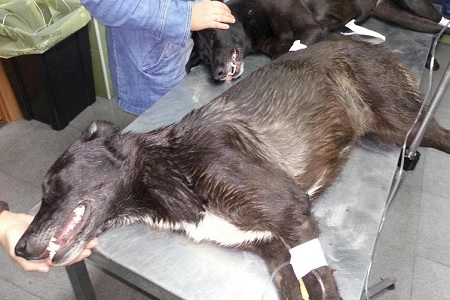
Antifreeze or ethylene glycol: ordinary antifreeze used for cars is lethal to our animals. This is made even worse by the fact that it tastes good, so dogs and cats may easily be attracted to it. The consequences occur in three successive stages. The first appears within 30 minutes to 12 hours, with nausea, vomiting, tremors, and convulsions, and the animal tends to drink and urinate excessively. Within 12-24 hours, it begins to breathe rapidly and with difficulty, while its heart rate increases. In 24-72 hours, kidney complications also appear, with dehydration, breath smelling of urine, depression, and eventually coma and death. In these cases, we must immediately rush to the veterinarian, who can administer the specific antidote for this poison. Generally, the chance of survival is greater if action is taken within 5 hours of ingestion.
These are only some of the poisons that can seriously endanger the lives of our animals.
Owners make many mistakes in these situations. One of them is giving milk to the dog because they have read somewhere that milk is the best antidote to poisons. Nothing could be more wrong. Milk is effective only for certain toxic substances, while in other cases it may even speed up the poison’s action.
To avoid harm, we should always be very careful whenever we go out with our dog in town, and especially in the countryside or woods. We should always carry a bottle of hydrogen peroxide and a teaspoon, so that we can intervene promptly. With some poisons, even a few minutes can make a difference.
We should also remember that whenever we come across suspicious bait, we must always contact the police or carabinieri, who will remove the poisoned food and clean up the area. As stated in the regulations against animal cruelty, the use of poisoned bait is a crime, punishable by heavy fines and imprisonment.