
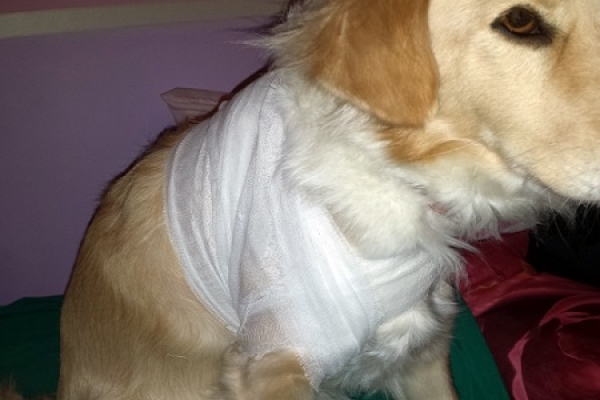
When a dog or cat is injured and needs frequent dressings, it is not always possible to run to the veterinarian once or twice a day. For this reason, it is important to be able to perform some minor procedures ourselves. In particular, this article explains how to bandage a dog or cat.
If your animal has sustained a wound, cutting itself on broken glass at the park or during a fight with other neighborhood dogs and cats, once your veterinarian has provided all the necessary treatment, you will need to carry out the daily dressings and bandages.
Bandaging the tip of the paw
If the wound is on the end of the paw, for example a paw pad or a nail, the bandage can easily be applied with a few materials. You will need:
-
Sterile gauze;
-
Paper adhesive tape;
-
A child’s sock or elastic netting.
After dressing the wound, apply the gauze so that it covers the entire end of the paw. If necessary, use two pieces or roll them up to create a kind of small sausage.
Then wrap the paper tape around the upper part of the sleeve, so that it remains partially attached to the paw hair. Try not to tighten it too much, since this is still a wound and may cause the animal pain.
Avoid bandages that are too occlusive, because wounds need to breathe. Instead, try to protect the gauze with a sock secured well at the top or with elastic netting.
Bandaging the middle of the paw
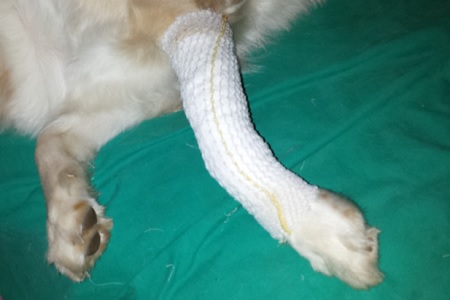
If the wound affects the middle of the paw, a different type of bandage will be needed.
You will need:
-
Sterile gauze;
-
Paper adhesive tape;
-
Cloth bandage;
-
A knee-high sock or elastic netting.
Apply the gauze over the wound. Be generous with the
amount of gauze, to prevent it from shifting and leaving the wound exposed.
Attach a piece of tape halfway onto the bandage and apply the other half to the animal’s leg, slightly above the wound. Slowly wrap the bandage around the leg, without tightening it too much. It should be secure, but not so tight that it prevents movement.
Once you have gone at least 2–3 centimeters beyond the wound, secure the end of the bandage with a turn of paper tape halfway between the fabric and the animal’s fur.
At this point the bandage may be considered finished, but if you want an additional precaution, you could protect it with an old knee-high sock, which will keep the bandage in place and at the same time prevent the animal from tearing everything off with its teeth.
Bandaging the shoulder or thigh
To bandage the shoulder and thigh, you need the same materials as for the paw.
Apply the gauze to the shoulder, then secure the bandage with tape to the skin and wrap it so that it makes several turns around the leg, neck and chest.
If the wound is on the thigh, repeat the same steps, but wrap the bandage around the leg, pelvis and buttocks of the animal.
It would therefore be better to obtain a sufficiently long bandage.
To finish, you could use an old sweater, to be worn over the front or rear part of the animal.
Bandaging the abdomen
If your animal has undergone abdominal surgery, such as sterilization, the risk that it will lick the wound and tear out the stitches is high. For this reason, you will need to protect the area with a suitable bandage.
Naturally, it is not possible to apply bandages or any kind of restrictive dressing, considering that the animal needs to eat and move.
To create suitable coverage for the abdomen, you will need:
-
Sterile gauze
-
Elastic netting
-
An old sweater, the sleeve of a sweatshirt or a special postoperative suit
After performing the dressing recommended by your veterinarian, place gauze over the wound, trying to extend it as much as possible over the abdomen, so that it does not remain exposed during movement.
Secure the gauze with elastic netting of a size suitable for the animal’s belly. For cats, elastic netting for men’s knees is suitable, while for dogs, netting for the legs is more appropriate. Make sure it is neither too loose nor so tight that it compresses the abdomen.
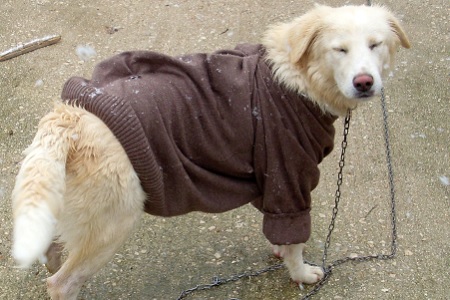
If you prefer, you can further cover the area with some of your old clothes.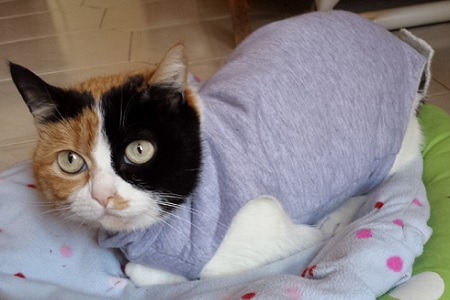
For dogs, it may be useful to have them wear one of your old sweaters, tying it as if it were a bodysuit or romper.
For cats, it is better to use the sleeve of an old sweatshirt, cutting and sewing it so that it fits the animal’s body.
Special postoperative garments made of hypoallergenic material are available commercially and can easily be adapted to all sizes and needs. For abdominal wounds, a bodysuit that can easily be opened when necessary to perform dressings, without removing it, is more suitable.
Alternatively, you can use the classic Elizabethan collars made of semi-rigid plastic, wrapped around the animal’s neck to prevent it from licking the wound.
In any case, do-it-yourself treatment is suitable only for simple dressings. If the wound shows signs of infection, do not hesitate to contact your veterinarian.