
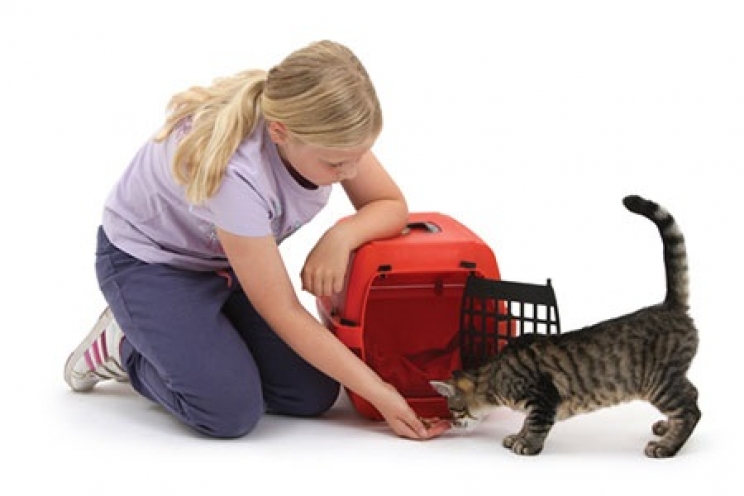
Over the course of our cat’s life, there will almost certainly be occasions when we have to convince Fuffi to get into the carrier, perhaps for a check-up at the vet or for a journey of some length. As many cat owners know well, however, this can be a truly complicated task, especially if the cat is not used to the carrier, in which case it may react by scratching, clinging to everything it can find with its claws, or crying desperately. Here is what to do to prevent all this from happening.
Why a carrier?
There is only one reason, but it is essential. The carrier is the easiest, most practical and, above all, safest solution. For the few who do not know, a carrier is simply a small plastic cage equipped with two essential elements: a door and ventilation holes.
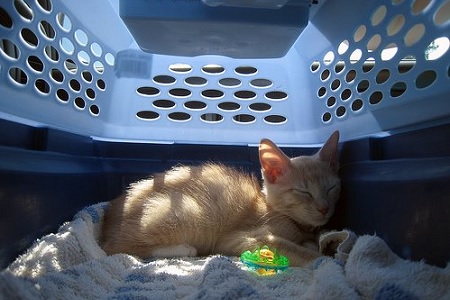 It is an easy solution because the problems are not actually related to the carrier itself, but to the cat’s lack of familiarity with it. If we follow the right guidelines, which we will see later, from the first months of life, Fuffi will get used to the idea of the carrier without major drama.
Practical for many reasons. First of all, the plastic carrier—the only type worth buying—can be quickly disassembled so that it can be cleaned and disinfected without any difficulty, which is even more useful if our cat tends to “let go” when frightened. In addition, every model has a front door, allowing us to put Fuffi in and take him out, although the most convenient models also have a second opening on top, which is particularly useful for the vet, who may be able to examine the animal without taking it out and while leaving it calm in its den.
Safe because it is the only tool we have available to “restrain” our cat while we are out on the road or in the car. When faced with an angry cat, boxes, baskets and other means cannot prevent it from escaping, whereas a good carrier can withstand even the most hyperactive cat.
Which carrier to choose
There are carriers on the market for every taste and need, from the simplest and most economical models to those that increasingly resemble a spaceship.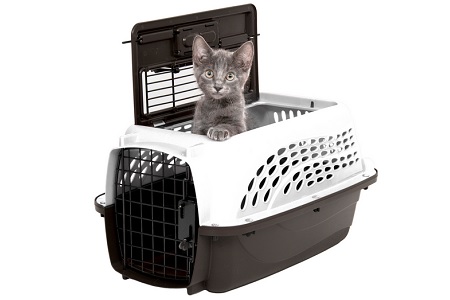
There are no particular rules, but it is best to avoid carriers that are not very sturdy, such as those made of nylon or fabric, whose sole purpose is to carry a toy-breed dog around.
Instead, choose a product with these requirements:
-
Suitable for the size of our cat, therefore neither too large nor too small;
-
Made entirely of metal or with a plastic body and metal door;
-
Designed to be disassembled across the entire upper section using sturdy side clips;
-
Equipped with holes that allow air to pass through;
-
Also openable from the top, although this is an additional option.
If we need to use the carrier immediately, for example to take Fuffi to the vet, it may be necessary to place an absorbent pad on the bottom, to prevent the frightened cat from getting dirty with accidental bodily waste.
How to get your cat used to the carrier
The main rule is to act from the first months of our cat’s life. Probably, even before reaching our home, the first thing Fuffi will see will be the carrier itself, which is essential for taking him from the shelter, street or breeder to his new home.
As we saw in the article dedicated to the kitten’s arrival home, the most important advice is to place the carrier in an isolated room, open the door and move away, giving the cat all the time it needs to understand the situation.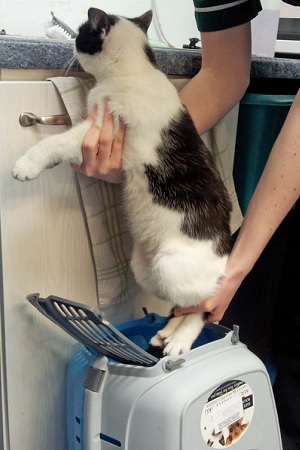
For the first few days, and even throughout its time with our family, it can be an excellent idea to leave the carrier available to it at all times, just as if it were a bed. Cats often like sheltered places, so Fuffi may find the idea of having a roof over his head very comforting.
Try to “furnish” it with lots of comfortable and welcoming objects, such as a warm blanket for winter, its favorite toys and perhaps even a few pieces of kibble scattered around to satisfy nighttime hunger.
Another piece of advice is to ensure that the cat associates the carrier with non-traumatic experiences as well, rather than only with the terror of a visit to the vet. So at least once a week, put it in the carrier and take it for a short car ride, enriching the experience with many pleasant stimuli, such as some kibble, kind words and a caress, without opening the door, naturally, so as not to endanger our safety in the car.
If Fuffi still remains tense at the thought of entering the carrier, we can try synthetic pheromones. As you can read in detail in the article on the use of synthetic pheromones, these act by relaxing the cat, making it believe that the environment it is in is pleasant and familiar. The most suitable pheromones for this purpose are those in spray form, which should be applied at least 20–30 minutes before leaving.
The last piece of advice, which is more of a professional trick, concerns the moment of putting the cat into the carrier, especially for cats that simply cannot tolerate it.
It is very important not to force the cat, pushing it with all our strength to make it pass through the carrier opening. With cats, all this is pointless, because they will simply assume the most unlikely positions in order to make themselves incompatible with the size of the door.
Instead, always try to put Fuffi in backwards, passing the hind legs through first and then the front legs. A useful suggestion may be to tilt the carrier, so that the opening is slightly higher and gravity helps us prevent the cat from catapulting out in a very short time. Remember to avoid a sudden entry, because the cat could hurt itself. Rather, let it slide slowly through the opening, keeping its hind legs together with one hand and closing the door immediately afterward.