
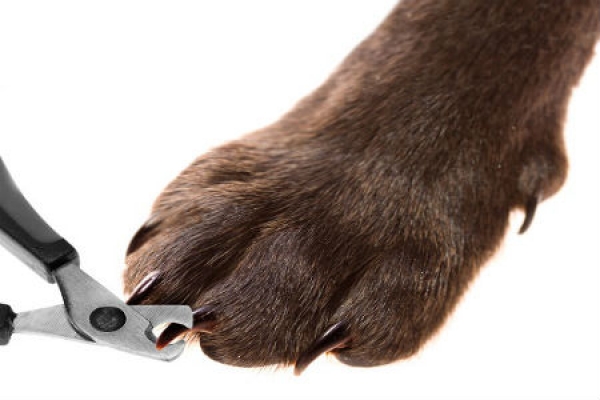
Trimming a dog’s nails is probably the most important part of grooming. In fact, all owners who regularly take their dog for professional washing will certainly know that, in addition to bathing and a “trim” of the coat, a good groomer always checks the condition of the nails.
Under normal conditions, the dog is able to keep the length of its nails under control automatically. Contact with rough asphalt and digging in garden flowerbeds are just some of the things that help the dog file its nails naturally.
For this reason, if the nails are too long, it may simply mean that you and your dog do not spend enough time walking and playing outdoors. The same applies to older dogs, which do not have the same energy or desire to run and walk for long periods.
In these cases, it is appropriate to intervene directly on the dog’s nails, with the help of a veterinarian or an expert. It is an operation you can also do yourself at any time.
In this guide, we will answer the most frequently asked questions.
“How do I know if my dog’s nails are too long?”
The answer to this question is very simple. One suggestion is to rely on sight and hearing. Get down on the floor at your dog’s level. If the nails are the right length, they will point forward rather than downward, staying at least two or three millimeters from the floor. If, on the other hand, the nails reach the floor or even tend to curve backward toward the paw pads, they need to be trimmed.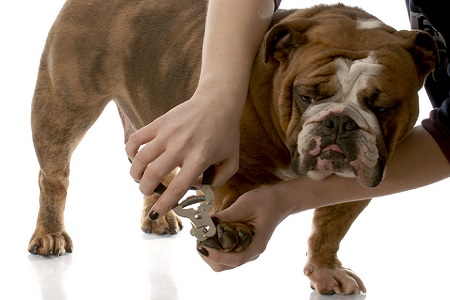
Another tip is to listen to the sound of your dog’s footsteps. The ideal sound should be fairly muted, caused by contact between the paw pads and the floor. If the nails are too long, they will touch the smooth floor with every step, producing the characteristic clicking sound.
Once you have performed this initial test, you can examine the nails.
A dog’s nail has a typical cone shape, inside which you may see another light-pink conical structure. This area represents the innervated portion of the nail, containing blood vessels and nerves. If you accidentally cut into this area, your dog will feel considerable pain and you will cause heavy bleeding.
For this reason, it is very important to position yourself so that you can identify the individual parts of the nail before beginning to cut. Spend several days becoming familiar with your dog’s nails, perhaps while sitting on the sofa watching television. This will make it easier to locate where to cut when the time comes, and will begin getting your dog used to having its paws handled.
In some dogs, the nail may be completely dark, making it impossible to locate the light-pink area. What should you do in these cases? Do not worry: simply trim only a few millimeters from the nail tips, without going too far. You could use a flashlight to examine the nail more closely. To be sure you do not make a mistake, you could instead use a stiff file, rubbing it little by little over the nail tip.
“What do I need to do to trim the nails?”
Once you are familiar with your dog’s nails, you can trim them by following a few simple steps.
-
Do not become agitated: who would ever want to be operated on by a surgeon so agitated that they could not even keep the scalpel steady in their hands? It is the same for a dog. If it sees you anxious, it will run away frightened. So remain calm, and you will also give your dog confidence. If necessary, reassure it in a calm, gentle tone and touch its paws, rewarding it frequently with dog treats;
-
Get familiar with the nail clipper: choose one suited to the size of your dog’s nails. There are several types on the market, guillotine, scissors or plier-style. Ask your trusted retailer for advice. Consider all aspects, such as how much force you will need to apply for a quick, precise cut;
-
Position the nail clipper:
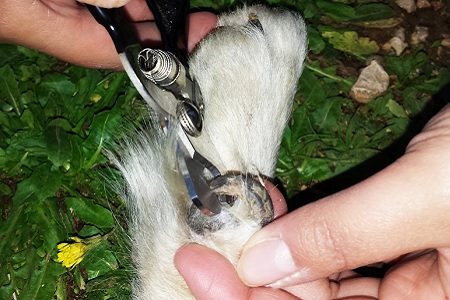 separate the nail to be trimmed from the others, then position the nail clipper so that it includes the entire portion you are going to cut. Do not come within 2 millimeters of the light-pink area;
 -
Cut: once the nail clipper is perfectly positioned, cut with one quick, decisive movement;
-
File: remove the pointed parts of the nail with a stiff file, gently rubbing the freshly cut surface;
-
Do not forget to reward your dog!
A fundamental part of nail trimming, often overlooked by owners, is the dewclaw. It is located on the inner side of the leg, higher than the other nails, and corresponds to our thumb. Not all dogs have one, so do not worry if you can count only four nails on your dog. The dewclaw may be present only on the front or rear legs, or on all four.
Because of its position, the dewclaw often does not experience the same wear as the other nails. For this reason, it often tends to curl, eventually growing into the paw pad. Before this happens, it is a good idea to regulate the length of the dewclaw as well. To do so, simply apply the same method used to trim the other nails.
“After trimming, my dog’s nail started bleeding. What should I do now?”
First of all, do not panic. You have probably cut into the vascularized part of the nail as well. Place a cotton ball soaked in disinfectant on the bleeding nail. You can then apply a healing powder, which will reduce the time needed to stop the bleeding.
If in the following days you notice swelling and pus, or if the dog cannot place its paw on the floor, contact your veterinarian immediately, because the wound may have become infected.
“When should I not trim my dog’s nails?”
The length of the nails should be regulated in almost all circumstances. There may, however, be some cases in which trimming them yourself could be counterproductive, for example:
-
The nails are already too short;
-
The nails are dark and you do not know where to cut;
-
The nails are very curved and thick;
-
One or more nails are ingrown.
In these cases, you should consult your veterinarian, to avoid causing pain and bleeding in the dog.
“Why is it important to trim the nails?”
A dog’s nails can develop various conditions, which often represent a warning sign of more or less serious problems. Let’s look at the main ones: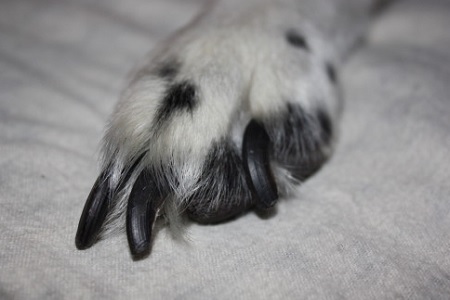
-
Ingrown nail: if the nail is too long, it can reach the paw pad and continue growing into it. In this case, it is necessary to intervene immediately to prevent the skin from becoming infected and causing the dog considerable pain;
-
Broken nail: when nails are fragile, they can break even after fairly mild stress. The cause may simply be traumatic, for example if the dog has struck a very hard surface, or it may be an infection of the nails. Consult your veterinarian if the nails break frequently;
-
Food allergies: if the dog is allergic to one or more foods, changes in the appearance of the nails may also be among the symptoms;
-
Fungal infections: these are infections caused by fungi, just like those that can affect our nails or feet. Nails affected by fungal infections appear yellowed, thickened and may break easily, eventually falling off in the most serious cases. If you suspect this type of infection, consult your veterinarian, who can recommend the most appropriate treatment;
-
Leishmaniasis: anyone who owns a dog has probably already heard of this disease. It is a widely discussed condition caused by Leishmania, a microorganism that can reach the animal by “using” sand flies, insects similar to mosquitoes. If a sand fly carrying Leishmania bites the dog, it may transmit the microorganism and infect it. The classic symptom of leishmaniasis is “onychogryphosis”, meaning the presence of very long, thickened nails that curl back on themselves.
If you notice any particular changes in the shape, color or consistency of your dog’s nails, discuss them with your veterinarian. It could be an easily resolved problem, but it could also be a more serious condition. Always remember that prevention is better than cure.