
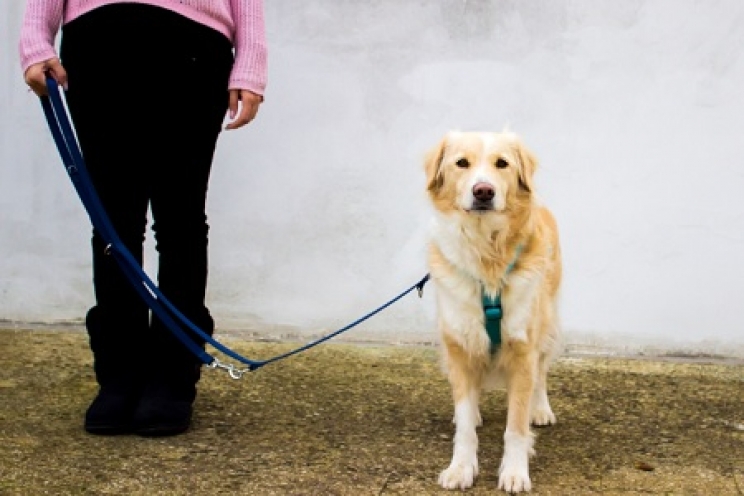
One of the recurring requests owners make to trainers is certainly help teaching their dog not to pull on the leash. Let’s clarify some doubts by examining the main training methods to put into practice when the dog “pulls”.
The theory
One of the most frequent mistakes owners make is believing that the leash is used to steer their dog, so that with a more or less gentle pull on our part, the dog should follow our movements.
Nothing could be more wrong. The leash is merely a tool intended to allow the owner to intervene to prevent the dog from running away or encountering certain dangers.
The leash must follow the animal’s movement, while the animal must learn to listen to its owner and keep pace with them.
Many of you are surely thinking, “easy to say, but how do you do it?”
You are probably right on this point, because teaching your dog not to pull on the leash is not always easy, but it is absolutely necessary. Simply follow the right method and put all the experts’ advice into practice.
Collar or harness?
We have already discussed the choice between a collar and a harness extensively, both ethically and practically. From a training standpoint, however, several points need to be clarified.
When talking about dogs that pull on the leash, the notorious choke collar is often mentioned. Most trainers categorically prohibit the use of this collar, which many consider harmful, cruel, and useless for training purposes.
A choke collar consists of small metal links without a true closure, so as soon as the dog pulls harder on the leash, the collar tightens like a noose around the animal’s neck.
The training principle behind the choke collar is that, feeling strong pressure on its neck, the dog would immediately stop pulling through a negative association. “It hurts, so I’ll stop doing it.”
This practice runs counter to the most widely accepted training theories, which instead stimulate the dog to reason along the lines of “it feels good, so I’ll keep doing it”.
In practice, the dog must not stop pulling because it will be punished, but because it has understood that staying alongside its owner will earn praise, affection, and treats.
According to other theories, however, a choke collar may be useful for large dogs, especially mastiff-type breeds, with strong, robust muscles, but only after the principles of training have been taught.
Most experts, in any case, always recommend using a harness, particularly an “H-shaped” or Swedish harness. This accessory is considered the most suitable for managing a dog’s walk because it does not compress any part of the animal’s body and allows the owner to avoid applying too much force if the dog should “pull”.
How to teach your dog to walk at your side
To teach your dog to stay alongside you, with or without a leash, several tips should be put into practice.
Let’s start with the basic principles, suitable for a puppy’s first walks or for an adult dog that has not yet been trained.
First of all, the leash should never be taut, but always relaxed. The dog must follow us because it has been taught to do so, not because it is being conditioned by the leash.
Find a fairly secluded outdoor place. The countryside, a park, or the home garden can work well, provided that, at least initially, the dog does not have too many distractions.
-
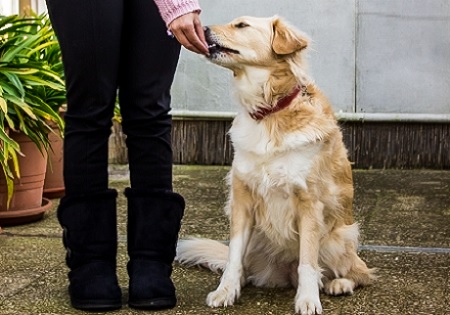
Teach the dog to stay on our left, aligned with our body, offering treats held as close as possible to our leg and its muzzle;
-
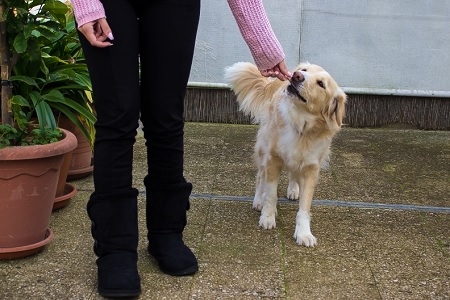
Holding the treat in your hand, let the dog sniff it without ever giving it to them. When you are sure you have their full attention, start walking slowly, continuing to let them sniff the treat. It is very important that the hand holding the reward always remains close to our left leg, so we can make things easier by holding it in our right hand;
-
After a few steps, stop and, if the dog has managed to follow our pace and direction, we can finally give them the treat;
-
Continue in this way for at least ten repetitions, taking only a few steps at a time.
Once the dog has learned this simple exercise, we can gradually raise our hand, holding it increasingly higher than its muzzle.
This way, the dog will focus on the treat without sniffing or licking it.
Little by little, we will be able to hold the reward at face level, so that the dog will look us in the eyes.
The dog will have associated the direction of our hand with the treat, so it should be able to look toward it at eye level even when we no longer have a morsel for them.
This exercise should also be repeated at least ten times. It is very important that the dog has enough time to memorize our request, so let’s always remember that, at least at first, whenever we begin training, we must repeat the commands from the beginning.
How to teach your dog not to pull
An excellent piece of advice is not to reward the dog when it is pulling. If we indulge the incorrect behavior by allowing ourselves to be dragged, we are doing nothing more than communicating that what the dog is doing is right.
Instead, if we see that the dog is beginning to stop staying alongside us, stop immediately, without pulling the leash. Only once the dog has relaxed may we continue.
To understand when the right moment has arrived, we must pay attention to the leash. A taut leash indicates that the dog is pulling, and vice versa.
We must train our dog to enjoy walks calmly and peacefully, while still following our decisions.
Stop often during the exercise and change direction several times. A dog well trained to walk on a leash will stop with us and always remain at our pace.