
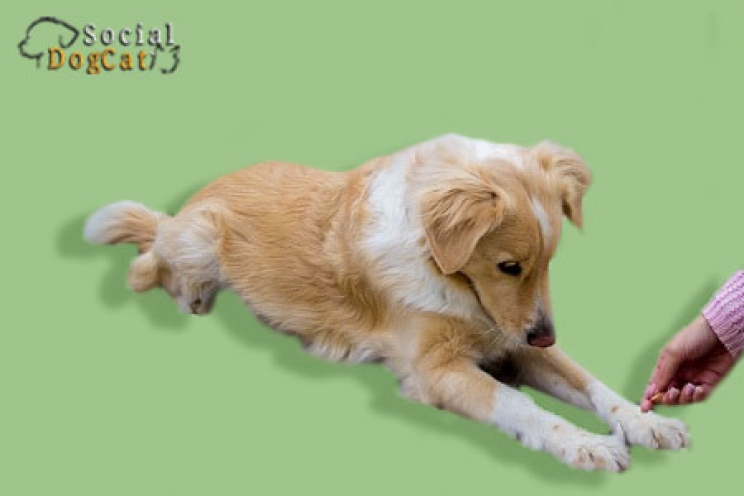
Dog training by owners often begins with these commands, considered the foundation for gaining a dog’s attention. Let’s look at how to teach a dog the “sit” and “down” commands.
What they are for
If the “sit” command is considered one of the most important, there must certainly be a reason.
Only when the dog sits at our request can we be sure that we have its full attention. When a dog is too exuberant, is running wild during play or is too distracted by its surroundings, the first thing we should do to moderate its energy or anxiety is ask it to sit.
Only once the dog has learned to sit whenever we ask will it be possible to proceed with teaching all the other commands.
As for the “down” command, it is more of an optional variation, not necessary for the dog, but potentially indispensable for teaching another command, “roll over”.
The “sit” command
This command should be taught to all dogs, both puppies and adults.
To succeed, it is necessary to apply the principle of positive reinforcement. When the dog does something we ask or behaves well, we should reward it with praise, affection or treats.
Conversely, punishing it when it does not listen or does something inappropriate will create negative emotions in the dog, without showing it what we expect from it.
To teach the dog the “sit” command, we need to get some dog treats or biscuits specifically for training. They are less caloric and more appetizing than regular kibble, so the dog will be particularly motivated to listen to us in order to get the treat.
Alternatively, we can also use a toy, perhaps one of its favorites, although for puppies or during the early stages of training it may not be as stimulating as food.
Here are the steps for teaching the dog the “sit” command: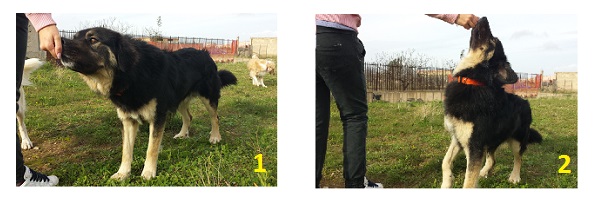
-
Position yourself in a secluded place, such as a room in the house away from noise and other people, at least initially. Try to attract the dog’s attention by making it understand that you have a treat for it;
-
Place the treat in front of the dog’s muzzle, moving it slowly upward and toward the back of its head. The dog will try to follow the movement of your hand, moving its head backward and consequently sitting down to avoid losing its balance;
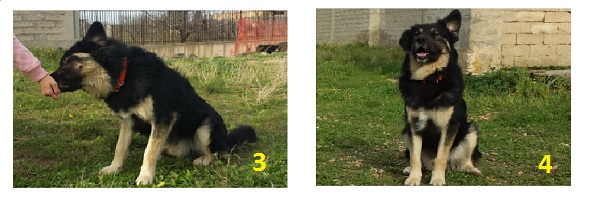
- Once its bottom touches the floor, give it the treat;
-
Repeat until it can sit correctly.
Repeat the same procedure several times. At first, it may be enough to reward the dog for sitting for only a few moments. We cannot expect it to remain still like a statue straight away, especially if it is a puppy.
At this point, we can introduce the spoken command “sit”.
Every time we place our hand in front of its muzzle, clearly say the word “sit” and repeat the hand movement above the dog’s head, rewarding it when it sits.
Only once it has associated the spoken command with the action of sitting can we begin trying without a treat. The procedure is the same, except that instead of food we use praise as the reward. Say a hearty “good boy!” every time it performs the command.
An important tip is not to positively reinforce actions other than sitting. Do not be permissive. If the dog stands on two legs or clings to your hand to get the treat, immediately move your hand away, stand properly again, and start over once it has calmed down.
The “down” command
This command is not essential, but it can help begin learning the “roll over” command.
Always start with the “sit” command. Once the dog is sitting properly and has your full attention, you can proceed: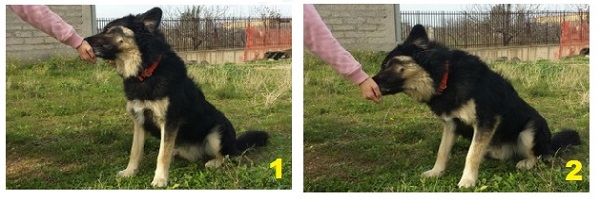
-
Hold a treat between your thumb and index finger. Show the dog its reward by bringing it close to its muzzle;
-
Slowly, move your hand gradually downward;
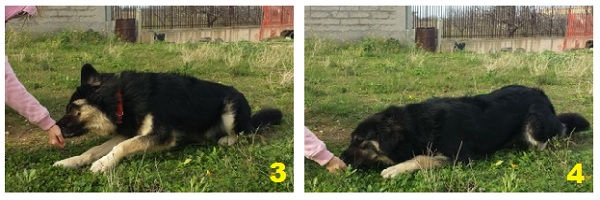
- Continue lowering your hand with the treat until it reaches the floor, then bring it toward your body;
-
The dog should lie down to reach the treat.
This procedure is never easy because in most cases the dog will tend to stand up again and move its entire body forward to reach its reward.
Therefore, whenever it does not remain seated, you must start again with the “sit” command, rewarding it only when it lies down.
Then proceed with the spoken command. When you show the dog the treat, say “down” and move your hand downward and then toward yourself.
When the dog clearly understands this step, you can try without using a treat as a reward, praising it if it succeeds.
To make the spoken command easier to recognize, try to use a simple gesture. For example, you could hold your open hand parallel to the floor, moving it downward while saying “down”.
Alternatively, you could point to the floor with your index finger.
You will need several attempts before the dog truly begins to lie down, but what you need is plenty of patience and several packages of treats.