

Ever since we were children, we have been taught that cats meow and dogs bark. That is a fact, but not everyone knows that our animals’ voices have many nuances, from different types of meows to hissing. In this article, we will focus mainly on cats, trying to recognize and interpret all the sounds they can produce.
The cat’s voice
Unlike dogs, which often start barking at the slightest stimulus, cats are generally not great talkers. That does not mean, however, that they cannot communicate—quite the opposite.
The cat’s language is very complex and includes not only what the cat “says” with its voice, but also a nonverbal language, made up of expressions, gestures, and body positions.
In this article, we will focus mainly on verbal communication, which consists of numerous vocal nuances that vary not only according to the situation and the message the animal wants to communicate, but also from one cat to another.
This aspect, in particular, is not easily noticeable when first listening to a dog’s bark. Cat owners, on the other hand, automatically manage to recognize their own animal’s voice, even when living with two or more felines.
Some cats may have a faint, delicate voice, while others may have shrill or ringing tones. This characteristic mainly depends on the cat’s physical structure, particularly its size, head shape, and throat dimensions.
Sound is produced through vibrations of the vocal cords, which we have all surely heard about. These two thin membranes can open and close according to breathing and our intentions.
When we breathe, they are open to allow air to pass to and from the lungs. If we want to make a sound, they tighten, causing a vibration as air passes through. This is the same mechanism produced when lightly blowing across the very thin edge of a sheet of paper.
As for cats, the tone and volume of their voice depend precisely on their physical characteristics. It seems that some feline breeds, such as Abyssinians, Siamese, and other Oriental breeds, have particularly intense and shrill voices.
This also partly depends on the cat’s character and emotional state. A fearful, insecure cat will never be able to meow at full volume, just as a bold, self-confident cat will hardly have a quiet meow.
In addition to this aspect, character can also influence a cat’s communication skills. Some breeds, in fact, tend to meow day and night, even when they have no particularly urgent messages to give their owner. It is no coincidence that breeds with these characteristics are precisely those with the most ringing voices.
Why does the cat meow?
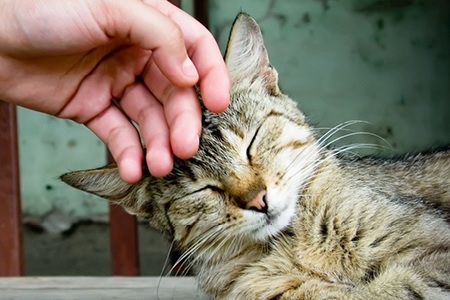 Cats may meow for an endless number of reasons. In this respect, they are very similar to us.
Think, for example, of how many of us would chat with our friends from morning to night, or of those who tend to grumble quietly when something is wrong.
The same applies to cats.
A cat may meow to ask for attention, because it is hungry, to greet you when you return from work, to communicate with other animals, to intimidate, or to complain.
It is not unusual for cats to meow simply for the pleasure of doing so, just as some people hate silence and therefore tend to talk constantly, with or without a listener.
One aspect that is almost never taken into consideration is that the cat is not merely a “meower”, but also produces a wide variety of different sounds depending on what it wants to communicate. We are referring to the other typical feline vocalizations, particularly purring, hissing, growling, and murmuring.
Let’s look in detail at what Fuffi wants to tell us with all these sounds.
The cat’s sounds
Among the sounds a cat may produce to communicate with its owner, other animals, or simply with itself, we find:
-
Happy meow: this is the typical prolonged “meow” that a cat may use when it is happy or wants to greet us. If the cat makes it while we are talking to it, it probably simply wants to have a nice chat with us;
-
Whining meow: this is the classic sound a cat makes when it wants to ask us for something, such as food or attention from its owner. It is a short, high-pitched sound, often repeated many times, and is especially typical of kittens seeking food and attention from their mother or new owner;

-
Murmur: this sound is not always easy to hear, but anyone with a cat at home probably knows what we mean. The typical murmur is what a cat makes when we return home or wake up in the morning: it begins to purr and produce a characteristic sound similar to a buzz or a car engine running, which may precede the happy meow itself;
-
Growl: this is a low, prolonged sound, comparable to a dog’s growl. The cat is warning us to move away before it is too late;
-
Chattering: this is one of the most amusing vocalizations for owners. The cat has spotted prey beyond its reach, perhaps a bird outside the window, and makes very rapid, faint meows. In practice, it rapidly chatters its teeth, interrupting the quiet meow; this serves to release frustration or warn other animals of the prey’s presence;
-
Clicking: the cat makes a very distinctive sound with its mouth, similar to a click—for example, the sound we make when imitating a horse’s hooves. It almost always accompanies an attack;
-
Hiss: this is a clear sign of intimidation, which a cat may use to drive away an unwanted person or animal, for territorial reasons, or out of fear. Trying to grab a hissing cat almost always results in a nasty scratch;
-
Screech: the cat “raises its voice” when its owner or another animal has done something that caused it pain or when it is fighting with other cats;
- Yowl: this is a loud, prolonged meow, similar to a screech but more intense, typical of cats during mating;
-
Purr: cats purr when they are relaxed, but also when they are in pain or uncomfortable and need help. There are still many theories seeking to explain the meaning of purring, but it is now clear that cats also use it to reassure themselves and calm their bodies and minds.
Some owners often confuse these sounds even after several years together with their cat, ignoring or misunderstanding the message their animal wants to communicate. Understanding the meaning of every feline vocalization is very important for establishing an excellent relationship with your four-legged friend.