
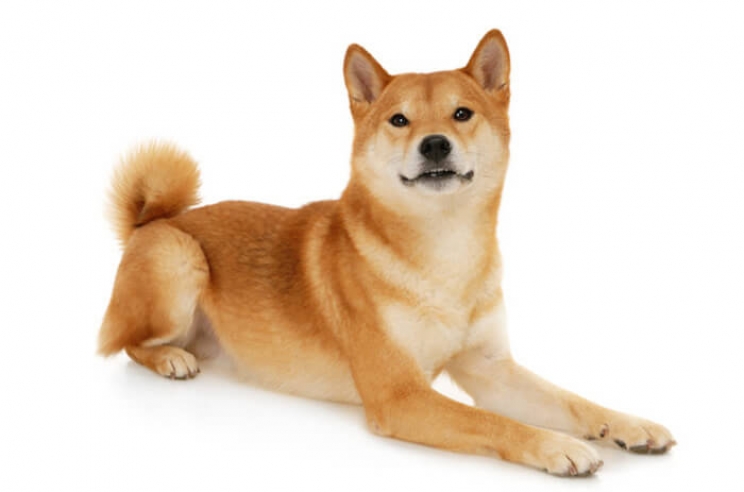
The Akita is a large, friendly, affectionate and very loyal dog. Its elegant bearing makes it highly appreciated, but it is also an excellent hunter. Loyal to its owner, it must be trained from puppyhood because it is very tenacious and fearless.
Character
The Akita is a faithful, loyal and very intelligent dog. Easy to train, it is composed and courageous in every situation.
Appearance
The Akita is a large dog with a robust build. Its form is very well proportioned, with marked sexual dimorphism. The skull is proportionate to the rest of the body, with a broad forehead and defined stop. The muzzle is moderately long and tapers toward the tip, with a straight nasal bridge and broad black nose. The jaw has strong teeth with a scissor bite and close-fitting lips. The eyes are small, almost triangular, moderately spaced and dark brown. The ears are relatively small, thick and triangular, with slightly rounded tips. The neck is powerful and muscular, without dewlap. The back is strong and straight, with a muscular, broad loin. The chest is deep, with a well-developed forechest and moderately sprung ribs. The high-set tail is thick and carried curled over the back. The forelimbs have sloping, well-developed shoulders, elbows close to the body and straight forearms with good bone. The hind limbs are well developed and moderately angulated. Both front and rear feet are thick and round, with arched, compact toes. The Akita’s coat is hard and straight, with variable length. The hair is longer on the tail than on the rest of the body, medium-length on the loin and withers, and short on the head and muzzle. The undercoat is soft and woolly. The Akita’s coat may be red fawn, sesame, brindle or white. Every coat must have urajiro, meaning whitish hair on the sides of the muzzle, cheeks, chest, neck, inner limbs and trunk.
History
The Akita is a Japanese dog that was once used as a fighting dog. The ancient Akita Matagi was crossed in the 1600s and in subsequent centuries with dogs such as Mastiffs and Tosas, and the breed became larger. In 1908, when dog fighting was banned, the Japanese breed was preserved and Akitas were designated “natural monuments” in 1931. During the Second World War, the breed came close to extinction because many soldiers used Akita fur as military clothing. After the war, Akitas declined drastically and three different types remained: Akita Matagi, fighting Akita and shepherd Akita.
Lifestyle
The Akita’s lifestyle is undoubtedly active. The dog enjoys living in large, open spaces and is not suited to apartment living.
Diseases
The dog’s health is good. There are no particular diseases that affect the breed.
Interesting facts
The Akita Club of America was founded in 1956, and the breed was recognized by the American Kennel Club in 1972. The Japanese Akita differs from the American Akita to such an extent that it is called the “great Japanese dog”.
Gait
The Akita’s gait is elastic and its movement is elegant, although powerful.
Ideal owner
The Akita’s ideal owner is an affectionate, attentive and caring person who can nevertheless give the dog freedom and independence. Training must be consistent from puppyhood.