

Skin diseases caused by mites are quite common in dogs and cats. In particular, among those that can also be transmitted to humans is cheyletiellosis. Let’s find out what it is, what symptoms it causes and how it is treated.
What is cheyletiellosis
Cheyletiellosis is a skin disease caused by mites belonging to the genus Cheyletiella (C. blackei in cats, C. yasguri in dogs, C. parasitovorax in rabbits), which can also infest humans, especially in the case of C. blackei. 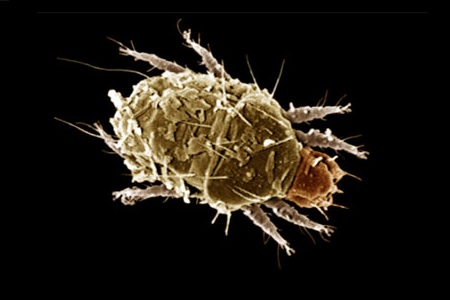
The parasite is quite small (about 0.4 millimetres), with a yellowish oval body, four pairs of long limbs ending in comb-like structures, and a mouth equipped with many small saw-like teeth and pronounced hooks, which it uses to cut the skin.
Their life cycle takes place entirely on the host, where adult females lay eggs on the animal’s hair (similar to lice eggs). Larvae and subsequently nymphs develop inside them, emerging from the eggs to mature into adults. Overall, approximately two weeks are required from egg production to maturation into an adult mite. Unlike the mites responsible for sarcoptic mange or scabies, Cheyletiella is not a burrowing parasite but simply lives on the skin’s surface.
Moreover, Cheyletiella does not necessarily require a host to survive, but can persist in the environment (kennels, carpets, beds, gardens) for up to 10 days without feeding, and sometimes even longer. This factor affects transmission of the parasite, which mainly occurs through direct contact between infected and healthy animals, although susceptible subjects may also acquire it from the external environment. In addition, fleas infesting dogs and cats can also transmit this mite.
Cheyletiella belongs to the same family as Demodex canis, responsible for demodicosis or demodectic mange, but unlike it, it is not part of the population of commensal organisms normally found on the skin.
In any case, the main problem associated with cheyletiellosis is that affected dogs and cats can easily transmit the infection to humans, even after brief contact or sharing a bed.
Symptoms
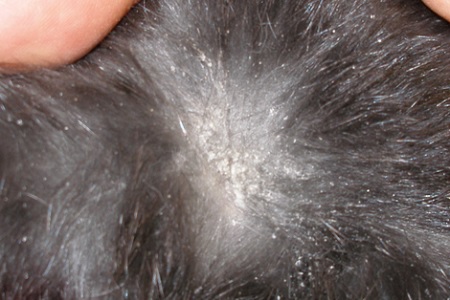 The presence of Cheyletiella is often asymptomatic or causes mild symptoms, resulting especially in young adults becoming healthy carriers. The condition may worsen considerably in puppies and kittens aged 2–8 weeks. The most affected subjects are long-haired cats and dogs with shorter coats.
The most evident clinical sign is marked scaling of the skin on the back, often not accompanied by itching, which is why cheyletiellosis is also called “walking dandruff”. This name refers to the fact that the hair is covered with whitish dandruff that moves as the parasite rapidly travels across the skin. Only in more severe cases may erythema, crusts and hair loss be observed.
In humans, on the other hand, symptoms are generally more evident and are accompanied by reddish spots 2–6 millimetres in diameter that are very itchy and may become excoriated due to scratching. They may appear singly or in groups, especially on areas that come into greater contact with animals, such as the hands, arms, trunk and legs.
Treatment
To diagnose the presence of Cheyletiella, it is often sufficient to observe abundant whitish dandruff, especially on the back, by parting the hair with the fingers. On close inspection, perhaps with a magnifying glass, an occasional mite may be seen moving across the skin. Alternatively, a very fine-toothed comb can be used to remove hair and dandruff, in which the parasite may be observed. 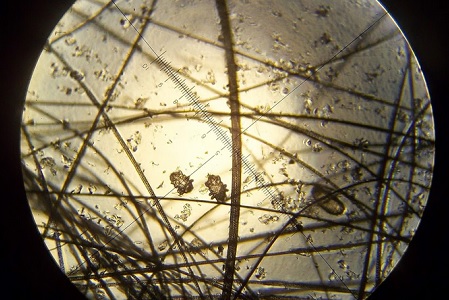
Generally, skin scrapings are not necessary, unlike with other mite-related skin diseases.
Treatment can be carried out using acaricide-based shampoos and spot-on products (carbamates, fipronil, amitraz in dogs and cats, permethrin only in dogs). Oral medication (milbemycin) may also be useful for eliminating the infestation.
It is very important to eliminate mites present in the environment, using insecticides also formulated to prevent flea infestations.