
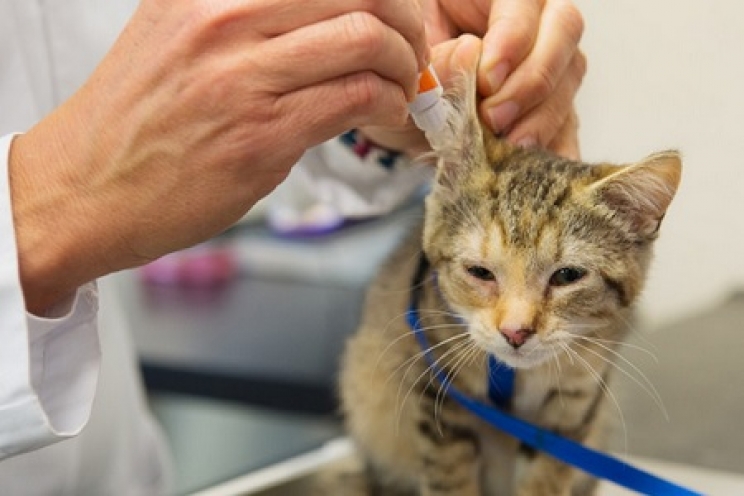
One of the most common types of mange in dogs and cats is otodectic mange, also commonly known as “otoacariasis” or “ear mites”. Let us find out what it is, what symptoms it causes and how it is treated.
What is otodectic mange?
Otoacariasis, or otodectic mange, is a skin disease caused by Otodectes cynotis, a mite that can settle inside the ears of dogs, cats and rabbits. It is quite small (0.7–0.8 mm), with an elongated body, four pairs of long legs and a well-developed mouthpart adapted for piercing the skin. It is a parasite belonging to the non-burrowing mites, which, once they infest a host, live on the skin’s surface, where they feed on cellular debris, blood, bacteria and earwax, and reproduce fairly rapidly. 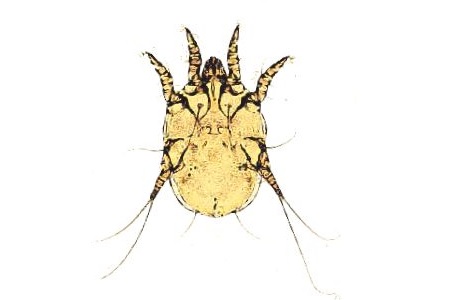
After feeding, they deposit their feces on the animal’s skin. These contain particular substances recognized and attacked by the animal’s immune system, triggering a fairly intense inflammatory response accompanied by:
-
Skin redness
-
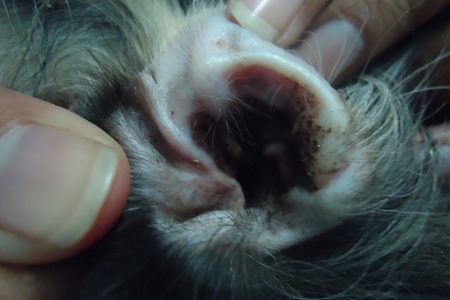
Presence of dry black earwax
-
Very intense itching (the animal constantly scratches its ears and keeps its head tilted to one side)
-
Scratches and wounds caused by the animal while scratching
-
Hair loss caused by scratching
The mites can move rapidly from one ear to the other, so finding symptoms in both ear flaps is considered practically normal. In some cases, especially if it is not treated properly, otoacariasis can also spread to nearby areas, particularly the face, head and neck. In cats, one of the most commonly affected “alternative” sites is the tail, precisely because they tend to curl it around their body while sleeping.
In more severe cases, the mites can even reach the innermost parts of the ear, as far as the eardrum, a very delicate membrane that may become inflamed or even perforated.
Otodectic mange is highly contagious and can easily be transmitted to animals of a different species, so it is not uncommon to observe it simultaneously in dogs and cats in homes where several pets live together. Transmission requires direct contact between the sick and healthy animal, since the parasite cannot survive for long in the external environment. Infection is therefore more common in catteries, kennels and breeding facilities, especially among puppies and kittens, which often “inherit” these mites from their mother.
In any case, it is important to emphasize that animal otoacariasis cannot in any way be transmitted to humans, unlike sarcoptic mange.
How it is treated
If we notice these symptoms in our dog or cat, we must first of all go to the veterinarian, who will need to make a correct diagnosis through:
-
Examination of the ear flap: the presence of the typical signs is unmistakable, but confirmation is still needed;
-
Examination of the ear with an otoscope
-
Microscopic examination of the earwax: this allows the mites to be sought directly
-
Skin scraping: especially if the problem also affects the skin surrounding the ears, the most superficial layer of skin must be collected with a scalpel blade and examined under a microscope to look for mites.
If suspected otoacariasis is confirmed, the veterinarian can prescribe the most suitable treatment for the animal’s clinical condition. Numerous acaricidal formulations are available as spot-ons (selamectin, fipronil), to be applied directly to the area between the shoulder blades—never directly into the ears unless stated in the product leaflet.
There are also highly effective products to be administered in the ears, often based on a combination of acaricides, antibiotics and antifungals, which are particularly useful when a mixed infection is suspected—an event that is not uncommon. When applying ear drops, we must hold the ear flap and massage it, preventing the liquid from being expelled when the animal shakes its head. In more extensive cases, systemic treatment may be necessary.
Self-treatment is strictly prohibited in these cases, because some of these products can be harmful if the eardrum is injured.
When treating ear mites, it is necessary to follow the veterinarian’s instructions scrupulously regarding how and how long to administer the treatment, because we must be absolutely certain that all forms of the parasite have been eliminated. If we stop treatment too early, the parasite population will probably return to its original level within a short time, causing unpleasant recurrences.
To relieve symptoms and speed recovery, it is advisable to clean the ear flap thoroughly with specific products, using gauze or a cotton swab, in order to remove a certain amount of mites trapped in the earwax.