
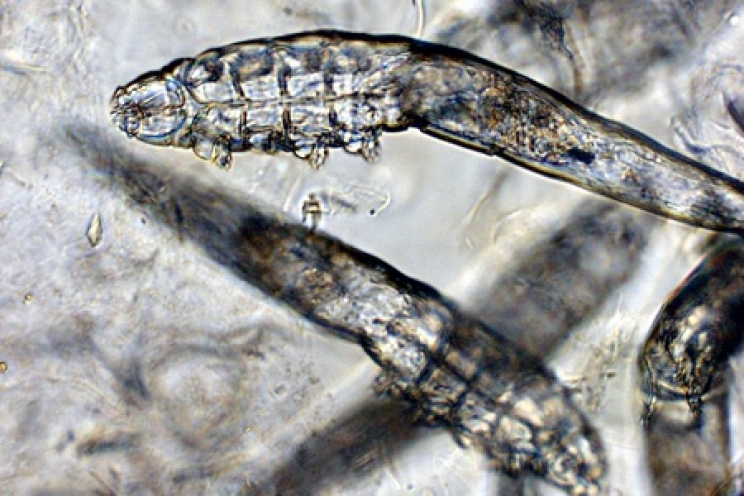
Skin disorders in our animals are numerous and often difficult to distinguish because of the similarity of the symptoms they cause. In this article, we examine demodicosis or demodectic mange, a condition that can affect dogs.
What is demodicosis?
Demodicosis or demodectic mange is a skin disease caused by Demodex, a mite that is part of the normal skin fauna but 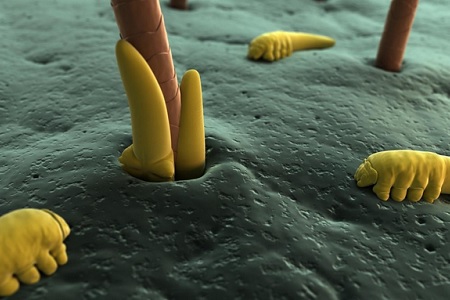 can cause this problem under particular conditions. Its appearance is quite unusual, with a cigar-shaped body, a small rounded head, a thorax with four poorly developed limbs, and a long, striated abdomen. This mite is passed from the mother to the puppy during the first days of life, moving to the skin of the muzzle, around the eyes, on the limbs, and in the interdigital spaces. During this phase, it settles deep in the skin and spends its entire life “upside down” inside hair follicles and sebaceous glands.
Its presence does not cause any problems for the body, especially considering the limited number of mites present. However, under particularly stressful conditions for the animal, it may begin reproducing rapidly, causing changes that lead to demodicosis.
Causes
It is very difficult to identify a true triggering cause in a dog affected by demodicosis. The parasite is also present in completely healthy animals, but may become dominant when conditions favor its development, such as:
-
Emotional stress (moving house, the arrival of a new animal or child, etc.)
-
Prolonged antibiotic treatments
-
Corticosteroid-based therapies
-
Pregnancy and nursing
All these factors have an immunosuppressive effect on the animal, which may lead to increased reproduction of Demodex. According to some recent theories, the disease may not be caused directly by the parasite, but by the animal’s immune system itself, which, while attempting to attack the mite, causes damage to the skin.
There also appears to be a higher incidence in younger dogs, although it can also occur in adults.
Symptoms
Demodicosis can occur in various forms:
-
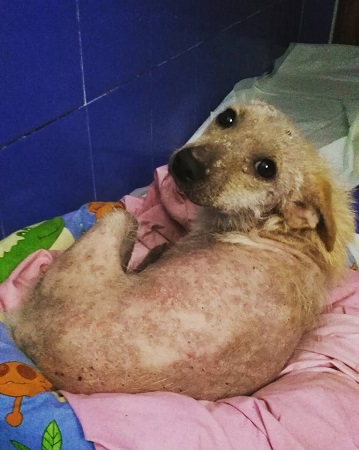
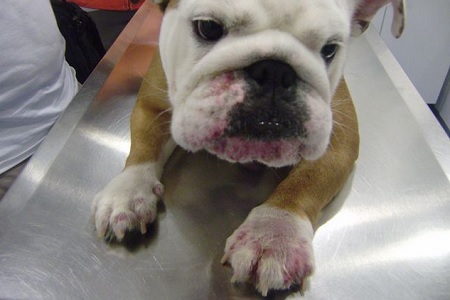
Localized form: this is certainly the most common. It appears with hair loss (alopecia), thickening of the skin, which may sometimes appear reddened or darker. The most affected areas are those where the mite normally resides, namely the muzzle, the area around the eyes, and the front legs. This form tends to heal spontaneously within a few weeks, often without requiring any treatment;
-
Generalized form: if the parasite spreads to other parts of the body, we speak of the “generalized form”. In this case, the clinical picture is often accompanied by other symptoms, such as scaling and the presence of crusts. In some dogs, the situation may worsen due to bacterial infections (especially Staphylococci), becoming what is known as “red mange”, characterized by particularly foul-smelling pustules containing blood and pus.
The feature common to both clinical forms, and which allows us to distinguish demodicosis from other types of mange, is the complete absence of itching. Therefore, the dog does not scratch continuously as it would with sarcoptic, notoedric, or otodectic mange, but continues to develop lesions in the affected areas.
How it is treated
 The veterinarian can confirm suspected demodicosis by performing a skin scraping: using a scalpel blade, a small amount of tissue is taken from the lesion-affected area and examined under a microscope for the mite. This is a painless, non-invasive procedure because it removes only the most superficial layers of skin.
Demodicosis is not contagious to other animals or the owner and tends to resolve spontaneously in milder cases. Treatment must therefore be determined according to the severity of the symptoms. In localized forms, applying acaricidal products as spot-ons to the area between the shoulder blades every 7-14 days may be sufficient, sometimes combined with amitraz rinses. In generalized forms, systemic oral treatments based on antibiotics (milbemycin) may be necessary; these can eliminate the parasite deep within the skin, where topical treatments often cannot reach.