

Cats are much more likely to contract infectious diseases than other domestic animals, such as dogs.
Cats and dogs are very different animals by nature, and while we can control a dog very well, a cat does more or less what it wants, unless we use rather drastic methods such as neutering.
The cat leaves the house when it wants, goes where it wants, and returns when it wants, and during its outings it often encounters other cats, not always domestic ones.
Strays are precisely the ones that transmit infectious diseases, and the one we are discussing on this page is essentially one of the less serious, but that does not mean it should be neglected: we are talking about feline chlamydiosis.
What it is
Feline chlamydiosis is an infectious bacterial disease caused by Chlamidiophila felis. It is a bacterium that settles in one of the most delicate organs in the entire body: the eye.
It affects practically only cats, so if we have another animal there is no danger; unlike other diseases, it is transmitted only through direct cat-to-cat contact, so if our cat does not come into contact with other felines we can rest assured.
Indirect transmission, on the other hand, is very rare, and if we use a shared bowl among several cats, the infection is unlikely to spread (but other much more serious diseases such as FeLV could, so we should not do it anyway).
It is easy to understand that the main route of transmission is when two cats come into contact and one of them is sick. Cats have their own way of communicating, so they may come into contact or, as they very often do, fight with each other. Through a scratch or bite, some bacteria present around the eye can pass to the other cat, which will then become infected.
What it does
As we have said, the consequences of infection are not serious, although they can become so if we do nothing.
The bacterium settles on the surface of the eye, where it begins to multiply; here it causes irritation, and the eyes become red and begin to water profusely; the tears will not be clear, because mixed with bacterial products they will have a thicker, mucus-like appearance. In practice, the cat will appear to be crying mucus, which will also remain crusted beneath the eyes.
In addition, the discomfort will cause it to rub its eye with its paw, which is dirty, thereby bringing in other bacteria that will worsen the situation.
If we do nothing, following the usual (and mistaken) “it will pass” approach, the chlamydiae will become so numerous that they will descend into the nasolacrimal duct, a small tube connecting the eye to the nose (we have one too, which is why we have to blow our nose when we stop crying); the infected tears enter it and may come out through the nose or travel inward until they reach the lungs, where they settle.
Pneumonia is the most serious consequence of this disease and is very common in young cats, whose immune systems have not yet fully developed.
How it is treated
The difficulty of treating chlamydiosis depends on how much time we allow to pass. If, when we notice that the cat is beginning to have unusual tears that do not go away, we immediately go to the veterinarian, topical antibiotics (eye drops, in other words) for a few days will probably be enough and the problem will be resolved.
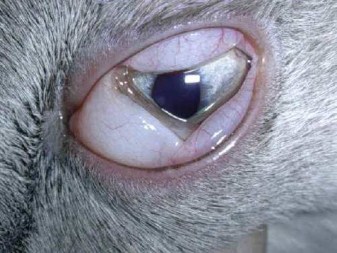
If we wait longer, it depends on how long we have waited, because stronger antibiotic treatment may now be necessary if the chlamydiae have spread extensively through the body, and in some cases, especially if there is a fever (due to pneumonia), something even stronger may be needed. In any case, it is up to us not to let the situation deteriorate.
During the days when antibiotics are administered, it is important to clean the eyes frequently with a damp cloth to remove crusted tears and relieve discomfort.
Very important, but also very simple, is prevention. If we have several cats and one is sick, keep them separated until it has recovered, or it will pass the infection to all the others.
If we see a cat wandering around the neighborhood with very red eyes, we should perhaps avoid letting our cat outside for a few days, thus avoiding contact, although objectively this is somewhat difficult to do.
Finally, a new vaccine for chlamydiosis has recently become available and seems to work quite well; if our cat always stays indoors, we do not need it, but if it roams outside it could be useful, because chlamydiosis is very widespread among cats: when we have the other vaccinations, we can ask the veterinarian for advice, and they will suggest whether to administer it based on the cat’s habits and the presence of the disease in the area where we live.