
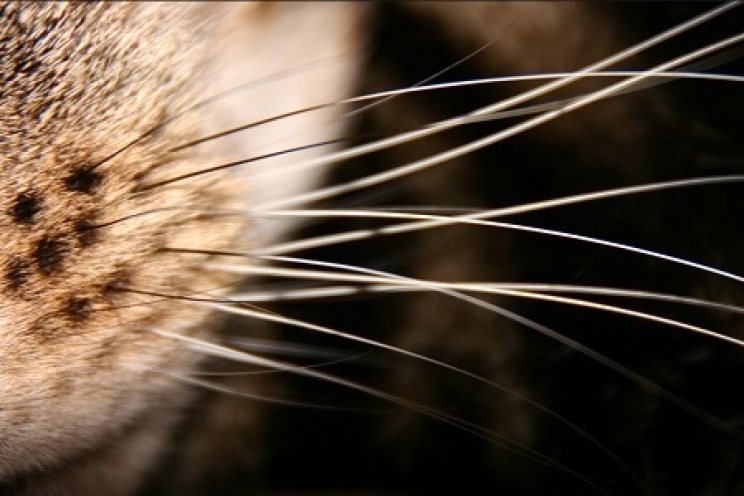
There are many curiosities and misconceptions about cat whiskers. Let’s examine the most important ones to understand exactly what these structures, so important to felines, are and what they do.
What they are
Whiskers are true sensory organs, just like the ears, nose, or eyes, but with different shapes and functions.
Their structure is very similar to that of a normal hair, although it actually differs in some important respects. In fact, whiskers are not only longer and thicker than the hairs making up a cat’s coat, but are also equipped with tiny nerves and blood vessels.
They can be found not only in the whisker area, but also slightly above the eyes and even on the ends of the front paws. Those on the face are identical to one another, unlike those on the paws, which are shorter and less thick.
Whiskers begin to grow while the cat is still in its mother’s womb, so all kittens already have them at birth.
According to some theories, the length of the whiskers on a cat’s face is equal to the width of its body.
One curiosity related to the feline world: some Rex cats have curly whiskers, just like the rest of their coat.
What they are used for
Whiskers are also called tactile hairs. Tactile sensitivity is the ability of a part of the body to perceive stimuli coming from the external environment. Think, for example, of fingertips, which have many tactile receptors capable of detecting a wide variety of sensations, including temperature and pain.
In the specific case of whiskers, their main function is to perceive essential information, such as the depth of obstacles, the recognition of objects in the dark, and even the perception of air movements.
Let’s take a closer look at the vital importance of all these aspects in a cat’s daily life.
Regarding depth, as we saw in the article about animal vision, cats are predators, so all their senses must be suited to hunting prey. It is therefore very important for a cat to calculate the depth and distance of a mouse or insect perfectly, so it can accurately calculate how far it needs to jump to catch it.
Whiskers therefore help cats accurately perceive the distance from prey, or from a toy in the case of indoor cats.
Another important function of whiskers is to help cats perceive the presence of possible obstacles in the dark or in conditions of poor visibility. Think, for example, of cats with vision problems: whiskers serve the same function as a cane for people who are blind.
To understand the function of the whiskers located behind the front paws, let’s try to “trip” our cat while it is walking. It will still manage to avoid the obstacle, even if we place it in front of its hind legs.
Whiskers can also perceive air movements caused by the movement of objects, people, or other animals.
From this perspective, whiskers are effectively a radar. By observing our cat, we will discover that it can move and orient them toward the source of the stimulus. If it is intent on catching a spot of light, for example, it will direct them all forward.
Whiskers are also very useful to owners because they can provide important information about their cat’s mood.
-
Fan-shaped at the sides of the face: the cat is bewildered and alert;
-
Forward: the cat is angry;
-
Backward, close to the sides of the face: the cat is frightened;
-
Downward: the cat is calm and relaxed.
What does it mean when a cat loses its whiskers?
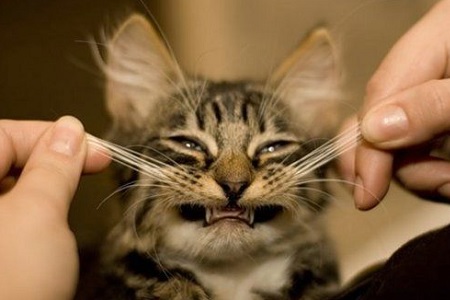 According to popular beliefs, if a cat lost its whiskers, it would never be able to find its way again and would permanently lose its sense of balance.
In reality, all cat owners know that Fuffi often leaves whiskers around the house, especially during shedding season. These hairs are also subject to the normal replacement cycle affecting the rest of the coat, so there is nothing strange about a cat occasionally losing one.
The same applies to less clever felines that get too close to pots on the stove or fireplaces, singeing the ends of their whiskers. They can be recognized by the unmistakable curl at the ends of their “whiskers.”
Whiskers grow back, contrary to what has been believed for centuries.
What we should always bear in mind, however, is that whiskers must absolutely not be cut. Our cat could remain disoriented and bewildered until they have fully grown back.