
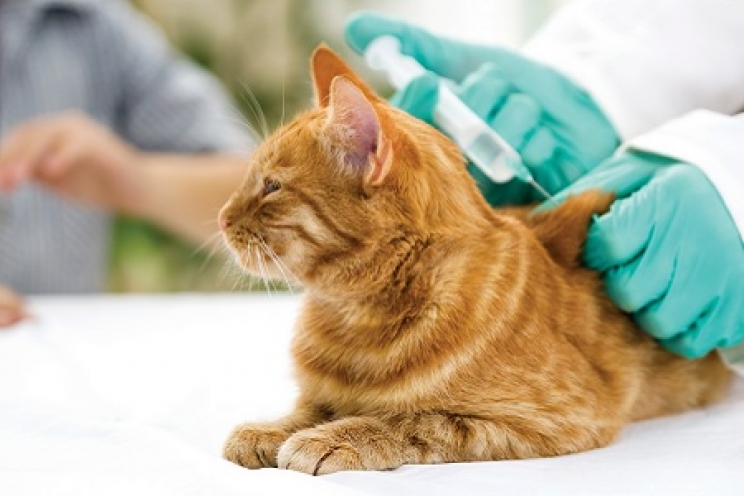
Injection-site sarcoma in cats is one of the most frequent malignant tumors that can develop in domestic felines. Despite the fairly high number of cases each year, many cat owners are unaware of the existence of this particular type of tumor. So let’s look at what injection-site sarcoma in cats is and how it presents.
What is injection-site sarcoma?
Specifically, this type of tumor is called fibrosarcoma. The terminology used may often vary, so it is generally referred to as injection-site, inoculation-site, or vaccine-associated fibrosarcoma.
Fibrosarcomas are tumors that originate in the “connective tissue,” meaning the tissue that makes up much of our body and includes, for example, bones, cartilage, and ligaments. Neoplastic cells can develop in any region of the body, but especially around the neck and shoulder blades, not coincidentally the areas most commonly targeted for injections of fluids, medications, and vaccines.
In fact, according to some scientific studies carried out in recent years, there appears to be a correlation between this form of tumor and injections, including those most commonly administered to cats. 
Therefore, it is not correct to speak of vaccine-associated sarcoma. The definition injection-site or inoculation-site sarcoma is more precise, because any subcutaneous or intramuscular injection could potentially expose a cat to the risk of developing the tumor.
So why is it still called vaccine-associated sarcoma?
This term is more commonly used in English-speaking countries, where the first cases were initially identified in the years following the introduction of vaccines specifically for this species, which are still used today.
In reality, in the past very few cats were treated with injectable medications, since greater importance was given to caring for livestock or hunting dogs. The main exception was the first vaccines for cats.
Initially, injection-site sarcoma was attributed to substances contained in vaccines, such as aluminum hydroxide and other oily compounds.
Over the years, however, different conclusions were reached.
It was thus demonstrated that certain key conditions are necessary for this type of tumor to develop:
-
The cat must have a genetic predisposition to induced sarcoma;
-
Any injectable vaccine or medication could potentially cause injection-site sarcoma in predisposed cats;
-
The incidence of inoculation-site fibrosarcoma is higher in the case of prolonged treatment with injectable medications or when vaccines are repeated more frequently;
-
Some medications may increase the risk of fibrosarcoma developing, as with prolonged treatment with certain types of antibiotics and corticosteroids;
-
The vaccines most closely associated with the appearance of injection-site sarcoma are those for rabies (which, however, is no longer administered in Italy) and for feline leukemia virus.
In light of this information, it might seem that a cat genetically predisposed to developing this type of tumor could develop it even if its skin were simply punctured with a needle once. In reality, the situation is much more complex and not so tragic. If that were the case, no one would vaccinate or treat their cat with injectable medications. For vaccine-associated sarcoma to form, multiple concurrent conditions and circumstances are still necessary.
How does it present?
Injection-site fibrosarcomas do not produce metastases, one of the main characteristics of the most lethal tumors.
But what exactly is a metastasis?
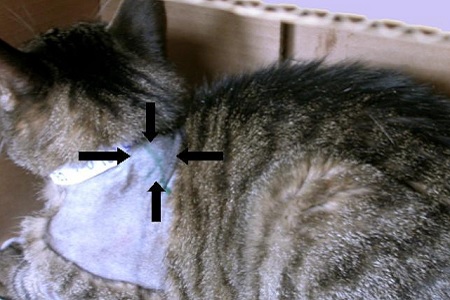
When neoplastic cells implant in a particular area of the body, they may travel through the blood vessels until they reach sites farther from the original one. Once they arrive at the new site, they give rise to new tumors, making their elimination more difficult and promoting their own survival at the expense of the animal’s.
This would seem to work in our favor.
Injection-site sarcomas, however, owe their dangerousness to other specific characteristics.
Once established, tumor cells can easily spread through all the surrounding tissues (if the tumor is on the shoulder, it will spread to the bones and muscles in that area), making them truly difficult to locate and eliminate completely.
In addition, this type of tumor has a high recurrence rate, meaning that the tumor reappears in the same place after some time.
Precisely because it is not always easy for the veterinarian to remove the tumor completely, some neoplastic cells that escaped surgery may multiply again.
For this very reason, cats affected by injection-site sarcoma often require many surgical procedures to remove the neoplastic tissue. In some cases, unfortunately, it may have spread so extensively that complete removal is impossible.
Can it be prevented?
First of all, avoiding vaccinating your cat is absolutely not a good method. Standard vaccinations should always be given. Putting your cat’s health at risk in anticipation of something that might occur in the future would make no sense. 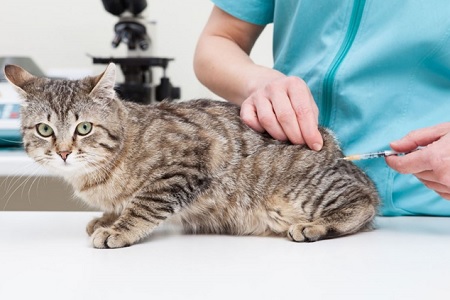
At most, if your cat has no contact with gardens, countryside, or areas potentially frequented by other cats, you might avoid giving it vaccines that are not always necessary, such as the feline leukemia vaccine, or reduce the boosters for other vaccines to once every two years. Always ask your veterinarian for advice if you want to consider this option.
Many veterinarians have stopped administering medications and vaccines in the area between the shoulder blades. An excellent alternative, however, is to give injections in the inguinal fold.
In the area between the shoulder blades, there is a possibility that the tumor may localize near the spine or ribs, making removal impossible. In the case of the inguinal fold, however, neoplastic cells could develop in a hind limb, which in the worst case could be amputated, without compromising the cat’s quality of life.
If your cat needs a specific treatment, you could ask your veterinarian whether the same medication is also available as tablets or syrup. Limiting injections to the absolute minimum necessary, especially in the case of prolonged treatment, may be advisable. Naturally, if fluids or injectable medications are necessary, do not become unnecessarily alarmed and calmly rely on your trusted veterinarian. Your cat’s health comes first.
Finally, another important piece of advice is to check your cat frequently, especially around the neck and shoulder blades. If you notice small lumps, immediately take your feline friend for a thorough veterinary examination. This may seem like obvious advice, but unfortunately there are still owners who prefer to postpone visits, seriously putting their cat’s health at risk.
It is much easier and safer to remove a small, non-invasive tumor than to wait for it to grow excessively and become deeply rooted.