
Dogs and cats tend to use their sense of smell as their primary sense, more than their sight. This means that they do not see the world as we do, and do not assess objects in the same way. It would never occur to us to eat a plastic toy or a piece of iron, but that same object may appear appetizing to an animal.
Thus, a dog or cat that is perfectly well may suddenly develop problems for reasons we cannot understand. If we notice certain types of symptoms, it is important to immediately consider this possibility and consult a veterinarian as soon as possible, because simple household objects can become, if ingested, deadly dangers.
Types of foreign bodies
We can distinguish three types of foreign bodies that animals may ingest, more commonly dogs than cats because the former tends to eat everything within reach, while the latter is more naturally wary.
There are obstructive foreign bodies, which lodge at a certain point in the digestive tract and no longer move, preventing food from passing; there are also lacerating foreign bodies, which can cut the digestive tract at various points to a greater or lesser depth, and perforating foreign bodies, which puncture it and may also enter other organs.
Foreign bodies that cause obstruction include socks, cloths, balls, pieces of plastic bags, foam rubber—in short, anything that cannot be digested (and therefore does not break down) but remains “stuck” at a certain point in the digestive tract, usually at the bottom of the stomach or where the small intestine becomes the large intestine (a rather narrow point).
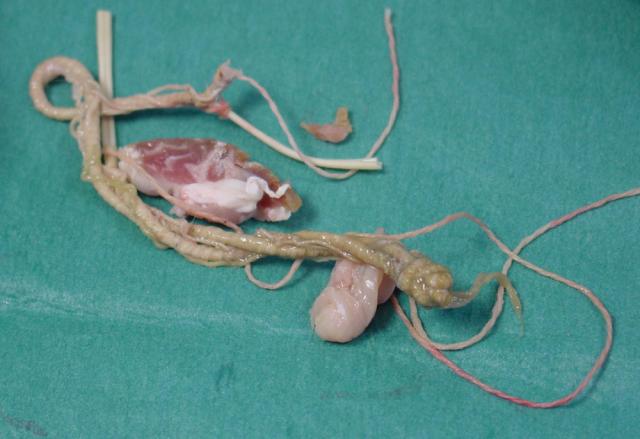
A very particular case is that of a ball of string: generally, the “ball” remains blocked, while the loose end of the string continues advancing toward the anus; since it is blocked at the other end, it “pulls” the intestine onto itself, causing it to bunch up.
Among foreign bodies that lacerate are anything sharp: a typical example is pieces of glass, which are sometimes deliberately placed in meatballs and cut the walls of a dog’s stomach, sometimes causing death because gastric juices can enter the bloodstream. Any other utensil with a sharp end, a razor blade, or a piece of iron has the same effect and usually does not reach the intestine but causes damage in the stomach.
A particularly noteworthy object here is the beer bottle cap: it is sharp on the outside and tends to become “stuck” in the stomach for several days, acting like a rotating-blade saw and causing enormous damage.
Among ingested objects that puncture the digestive tract, there is practically everything: pens, toys with a pointed end (the sheep from nativity scenes), pieces of wood, stones, bone fragments, scissors—more or less anything. These are the worst because they generally manage to reach the intestine, where the walls are thin and can be perforated. If digested material and bacteria escape through the hole and enter the cavity in which the intestine lies, the peritoneal cavity, they cause instant peritonitis with extremely severe pain.
Symptoms of an ingested foreign body
It is difficult to list a set of symptoms in this case, mainly because every case is different; in general, substances in the digestive tract leave the body through two routes: vomit and feces.
If the animal has retching, even if it does not actually vomit, it may be trying to expel something; traces of blood in the vomit are particularly indicative if lacerations have occurred.
The same applies to feces, which may or may not be present (if the foreign body prevents passage); in this case, we may see the dog straining to defecate but unable to do so, while in other cases there may be diarrhea containing blood. Also watch for melena, the presence of digested blood in the feces: in this case its color will not be red, but we will see black clots, blood originating in the stomach that has remained in the digestive tract for a long time.
In the event of perforation, the animal will experience severe pain and we will immediately realize that something is wrong; the important thing is to go straight to a veterinarian, because peritonitis can be fatal.
Treatment
There is only one way to treat this type of situation, and that is to remove the foreign body: only a veterinary surgeon can do this, opening the animal’s abdomen and removing the ingested object or objects.
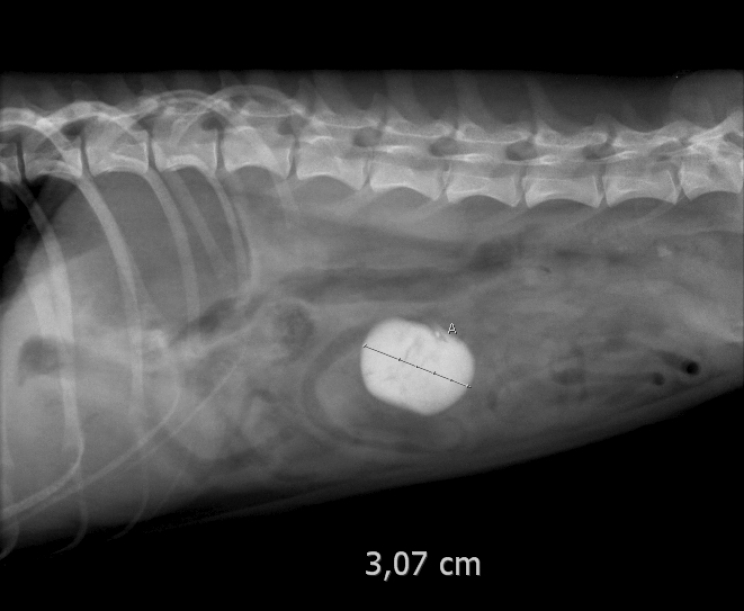
In the case of metal objects, stones, or bones—dense objects that are clearly visible on X-rays—things will be easier because we already know where to look; for less dense materials such as plastic or string, things are more complicated because it is not always possible to tell that they are present (they do not show up on X-rays). The owner must monitor the dog at home and try to determine whether an object is missing, so as to provide the veterinarian with all potentially useful information and avoid, if the cause turns out not to be a foreign body, unnecessarily opening the animal’s abdomen.