
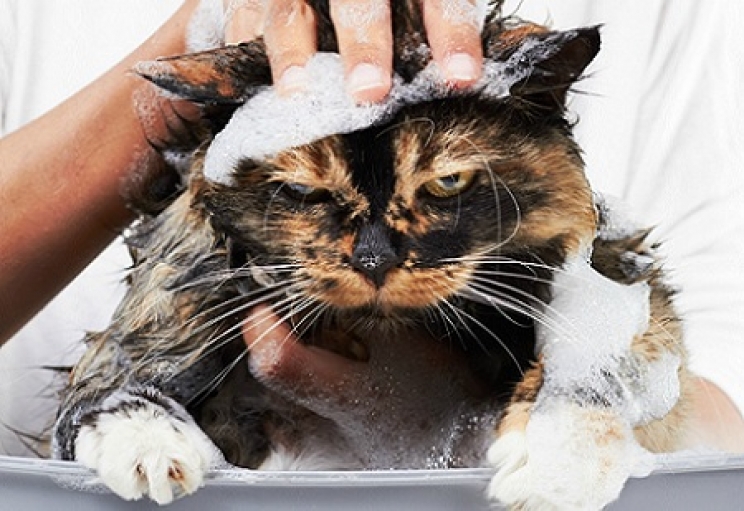
One of the most widespread beliefs is that bathing a cat is not only unnecessary but also harmful to the cat’s health. Let us find out whether there is any truth to this claim or whether it is simply yet another common misconception about cats, and how to bathe a cat.
“Cats hate water”
Generalizing does not always lead to great truths. It is true that most cats absolutely cannot stand contact with water.
At the same time, however, it is also true that almost all cats, once they discover the indescribable pleasure of drinking from a tap, will accept getting their paws wet rather than give it up. Cats that find being immersed in a bathtub full of water equally pleasant are rare.
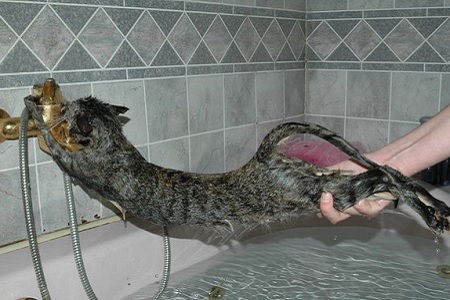
Felines’ relationship with water is not actually so controversial. Essentially, a few drops or a thin stream of water from the tap may be pleasant, but having the entire body in contact with water is generally not pleasant at all.
There are exceptions, as with every aspect of our animals’ lives. Some cats even find it amusing to “paddle” in puddles after the rain, while others go crazy for a bath.
“Bathing a cat is harmful”
False. This is a genuine urban legend. Clearly, if after washing your cat you let it roam around the house or garden without drying it first, it could develop respiratory problems such as a cold. Therefore, simply make sure it is completely dry before “letting it go”.
Bathing a cat may probably be harmful only to you, since in most cases, when immersed in water, sweet Fuffi turns into Terminator.
“Cats do not need baths”
This statement is both true and false.
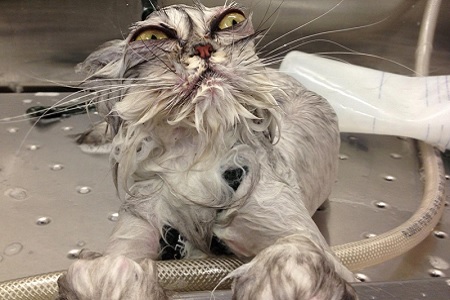 Cats are among the cleanest animals found in nature. Their rough tongues, rich in cleansing and disinfecting substances, can remove all dirt and impurities from their fur. Cats also spend a large part of their day grooming themselves.
Before a nap, just after waking up, after eating, whenever someone dares to soil them by petting them. Every situation is suitable for cleaning their coat. It is much more common for a dog to remain with its muzzle completely covered in pasta sauce after eating than to find even a microscopic crumb on a cat’s whiskers.
It is also true, however, that there may be situations in which a cat, despite its efforts, simply cannot clean itself perfectly. For this reason, in some cases it may be necessary to wash your cat, such as:
-
Disabled or paralyzed cats;
-
The owner is allergic to the cat;
-
Dermatological problems with dandruff and itching;
-
As support for parasite treatments;
-
The presence of toxic or difficult-to-remove substances on the coat.
How to bathe a cat
Let us clarify one point. If your cat absolutely refuses any contact with water, there will be no way to convince it to accept a bath. In these cases, you should contact an experienced groomer or try cleaning it with wet wipes or specific dry shampoos.
Another very important point is that the older the cat, the more difficult it will be to get it used to washing. Therefore, if you have just adopted a kitten, start getting it accustomed to water while it is still young. It is generally advised not to bathe very young kittens. Ideally, wait until they have received at least their first vaccinations.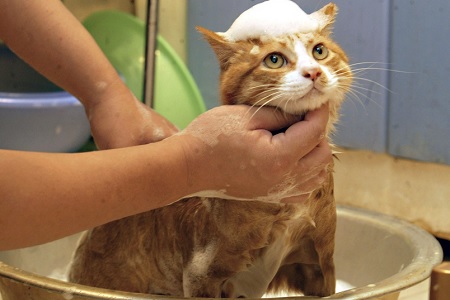
That said, let us see what supplies are needed to bathe a cat:
-
Basin
-
Handheld shower
-
Shampoo specifically for cats
-
Large enough towel
-
Cat comb
-
Hair dryer
-
Carrier, if necessary
Let us move on to the steps to follow to wash your cat properly:
-
Clothing: especially if the cat is an adult or if this is one of the first times, wear clothing that can cover your arms to protect yourself from your cat’s claws. If you consider it appropriate, you could also wear padded, waterproof gloves;
-
Brush the cat, especially if it has long fur, to remove any knots;
-
Fill the basin with a maximum of 10–15 centimeters of lukewarm water, depending on your cat’s age and size. Calculate the amount of water needed so that only the paws are submerged and not the rest of the body;
-
Make sure you already have all the necessary supplies within reach;
-
Calmly pick up the cat and slowly place it in the basin. Have someone help you by holding it still while you wash it, or vice versa;
-
Wet the cat’s fur, avoiding the head, ears, and muzzle. Then apply a small amount of shampoo and massage gently. It is very important that the shampoo be specifically for cats, because products intended for human use can damage the cat’s skin and fur;
-
Rinse slowly using a handheld shower with the flow set very low and gentle. Be very careful not to wet the ears and face;
-
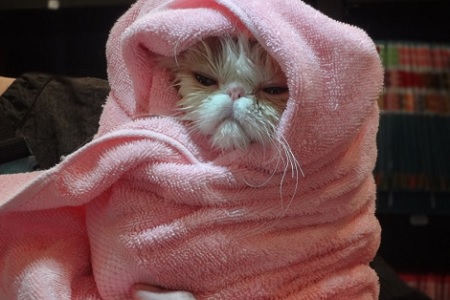
Wrap the cat in the towel and rub gently to remove excess moisture;
-
Dry the cat with the hair dryer set to warm air at the lowest setting. Alternatively, you could place the cat near a space heater blowing warm air. If the cat is frightened by the noise, put it in the carrier and direct the warm air inside, without using excessive power or heat;
-
Once your cat is completely dry, you can let it go. Reward it with some food and do not worry if it runs to hide in the most inaccessible place in the house.
Bathing a cat is not extremely difficult, provided that your cat does not categorically reject contact with water. You do not need a beekeeper’s suit or a sedation kit, just a little patience and a few extra precautions.