
Understanding a cat’s nonverbal language can be an important step toward experiencing the relationship between owner and pet even more intensely. Let’s see how to interpret it and which basic behaviors we should always be able to recognize.
“My cat is only missing the ability to speak.” Everyone who lives with a feline friend has thought or said this at least once. In reality, what is most surprising about cats, just as with dogs, is that they really do not need speech. To make themselves understood, they can use different types of meows and many postures and movements of their body. In particular, cats associate each position of their ears, tail, or body in general with a specific mood or with something they want to communicate to us.
Behaviors
-
The cat “kneads”: this behavior is typical of very young cats and usually gradually decreases as they become adults. It is a movement all kittens make, pushing their paws against their mother’s mammary glands to encourage the milk to come out. When a young or adult cat becomes completely absorbed in this activity, it mainly does so to evoke the memory of that sensation during the most relaxed and pleasant moments. That is why it will choose your warm winter duvet, furry rug, padded cushion, and even its human. Some cats even continue to accompany the “kneading” motion with actual suckling of anything they find nearby, such as your hair, a wool blanket, or a rug, so don’t worry. Your cat is not a vampire, just a little “mommy’s baby”;
-
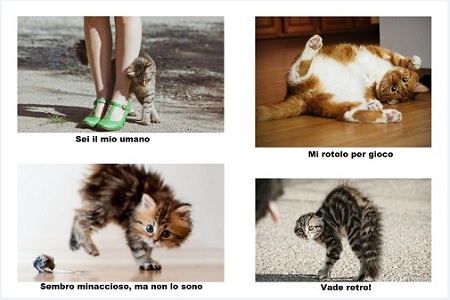
The cat rubs its head against everything it finds: when a cat seems to be rubbing its head and muzzle against our legs, shoes, or furniture, it is not just greeting us. This gesture actually serves to mark its territory, so as soon as you return from work, it will do this to cover all the smells you have picked up during the day with its own. There are small glands on a cat’s muzzle that release substances specific to each animal, called “pheromones.” When our cat releases these substances on our face, legs, or clothes, we officially belong to it. Every cat in the neighborhood will know whom we belong to;
-
The cat purrs: this is perhaps the behavior that gives owners the most satisfaction. Felines are the only animals in nature able to produce these intense vibrations, emitting the classic “purr purr” that all enthusiasts love so much. Purring has always been associated with the pleasure cats experience while relaxing with our petting. In reality, many theories have been proposed to explain this behavior. One fact not everyone knows is that mother cats purr during labor to call their newborn kittens toward them. Another aspect often overlooked is that cats also purr when they are in pain. To better understand the meaning of our cat’s purring, let’s listen to and observe it. If the purring is loud and irregular, Kitty is happy to see us. Conversely, if it is faint and monotonous, it is bored or simply wants to sleep. When the cat purrs for no apparent reason and seems apathetic, tired, and unwilling to eat, it is probably experiencing pain. By listening to our cat’s purring, we may understand many things;
-
The cat arches its back and its fur stands on end: your cat is very frightened and is trying to make itself look impressive so it will not run away. By puffing up all its fur, especially on its back and tail, it will look larger and more threatening. In this way, it tries to frighten its opponent, so leave it alone and above all avoid picking it up. Fear could turn into aggression toward anyone who approaches it. If this behavior is accompanied by hissing, quiet growls, and deep meows, and the cat’s ears are flattened backward, it is probably preparing to attack, so stay away!
-
The cat arches its back and moves sideways: this behavior is typical of kittens, which move this way during play. They move sideways, with an arched back and a small bump at the base of the tail. Some particularly playful adult cats also do this;
-
The cat rolls onto its back: unlike dogs, cats rarely expose their bellies. For owners, therefore, when a cat allows its belly to be petted, it is a real achievement, because it means that it is beginning to trust them. If, however, it continually rolls onto its back, it may simply be playing, so as soon as you try to touch its belly, you may earn a nice scratch;
-
The cat “hisses”: when a cat makes the typical hissing sounds, it is seriously telling you not to come closer. It may be very frightened or preparing to attack. In any case, it wants to be left alone;
-
The cat bites: a cat’s main weapons are its claws, so if it bites you deliberately, it has probably already given you other warnings. When, instead, the cat bites in the middle of a session of cuddling, purring, and petting, it may mean that you have exceeded the permitted time limit or touched areas that are too sensitive, such as the belly or sides.
Tail movements
These are only some of the cat’s most common behaviors. To better understand its language, you can also analyze the position of individual parts of its body. One of these is the tail. But what does our cat tell us by moving its tail?
-
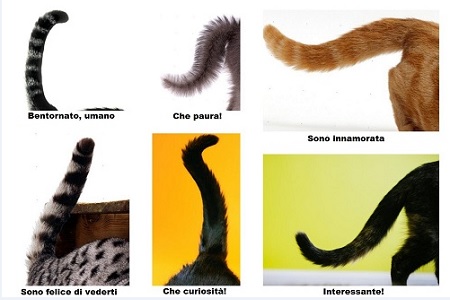
Perfectly straight tail: your cat is greeting you and is happy to see you again;
-
Question-mark tail: the tail is straight, but the tip is slightly curved, just like a question mark. Your cat is curious and absolutely wants to know what you are doing;
-
Straight, quivering tail: the tail seems to be vibrating. In male cats, it is often accompanied by the classic “spraying” on the wall to mark territory. In other cases, it may simply be an expression of great enthusiasm at seeing you;
-
Puffed-up, low tail: your cat has not magically turned into a fox. It is simply very frightened;
-
Puffed-up, high tail: this may mean that the cat is really very angry or simply that it is playing. To understand which, you will need to analyze its other behaviors as well;
-
Tail moving in broad sweeps: your cat may be irritated or excited. If it is looking out the window, it has probably just spotted a bird and is preparing to hunt;
-
Tail moving in jerks: now it really is angry and about to attack. Stop bothering it immediately or there will be trouble;
-
Tail held straight to the side: your female cat is in heat and is showing that she is receptive;
-
Tail lowered between the legs: the cat is submissive;
-
Horizontal tail, with a slight curve at the tip: the cat is interested in something but is deciding what to do;
-
Low tail and slightly lowered pelvis: your cat is worried and walks as if something were pushing it toward the floor.
Facial expressions
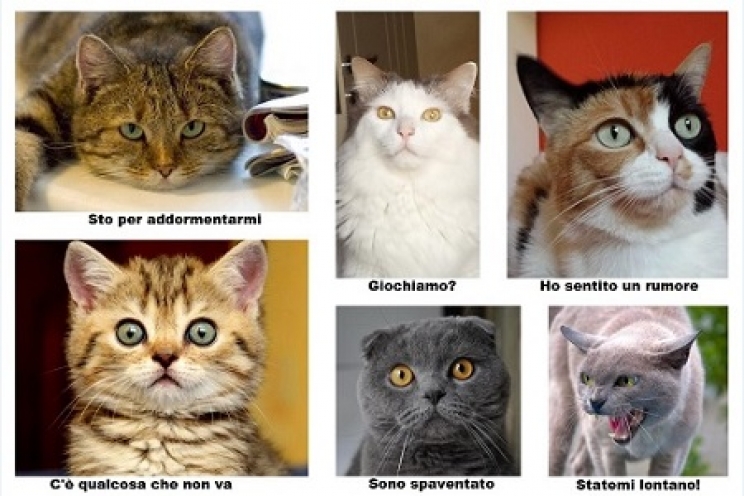
Facial expression and ear orientation can also help us understand a cat’s language. For example:
-
Relaxed cat, open to interaction: the cat has its eyes open and relaxed ears. It will probably adopt the sphinx position, with its belly on the floor and its front paws tucked under its chest;
-
Satisfied or sleepy cat: the cat has half-closed eyes and relaxed ears;
-
Attentive and undecided cat: it has probably heard a noise or seen something interesting outside the window. One or both ears point toward the source of interest, and its eyes are wide open;
-
Alert cat: it holds its ears forward and has dilated pupils;
-
Frightened cat: in this case, it has its ears flattened against its head, slightly backward, and dilated pupils;
-
Aggressive cat: a cat preparing to attack will have its ears upright and backward, turned approximately 180 degrees, and its eyes half-closed.
These are only some of the cat’s possible expressions. To learn its language as well as possible, all you need to do is observe and study it day after day.