
Hairballs are an annoying problem that almost all cats have to deal with sooner or later. Here is a simple guide explaining how they form, how to prevent them, and how to remove them.
Probably anyone who has had at least one cat in their life knows perfectly well the discomfort and reactions that hairballs can cause in the animal.
Cats are true cleanliness fanatics, so they love spending much of their time grooming themselves thoroughly and carefully. The main purpose of these long “washing” sessions is undoubtedly to keep their coat shiny and clean, especially on certain occasions.
Anyone who owns a cat knows that Fufi will remove every trace of dirt immediately after eating, upon returning from a long walk and, naturally, after using the litter box.
Not everyone knows, however, that grooming is also very important for regulating body temperature. Cats cannot sweat, so they moisten the outermost surface of their body with saliva to promote evaporation of excess body heat.
The habit of licking themselves can also be useful as a way to relax, much like we might enjoy a nice warm bath.
Furthermore, when several cats live peacefully in the same environment, they may engage in mutual grooming, recreating the pleasant experience of a mother cat cleaning her kittens.
As you can see, for our feline friend, every occasion seems to be a good opportunity to devote themselves to grooming.
Why do hairballs form?
A cat’s tongue is very rough because of tiny spines covering its upper surface. For this reason, while grooming, cats can remove traces of dirt and dead hair, which become trapped on the tongue among these spines. Thus, everything on the tongue automatically ends up in the stomach.
Ingesting hair is not in itself a problem, since once it reaches the stomach, it mixes with the food eaten and is eventually eliminated through the feces.
However, dead hair may sometimes be present in excessive amounts, causing it to form a real mass inside the stomach and intestines and causing considerable discomfort for our cat.
Hairballs, also known as trichobezoars, appear as compact masses of hair, almost always dark in color, with an elongated, cylindrical shape, much like a small sausage.
Conditions that may promote hairball formation include:
-
Seasonal shedding: during spring and autumn, cats prepare for the change of season. Hairball problems are particularly evident during the spring months, when cats lose their thick winter undercoat;
-
Skin problems: some forms of dermatitis can promote hair loss, increasing the likelihood of hairballs forming;
-
Low-fiber diet: fiber is very important for ensuring proper intestinal transit. If your cat’s diet is particularly low in fiber, the hair may remain in the intestines for a long time, forming compact and resistant hairballs;
-
Excessive grooming: stress, boredom, itchy skin, and food allergies are just some of the factors that may cause a cat to lick itself frequently and excessively, promoting hairball formation.
Does my cat have hairballs?
A cat with hairballs may show some typical symptoms, including:
-
Hairballs present in vomit or feces;
-
Persistent coughing;
-
Gagging;
-
Constipation or diarrhea;
-
Loss of appetite;
-
Lethargy.
If hairballs become particularly large and compact, the cat may be unable to expel them, causing serious intestinal blockages. In addition, the presence of bright red blood in the vomit may be caused by frequent vomiting or straining while attempting to expel the hairballs. In these cases, contact your veterinarian immediately.
What remedies can prevent and eliminate hairballs?
To prevent hairballs from forming, it may be helpful to follow a few simple tips.
-
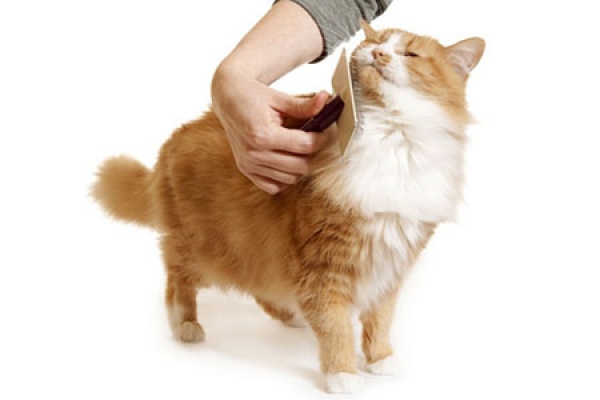
Brush your cat every day: specific brushes for every type of coat are readily available. By brushing your cat daily, you will effectively remove dead hair;
-
Change the diet: dry and wet food rich in fiber is ideal for promoting the expulsion of hairballs through the feces;
-
Use palatable hairball pastes: these palatable pastes are rich in fiber, fatty acids, oligosaccharides, and natural oils. These substances promote hairball elimination and support intestinal and skin health;
-
Plant cat grass: this plant stimulates digestion and helps cats eliminate hairballs through vomiting or feces.
In conclusion, hairballs are a very common problem that in most cases can be resolved by patiently following a few precautions. If the problem persists or becomes particularly severe, it may be advisable to consult your veterinarian, who can assess the causes of the problem and the most appropriate treatment.