
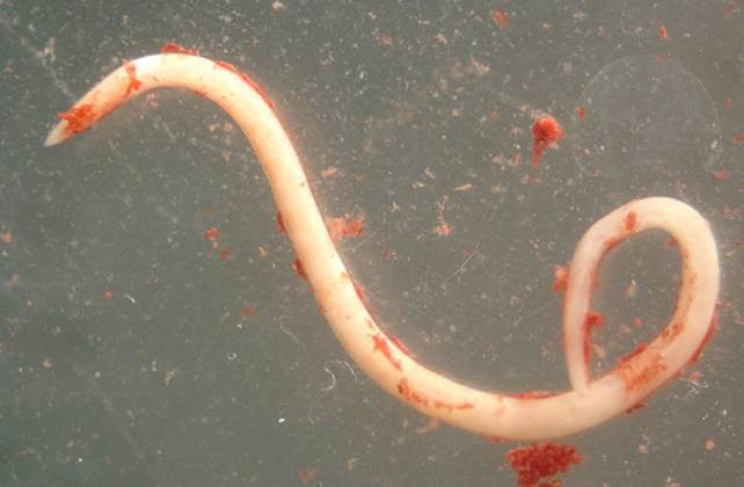
Anisakiasis is a parasitic disease that has been widely discussed in recent years. It is discussed almost exclusively in relation to humans, since the consequences can be very serious, but because the parasite can infect dogs and cats in exactly the same way as it infects us, it is important to understand its cause and how it is transmitted, in order to prevent very serious illnesses in our four-legged friends.
What it is and how it is transmitted
Anisakiasis is a parasitic disease caused by worms of the genus Anisakis. These parasites infest marine animals.
Their “normal” life cycle is as follows: adults live in the intestines of cetaceans, where they produce eggs. The eggs hatch and the larvae are ingested by a crustacean, such as a shrimp, where they molt (similar to the caterpillar-cocoon-butterfly process, so to speak).
The shrimp is then eaten by a carnivorous fish (such as sea bream, anchovies or sea bass), and the worm reaches its intestine, where it moves into the muscle without causing particular harm.
At this point, if the fish is eaten by another fish, the worm moves into the muscle of the predatory fish, and so on until the fish is eaten by a cetacean. In this case, the parasite feels at home and begins producing eggs.
The problem occurs when the fish carrying the worm, instead of remaining at sea, is caught: in this case, it may be eaten by a human or a land animal.
What it does
In reality, the Anisakis worm behaves in exactly the same way whether it is in a fish, a human or a dog. It does not really realize which organism it is in; it only knows that it is not in a cetacean. It does the same thing it does in a fish: it tries to pierce the intestine and enter the muscles. This is when it causes damage.
The intestine of our dog or cat is located inside a practically sterile cavity, the peritoneum. When the worm pierces the wall, intestinal material, including the bacteria normally present there, enters the peritoneum, multiplying without encountering practically any defenses and causing severe abdominal pain.
In some cases, the anisakis is stopped by the intestinal immune system, but granulomas are formed (“barricades” that take the form of more or less large nodules) that can obstruct the passage of food, causing recurring intestinal blockages.
In some cases, the worm is unable to pierce the intestine and is expelled with the normal feces, then dies; however, we must not become complacent, because it is important to follow the proper guidelines to avoid the risk of a disease that, if contracted, must necessarily be treated urgently.
How it is treated and prevented
As for treatment, this can only be carried out urgently by a veterinarian: generally, it is necessary to perform surgery, meaning opening the animal’s abdomen and removing a section of intestine, then reconnecting the two ends, as well as washing the peritoneum. Since the “pierced” area tends to worsen as time passes, it must necessarily be removed by a surgeon in order to prevent any problems, and recovery times are fairly long.
Surgery is also required when granulomas form that are large enough to prevent food from passing through the intestine.
If the granulomas are smaller or if less severe gastrointestinal symptoms appear, the veterinarian may try treatment with less invasive medicines.
But the best way to prevent anisakiasis is certainly prevention: it is a disease transmitted only by fish, and only when it is raw.
Italian law requires restaurants not to serve raw fish that has not previously been frozen (freezing, like cooking, kills the worm).
As for the fish we buy, which also concerns animals, fishmongers are required to display this sign in their shops: fish may be eaten raw only if previously frozen for 96 hours (take note the next time you enter a fishmonger’s).
This guideline must necessarily be followed for fish (sea bream, sea bass) and mollusks (cuttlefish, squid) for the health of ourselves and our animals. Avoid tasting raw fish while cooking, and avoid “giving a little piece” to your dog or cat (cats are often associated with raw fish) if they watch you while you cook. In this way, you will do yourselves and your friend a great favor.
On this point: cooked fish poses no problem, but be careful with raw fish preserved in salt or marinated in vinegar or lemon. The worms survive under these conditions and, if the fish has not previously been frozen, the risk of disease remains.