
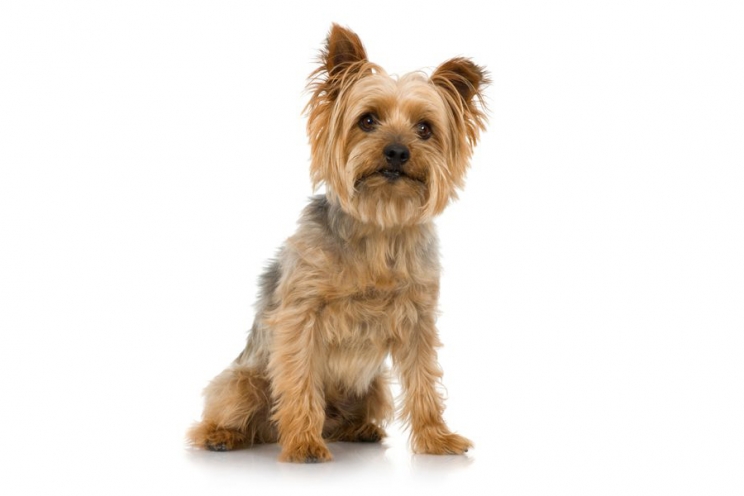
The Australian Silky Terrier is a small, agile, cheerful, and sociable dog. Suitable for children, it was once an excellent rat hunter, whereas today it is mainly kept as a companion dog.
Temperament
The Australian Silky Terrier is a sweet, affable, and very courageous dog. It can be a loyal companion and is never aggressive. Stubborn and determined, it has proverbial intelligence.
Appearance
The Australian Silky Terrier is a compact, low-set dog of medium length. Similar in appearance to the Yorkshire Terrier, it has a long, glossy coat and a very elegant appearance.The head is strong and moderately long and broad between the ears. The skull is flat and not full between the eyes, with a tuft of fine hair that does not fall over the forehead or eyes. The muzzle has tight, dry lips and a black nose. The jaws are strong, with regular teeth and a scissor bite. The eyes are small, round, and dark. The ears, always small, are V-shaped with thin ear flaps. They are set high and lack long hair. The neck, of medium length, is elegant and slightly arched.The body is slightly long in proportion to the dog’s height. The topline is horizontal, with a solid loin and a moderately deep and broad chest. The ribs extend backward. The tail is set high and carried erect. It is preferably docked. The forelegs have fine bone and are straight and well placed. The shoulders are fine and well laid back, with elbows not turned out. The hind legs have well-developed thighs, well-directed stifles, and well-angulated hocks. The cat-like feet have tightly closed toes and good pads with very dark nails. The Australian Silky Terrier’s coat is fine, glossy, and straight. Curly or wavy hair is undesirable. Coat length varies from 13 to 15 cm, while the legs do not have long hair. The Australian Silky Terrier’s coat is blue and tan or gray-blue and tan. The color is darker on the tail, while the topknot is silver or fawn. Tan markings appear on the ears and muzzle, while blue extends from the base of the skull to the tail. There must be no black shading or dark shadowed areas on the body. Black is permitted only in puppies.
Historical background
The Australian Silky Terrier originated in Australia in the 19th century through crosses between Yorkshire, Norwich Terrier, Cairn Terrier, Manchester Terrier, and Skye Terrier. The breed standard is quite recent, and breed recognition took place in 1933.
Lifestyle
The Australian Silky Terrier has a dynamic and active lifestyle, although it also enjoys domestic quiet. Apartment living is ideal.
Diseases
It suffers from otitis and Progressive Retinal Atrophy (PRA).
Interesting facts
The Australian Silky Terrier is a prolific barker. Its coat requires considerable care, as dermatitis or hair loss is common.
Gait
The Australian Silky Terrier’s gait is free and fluid. The hind legs propel the whole body, with good reach from the forelegs. Viewed from behind, the legs should be neither too close together nor too far apart when the dog is moving.
Ideal owner
The ideal owner of the Australian Silky Terrier is a present, affectionate, and never aggressive person. The dog’s great intelligence allows for simple training, but sometimes the animal is so stubborn that it requires firmer education.
The Alaskan Malamute is a large dog with a courageous and friendly spirit. Friendly with other animals, it can be a good life companion, always wise and caring.