
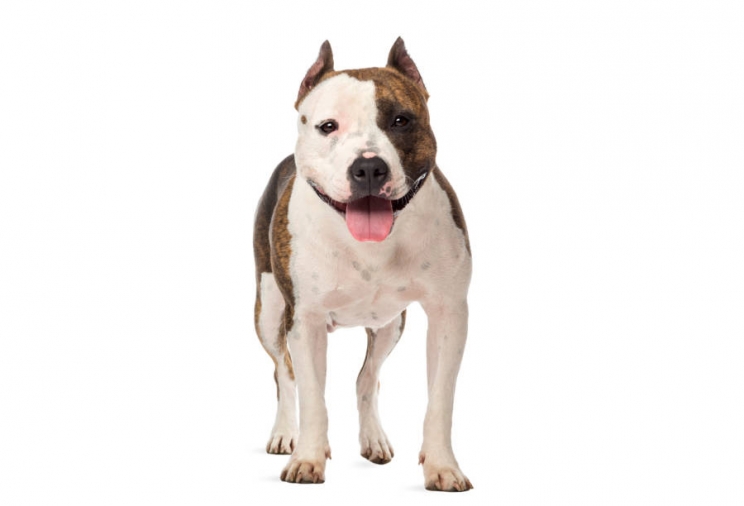
The American Staffordshire Terrier is a breed selected for fighting, yet despite this it forms a deep bond with its owner and is an excellent playmate for children.
Character
A dog with self-control, but proud and combative. It has relationship problems with other dogs, particularly those of the same sex. The primary socialization phase and the owner’s ability to establish themselves as the pack leader are essential.
A well-balanced dog forms excellent relationships with its owner and especially with children.
Appearance
The American Staffordshire Terrier is a muscular and sturdy dog, compact overall but harmonious in shape and with beautiful lines. The head is large but proportionate to the body. It is not too long, but broad and high. The muzzle is of medium length and is separated from the broad skull by a pronounced stop. The jaws are well defined, with the lower jaw marked and powerful. The masseter muscles are very pronounced. The nose is broad and black-pigmented. The eyes are set wide apart, positioned low and round. The iris must be dark, and the eyelids must show no signs of depigmentation. The ears are set high and may be left natural or cropped. Natural ears are preferred and are carried semi-erect or rose-shaped. Fully drooping ears are penalized. The neck is of medium length, muscular and slightly arched dorsally. The back is short and slightly sloping toward the loin, which rises slightly. The croup always slopes slightly toward the tail attachment.The chest is broad, wide and deep, with well-developed pectoral muscles.The tail is short and straight. The root is broad and the tip fine. It must not be carried above the back. The limbs, not very long, are thick, muscular and straight. The feet are compact with well-arched toes. The coat is short, dense and hard. All colors in different combinations are permitted (solid, multicolored, piebald). However, the following are not appreciated: White exceeding 80%, black and tan, liver.
Historical notes
The breed’s origins parallel those of the Staffordshire Bull Terrier, with which it shares physical and character similarities. It seems that both breeds have a common ancestor, the Blue Paul Terrier, a now-extinct dog of Scottish origin. This breed appears to have been exported to the United States along with other types of “Bull and Terrier” breeds. In the following years the breed became very popular and, in 1898, was registered under the name Pitt Bull Terrier. Further changes were subsequently made to the breed, until the new standard, very similar to the current one, was drawn up in 1921.
Lifestyle
The Amastiff is a very athletic breed that requires plenty of exercise to release accumulated energy. It is not suitable for apartment living unless a large garden is available. It can live in a garden, but time must still be devoted to play.
Diseases
This breed may be prone to hereditary ataxia, heart disease, hip dysplasia and elbow dysplasia.
Interesting facts
The most common name by which this breed is called is its former designation, Pitt Bull Terrier. Only in 1972 was the breed given its current name. It is also commonly called Amstaff and is suited to many sporting activities and useful work, from agility to pet therapy.
Gait
The movement is elastic, with the limbs moving parallel, without rolling or pacing.
Ideal owner
The ideal Amstaff owner must have very specific qualities and have acquired a certain amount of experience. They must be decisive in correcting incorrect behavior, establishing themselves as a reliable pack leader, and be willing to devote time to sporting activities with their dog.
The Alaskan Malamute is a large dog with a courageous and friendly spirit. Friendly with other animals, it can be a good life companion, always wise and caring.